Project overview
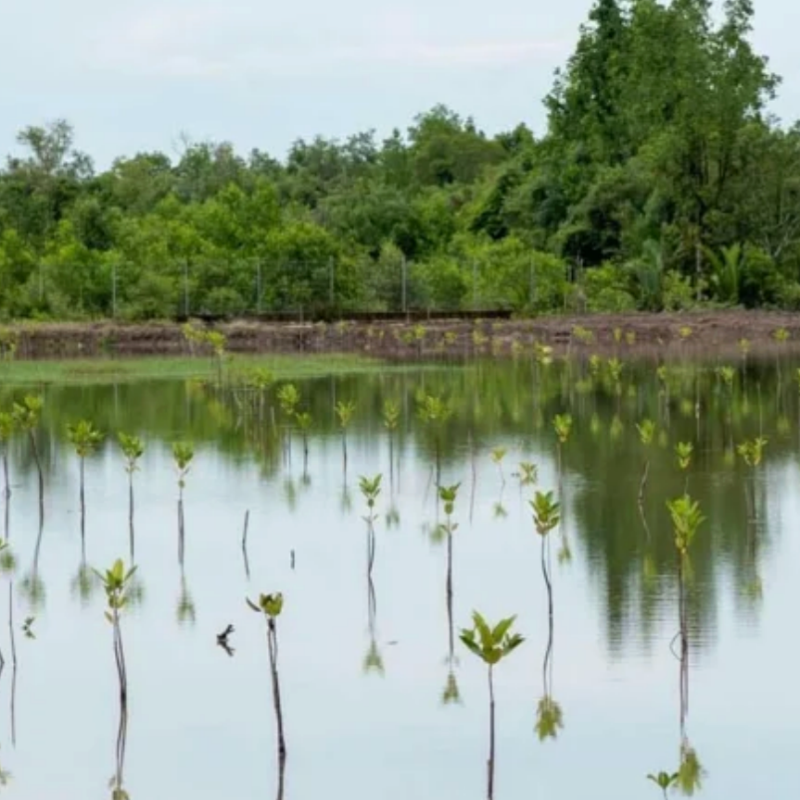
Blueyou is integrating mangrove restoration directly into seafood supply chains across South-East Asia, showing how sustainable aquaculture can improve environmental outcomes while strengthening business performance. Its Selva Shrimp programme in Eastern Kalimantan, Indonesia, focuses on restoring mangroves within aquaculture landscapes where large areas had previously been deforested for shrimp farming and where many ponds are now degraded or abandoned. The programme aims to create economic incentives for farmers to conserve mangroves as the natural basis for growing seafood, supporting biodiversity, carbon capture and more resilient coastal communities.
The Selva Shrimp programme was initiated in 2018. According to Blueyou, the pilot currently involves 30 farmers across a 400-hectare project area, with a stated future scale of 50,000 hectares. Impact to date includes 280 hectares of restored mangroves. The case is relevant for ACT Ocean because it links regenerative production, blue carbon, smallholder livelihoods and seafood market access into a model that can be understood by financiers, buyers and coastal development actors.
Approach
The model is built around the idea that mangrove restoration and aquaculture productivity can be mutually reinforcing rather than competing objectives. In degraded or abandoned intertidal ponds, mangroves are replanted within the pond system. Once restored, they provide structure and shelter for shrimp, crab and other aquatic species, supporting functional food webs and helping raise productivity. Blueyou reports that its Selva Shrimp programme has increased shrimp productivity by 70-100% without additional inputs or costs.
The approach combines ecological restoration with supply chain design. Blueyou provides technical assistance to help farmers improve production practices and certification support to prepare seafood products for market access. It also uses long-term sourcing agreements to connect regenerative production systems with seafood buyers. This matters because many restoration models remain dependent on grants or isolated project finance. In contrast, this model seeks to embed restoration in a commercial supply chain so that farmers, buyers and financiers can all see a pathway to durable value creation.
The programme also emphasizes natural production conditions. The restoration of mangroves contributes to blue carbon and biodiversity benefits, while the aquaculture system is presented as relying on natural food webs rather than additional inputs. In this way, the case shows how a seafood supply chain can be structured around improved ecosystem function, rather than only around yield expansion.
For financiers, the approach is relevant because it translates restoration into a more investable model: technical assistance reduces implementation risk, certification can support access to higher-value markets, and long-term sourcing agreements can improve the credibility of future revenue streams. The provided sources do not specify the detailed financing structure behind the programme, but they show how the model is designed to make regenerative aquaculture more bankable.
Business and economic value
The business value of the Blueyou model lies in demonstrating that sustainable production practices can support both ecological restoration and commercial performance. A 70-100% increase in shrimp productivity without additional inputs or costs can improve farmer economics while reducing pressure to clear additional mangrove areas. By restoring mangroves in production landscapes, the model also supports natural capital outcomes, including biodiversity, carbon sequestration and coastal resilience.
The model creates value for several actors. Farmers can benefit from improved productivity, technical support and potential market access. Seafood buyers can source products linked to restoration and more sustainable production practices. Financiers can assess a model that connects ecosystem restoration to revenue-generating supply chains, rather than treating conservation as a separate cost. Coastal communities can benefit from more resilient ecosystems and diversified seafood production systems.
For ACT Ocean, Blueyou offers a practical case of how corporate and supply chain models can help channel finance toward regenerative coastal systems. It is particularly relevant for blue finance, fisheries and aquaculture because it shows how investable opportunities can be built around smallholder production, restoration, certification and buyer demand. The case also illustrates a broader lesson: blue carbon and biodiversity outcomes may be more scalable when they are integrated into real economy supply chains that reward stewardship over degradation.
References
1. Blueprint for restorative mangrove aquaculture at scale - Blueyou Selva Shrimp Kalimantan
2. Turning the Tide: A Financier's Guide to Investing in Blue Carbon Ecosystems - World Economic Forum