Project overview
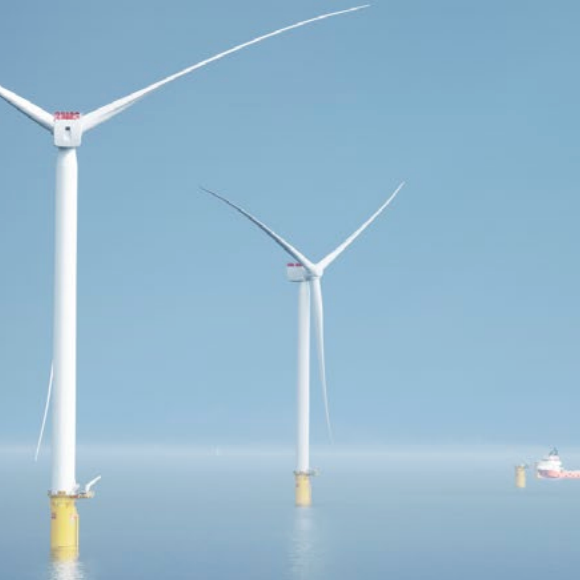
Offshore wind is a core growth sector in the ocean economy and must scale rapidly to support decarbonization and energy security. At the same time, expansion in heavily used marine environments raises an important question for the regenerative blue economy: can offshore energy infrastructure contribute to ecosystem recovery, rather than only reducing harm? Hollandse Kust Zuid, located 18-36 kilometres off the Dutch coast in the North Sea, offers one of the largest examples of this shift in practice. Jointly owned by Vattenfall, BASF and Allianz, the project has 139 turbines and 1.5 gigawatts of installed capacity, producing approximately 1.5 terawatt-hours of electricity annually, enough for more than 1.5 million households. Operational since 2024 and funded by Vattenfall, it is the first offshore wind farm in Europe developed without direct government subsidies. The case shows how renewable energy deployment can be linked with nature-inclusive design, circular infrastructure pilots and adaptive ecological monitoring at gigawatt scale.
Approach
HKZ was enabled by a stable regulatory environment, Dutch government-backed grid connections, visibility on future market volumes and a tender process that reduced risk for private investors while allowing power to be sold into wholesale markets. This enabling context helped create the conditions for a large-scale private investment model in offshore wind. Beyond energy generation, HKZ has been designed as a testbed for innovation and ecosystem restoration through SeaLab, a dedicated research and development platform that convenes research institutes, universities and other stakeholders. SeaLab supports work on marine restoration, biodiversity conservation and circular supply chain design. In partnership with De Rijke Noordzee, Vattenfall introduced several nature-inclusive measures into the wind farm's infrastructure and operations. These include elliptical openings in turbine foundations to allow water exchange and create shelter for marine species, artificial rock reefs on scour protection to increase habitat complexity, and a double bubble curtain to reduce construction noise while monitoring impacts on marine mammals. Further pilots include using thermal cameras and artificial intelligence to trigger temporary shutdowns during peak bird migration, testing a floating seaweed farm between turbines to explore co-location and carbon sequestration, and trialling recyclable blades developed by Siemens Gamesa to reduce the life-cycle impact of offshore infrastructure. Results are still being assessed, and monitoring is informing adaptive management. The value of the approach lies in combining commercial offshore energy production with practical measures that test how marine infrastructure can create habitat, reduce wildlife impacts and support more circular supply chains.
Business and economic value
HKZ demonstrates that nature-inclusive design can be integrated into a commercially significant offshore wind project when enabling policy, investor confidence and partnerships are in place. Its 1.5 gigawatts of capacity contribute to industrial decarbonization and fossil-free electricity supply for businesses and households, while the absence of direct government subsidies signals that large-scale offshore wind can attract private capital under the right market and regulatory conditions. The project also shows how innovation platforms can help reduce uncertainty around regenerative infrastructure by generating evidence, testing operational practices and building collaboration between developers, researchers and civil society. For ACT Ocean, the case is especially useful because it illustrates both the promise and limits of site-level regeneration. HKZ shows that habitat-oriented design, bird protection measures, noise mitigation, seaweed co-location and circular material pilots are achievable at scale. However, the case also highlights that individual site measures cannot substitute for seascape-level governance. Scaling from project to system requires marine spatial planning, cross-sector coordination and policy signals that reward net-positive contribution, not only impact minimization.
References
1. The Regenerative Blue Economy: Pathways to Prosperity - World Economic Forum