
Project overview
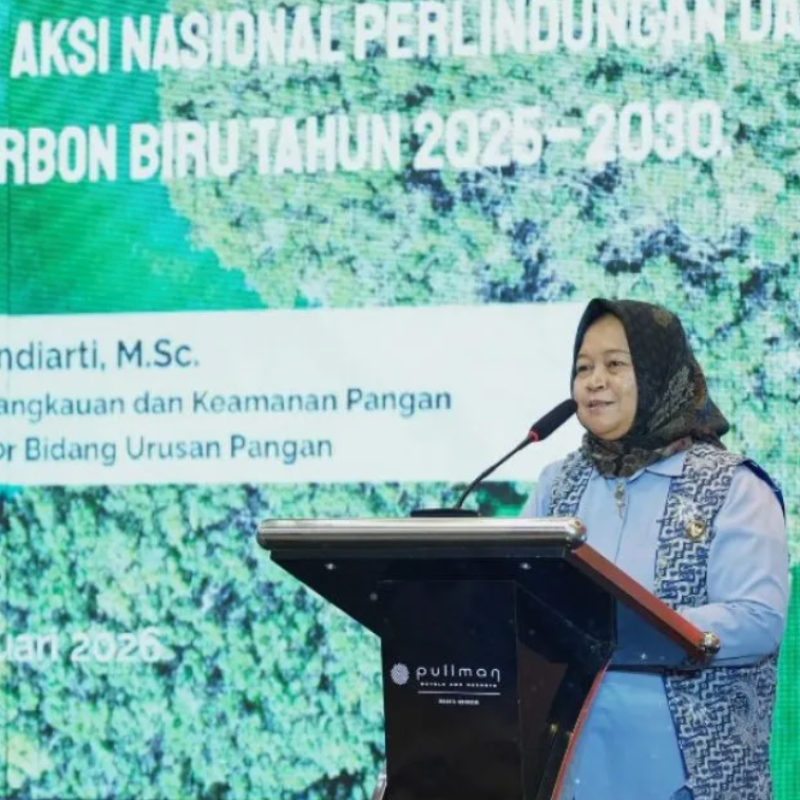
In February 2026, Indonesia launched RENAKSI, the National Action Plan for the Protection and Management of Blue Carbon Ecosystems 2025-2030, marking an important step in coordinating policy, finance and stakeholder action around one of the world's most significant blue carbon landscapes. Indonesia holds around 17% of global blue carbon reserves, supported by approximately 3.45 million hectares of mangroves and 660,000 hectares of seagrass meadows. These ecosystems are central to climate mitigation, coastal resilience, biodiversity protection and the development of a regenerative blue economy.
RENAKSI was launched by the Coordinating Ministry for Food Affairs together with the Indonesia National Blue Carbon Action Partnership. It was developed with the support of multiple ministries and agencies, including those responsible for marine affairs and fisheries, environment, finance, national development planning, forestry, research and innovation, and village development, alongside NGOs, scientists and academic institutions. Its purpose is to create a shared national framework for protecting and managing mangrove, seagrass and tidal marsh ecosystems while aligning blue carbon action with climate targets, inclusive development and sustainable financing.
Approach
RENAKSI responds to a core implementation challenge: Indonesia already has significant blue carbon assets, policy momentum and technical capabilities, but long-term ecosystem protection requires stronger alignment across institutions, regulations, data systems, financing instruments and community-level priorities. The action plan provides a government-anchored framework to harmonize policies, identify programme needs and guide implementation by relevant ministries and institutions according to their mandates.
The plan builds on existing governance foundations, including international agreements, national climate commitments, regulations on mangrove protection and carbon economic value instruments. It also recognizes the need to clarify definitions, strengthen mitigation methodologies, improve marine spatial planning, and reinforce law enforcement so that blue carbon ecosystems can be managed consistently across jurisdictions.
A second pillar is science and data. Indonesia has important technical assets, including national mangrove mapping, forest reference emission levels, greenhouse gas inventories, measurement, reporting and verification systems, and geospatial monitoring platforms. RENAKSI highlights the need to further adapt MRV systems for blue carbon, strengthen seagrass mapping and improve access to research infrastructure.
The third pillar is financing and social inclusion. RENAKSI aligns implementation strategies with funding instruments and principles of Gender Equality, Disability and Social Inclusion. It recognizes the role of public programmes, community initiatives, carbon economic value mechanisms, Green Sukuk, Blue Bonds, grants and concessional finance. By linking policy coordination with inclusive financing, the plan aims to move beyond isolated projects towards a more coherent national investment environment for blue carbon protection and management.
Business and economic value
RENAKSI helps create the enabling conditions for high-integrity blue carbon investment in Indonesia. A unified national framework can give companies, investors and development partners greater confidence to engage through sustainability credit purchases, supply chain transformation, direct project development or catalytic finance. This is particularly important in a market where credibility, clear rules, robust data and community safeguards are essential for scaling investment.
The action plan also supports Indonesia's broader blue economy opportunity, estimated at roughly USD 1.3 trillion. By protecting and restoring mangroves, seagrasses and tidal marshes, RENAKSI can contribute to climate mitigation, coastal protection, fisheries productivity, biodiversity conservation and climate-resilient livelihoods. Its value lies not only in carbon potential, but in demonstrating how blue carbon can be integrated into national development planning, public finance, private investment and community resilience.
For ACT Ocean, the case shows how governments can coordinate multiple institutions and partners around blue carbon while creating clearer pathways for responsible corporate and financial engagement. It offers a relevant model for countries seeking to convert natural capital into investable, inclusive and policy-aligned opportunities without losing sight of ecosystem integrity and local benefit.
References
1. Indonesia launches national action plan for blue carbon ecosystems - ANTARA News
2. National Action Plan: Protection & Management of Blue Carbon Ecosystems - Konservasi Indonesia
3. Indonesia National Blue Carbon Action Partnership and Government of Indonesia launch materials