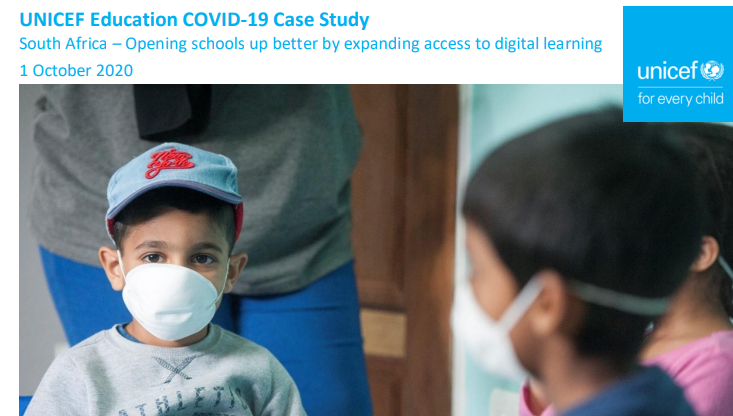
Efforts to expand digital learning have been pivotal not only to South Africa’s COVID-19 response, but also well beyond it. UNICEF is working with the Department of Basic Education (DBE) to scale up mass e-learning, online and app-based access with private sector input, including partnering with 2Enable to develop new digital learning content for preschool and primary students. Strategies also comprise radio and TV broadcasts to reach children who lack devices and the internet. Reopening was phased, starting with students in examination classes. Due to fluctuations in COVID-19 cases throughout the country, reopening took various steps forwards and backwards as required. Schools are using a hybrid model to ensure physical distancing, where 50 per cent of students come to school on a rotational basis, alternating days. On the days that students are not in school, UNICEF is continuing radio and TV broadcasting as well as digital platforms, discussed in this paper.