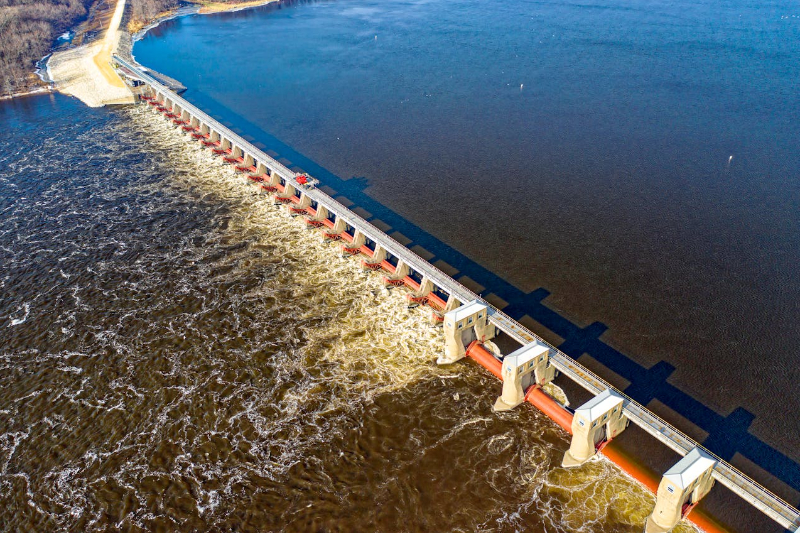
Hybrid hydro-battery flexibility systems
Hybrid hydro–battery systems pair existing hydropower plants with co-located battery storage to provide flexibility across multiple operational timescales. Hydropower reservoirs offer multi-hour energy shifting and firm capacity, while batteries deliver fast frequency response, rapid ramping and short-term balancing. When operated through integrated digital control systems, the combined asset can absorb variable renewable generation, support grid stability and enhance the flexibility of hydropower operations.
As renewable penetration increases and system variability grows, hybridization enables hydropower plants to operate more efficiently by coordinating water releases with battery dispatch. The International Energy Agency’s (IEA) Hydropower Special Market Report notes that reservoir hydropower provides valuable long-duration flexibility, while batteries excel at millisecond-level response.[1] Combining these capabilities helps operators manage ramps, reduce cycling stress on turbines and provide a broader suite of ancillary services.
Main outcomes of the solution
- Sustainability: Enables more flexible hydropower operation that reduces curtailment of renewable generation and supports climate-aligned utilization of existing low-carbon infrastructure, without requiring significant new civil works.
- Reliability & Flexibility: Provides multi-timescale system support by combining hydropower’s long-duration flexibility with the fast-response capabilities of battery storage, enhancing frequency regulation, ramping control and management of variable renewable output.
- Business Value: Increases the productivity of existing hydropower infrastructure by enabling participation in ancillary-service markets, enhancing operational efficiency through coordinated dispatch, and supporting new value streams arising from hybrid flexibility services.
Key deployment and scaling factors
- Hybrid control system integration to coordinate real-time turbine dispatch and battery operation within EMS and SCADA environments.
- Digital monitoring and optimization tools to manage reservoir levels, battery state-of-charge, forecasted inflows and renewable variability.
- Hydrological and reservoir-operation assessments to determine storage potential, water-use constraints and suitability for hybridization.
- Market and regulatory recognition of hybrid assets to enable participation in ancillary-service markets and stacked revenue streams.
- Electrical, mechanical and safety interfaces ensuring compliant integration between hydro-mechanical equipment and battery systems.
- Collaboration across operators, battery vendors and grid operators to align on operational procedures and ensure interoperability.
Case Study
Enel (2025), Italy
At the Dossi hydropower plant in Italy, Enel is implementing BESS4HYDRO, a project supported by the European Commission’s Innovation Fund to hybridize reservoir hydropower with battery storage.[2] The project integrates a 4 MW / 2 MWh battery with existing hydropower infrastructure, enabling the plant to operate with flexibility characteristics similar to those of a pumped-storage facility.[3]
Enel’s hybrid control system enables the battery at Dossi to operate as a form of “virtual pumping,” acting as a virtual second reservoir that absorbs electricity during periods of high supply and dispatches it rapidly when demand rises. This coordinated hydro-battery operation improves the scheduling and utilization of the hydropower resource and allows the plant to provide fast-response grid services typically delivered by flexible thermal units. The integrated system enhances frequency regulation, improves ramping capability and supports local renewable integration. By demonstrating how existing hydropower assets can be modernized through battery retrofits and unified digital controls, BESS4HYDRO offers a replicable approach for strengthening the flexibility of Europe’s hydropower fleet.[3]
VERBUND and Fluence (2025), Austria
VERBUND AG, one of Europe’s largest hydropower producers, is deploying large-scale battery energy storage systems in Germany in partnership with Fluence Energy to strengthen short-term system flexibility and grid stability. In 2025, VERBUND and Fluence announced the development of two grid-connected battery projects with a combined capacity of over 92 MW / 186 MWh, located in Rhineland-Palatinate (50 MW / 100 MWh) and Saxony (42.9 MW / 86.5 MWh).
The battery systems are designed to provide fast-response balancing services, support intraday and balancing markets, and help manage increasing variability from wind and solar generation. VERBUND will operate and market the assets using advanced trading algorithms across energy and ancillary-service markets, while Fluence supplies modular battery systems designed to meet stringent German requirements for noise protection and cybersecurity.
Although the projects are not physically co-located with hydropower plants, they illustrate how hydropower-centric utilities can complement long-duration reservoir and pumped-storage assets with fast-acting battery storage. This portfolio-level approach allows utilities like VERBUND to combine long-duration flexibility from hydropower with millisecond-level response from batteries, strengthening overall system balancing capability as renewable penetration increases.[4]
References:
- Hydropower Special Market Report I IEA (June 2021)
- BESS4HYDRO: Battery Energy Storage System for HYDROpower I European Commission Innovation Fund (2025)
- BESS4Hydro, our European record for innovation in hydropower I Enel (March 2025)
- VERBUND and Fluence launch large-scale battery storage projects in Germany I Fluence (July 2025)