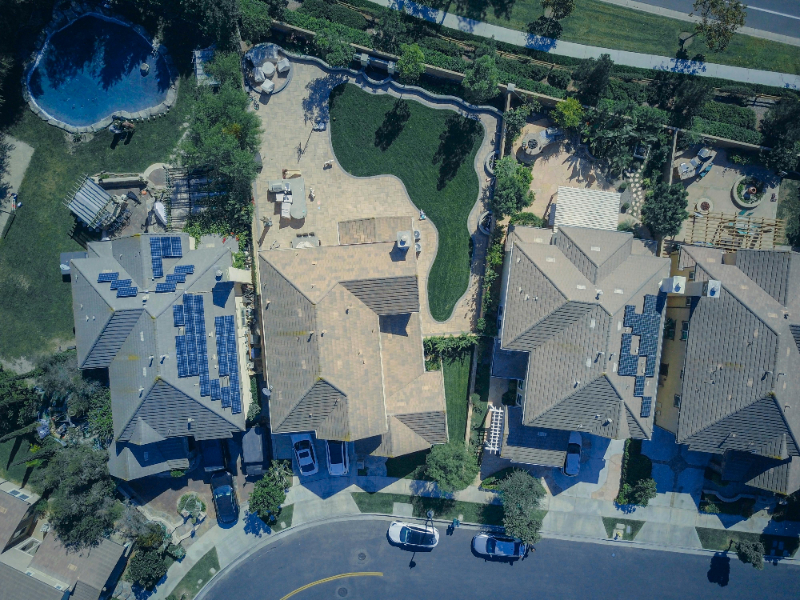
Residential renewable energy systems
Residential renewable energy systems integrate rooftop solar photovoltaic (PV) generation with household batteries, EV chargers and heat pumps, coordinated through a smart energy-management platform. These systems enable households to optimize self-consumption, manage flexible loads and, where permitted, participate in demand-response and virtual power plant (VPP) schemes.
According to the World Economic Forum, digitally connected prosumer technologies are becoming an important element of distributed energy systems, helping smooth local demand profiles and support the wider grid.[1] As adoption grows, coordinated residential systems can reduce peak loads and contribute to a more resilient distribution network.
Main outcomes of the solution
- Affordability: Reduces household electricity costs by increasing self-consumption of rooftop solar and lowering reliance on peak-price imports; overall savings depend on local tariff structures, export rules and system utilisation.
- Reliability & Flexibility: Provides short-duration backup capability and enables coordinated control of household loads such as EV charging and heat pumps. Aggregated fleets can deliver local balancing and flexibility services where regulatory frameworks allow.
- System Resilience: Enhances resilience at distribution level by decentralising flexible capacity across many households, helping mitigate congestion, manage variability and maintain stability during periods of high demand or fluctuating renewable output.
Key deployment and scaling factors
- Install smart meters, communication interfaces and safe interconnection hardware to enable export capability and grid-service participation.
- Deploy comprehensive household energy-management platforms that coordinate solar generation, storage, EV charging and heat-pump operation.
- Strengthen regulatory frameworks allowing aggregated residential batteries to access flexibility markets, demand-response programmes and balancing services.
- Ensure robust installer certification and safety standards covering battery installation, wiring, backup switching and fire protection.
- Development of scalable commercial models—ownership, leasing and energy-as-a-service—that lower upfront costs and accelerate adoption.
- Provide clear cybersecurity and data-governance guidelines for connected residential DER systems and digital energy platforms.
- Incorporate interoperability standards to ensure devices can be aggregated reliably.
- Align deployments with DSO capacity assessments to avoid local network congestion.
Case Study
Enpal (2017), Germany
Enpal provides integrated residential clean-energy systems combining rooftop solar, battery storage, EV chargers and heat pumps, offered through an innovative, flexible financing model that lowers upfront investment for households. The company operates Enpal. One, an AI-enabled energy-management platform that coordinates generation and consumption across its customer base. The platform aggregates tens of thousands of decentralized assets and, where allowed by regulation, enables participation in flexibility services.
The system improves household self-consumption and supports local network efficiency by managing EV charging, heat-pump operation and battery dispatch in response to price signals or grid needs. Enpal’s deployments illustrate how integrated solar-plus-storage offerings, combined with digital coordination, can scale rapidly and contribute to distributed flexibility in a high-renewables market such as Germany.[2]
References: