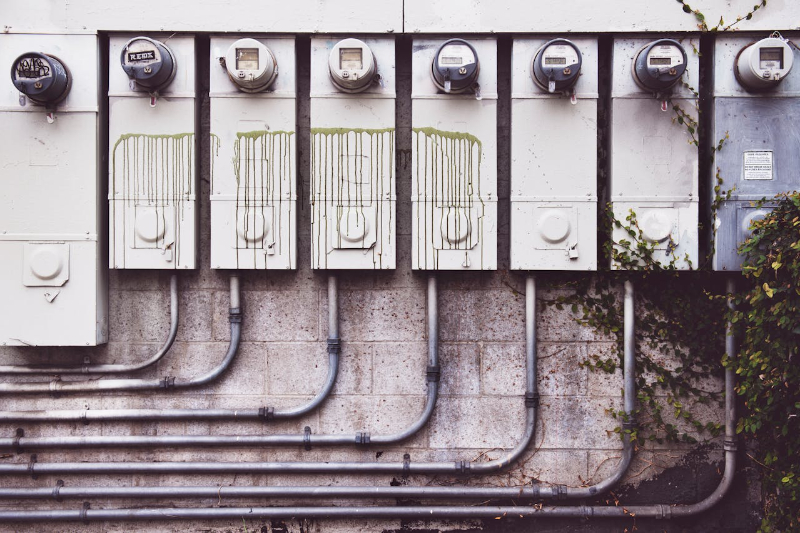
Behind-the-meter
Behind-the-meter power systems allow energy-intensive facilities – such as data centres, industrial plants and large commercial campuses – to generate or store electricity directly on-site rather than relying exclusively on the public grid. By integrating local energy sources such as natural gas cogeneration, solar PV, battery storage or, where feasible, hydrogen-ready turbines, organizations can reduce exposure to grid congestion and improve operational reliability during peak demand.
Behind-the-meter assets also help facilities align consumption with on-site renewables, cutting emissions and strengthening resilience. Analysis by the International Energy Agency (IEA) indicates that decentralized energy resources can support system reliability and improve resilience to grid disturbances.[1] The International Renewable Energy Agency (IRENA) notes that on-site generation paired with storage enhances operational flexibility and mitigates stress on regional grids.[2]
Main outcomes of the solution
- Sustainability: Enables the use of on-site cleaner energy sources, lowering emissions and reducing reliance on carbon-intensive grid electricity; support integration of low-carbon fuels and emerging technologies into industrial and data center operations.
- Affordability: Reduces exposure to wholesale price volatility and provides greater long-term cost predictability for mission-critical facilities; avoids costly transmission upgrades, connection-queue delays and certain tariff components (e.g., demand charges, transmission fees), improving economics where grid congestion or high connection costs would otherwise increase total energy costs.
- Reliability & Flexibility: Improves resilience during peak demand, outages or grid congestion by allowing facilities to rely on on-site generation or storage; supports continuity of operations in mission-critical facilities such as data centers, advanced manufacturing sites and logistics hubs.
Key implementation and scaling factors
- Conduct early assessments of load profiles, site constraints, permitting requirements and environmental regulations to confirm the feasibility of on-site generation or storage.
- Use modular, standardized designs and ensure seamless integration with existing and future facility infrastructure, including mission-critical equipment.
- Implement rigorous safety, compliance and maintenance frameworks that address hydrogen handling, battery safety codes, emissions standards and operational reliability.
- Secure resilient fuel-supply and logistics arrangements for natural gas, hydrogen or other clean fuels to ensure uninterrupted behind-the-meter operation.
- Deploy advanced digital control and energy-management systems to coordinate on-site generation, storage and grid interactions in real time.
- Address regulatory and market conditions – including tariff structures, standby charges, private-wire rights and self-generation rules – that determine project viability.
- Manage applicable interconnection, protection and metering requirements to remain compliant with grid-code obligations even when operating primarily behind the meter.
Case Study
Energy Abundance Development Corp. (under development, 2026 onwards), USA
In Texas, Energy Abundance Development Corp. (formerly Green Hydrogen International) is developing Data City – what it describes as “the world’s largest behind-the-meter data center”– designed to operate independently of the public grid and to be powered by dedicated on-site and local clean fuel generation. The planned 50,000-acre campus near Laredo will initially rely on locally sourced natural-gas generation, with a phased transition to 100% green hydrogen stored in nearby salt-dome caverns.[3]
According to the developer, the project will be built in phases, beginning with 300 MW of data-center capacity and 1 million square feet of data-center space targeted for 2026, with an envisaged long-term expansion pathway of up to 5 GW and more than 15 million square feet of leasable space as demand grows. A related green energy hub near Corpus Christi is expected to produce approximately 280,000 tons of green hydrogen and 1 million tons of green ammonia per year, using wind and solar power.
As a forward-looking development, the Texas project illustrates how large industrial and data center facilities may use behind-the-meter generation and dedicated clean-fuel supply to secure power availability, stabilize long-term energy costs and bypass grid-connection constraints while supporting the growth of high-density operations.
References:
