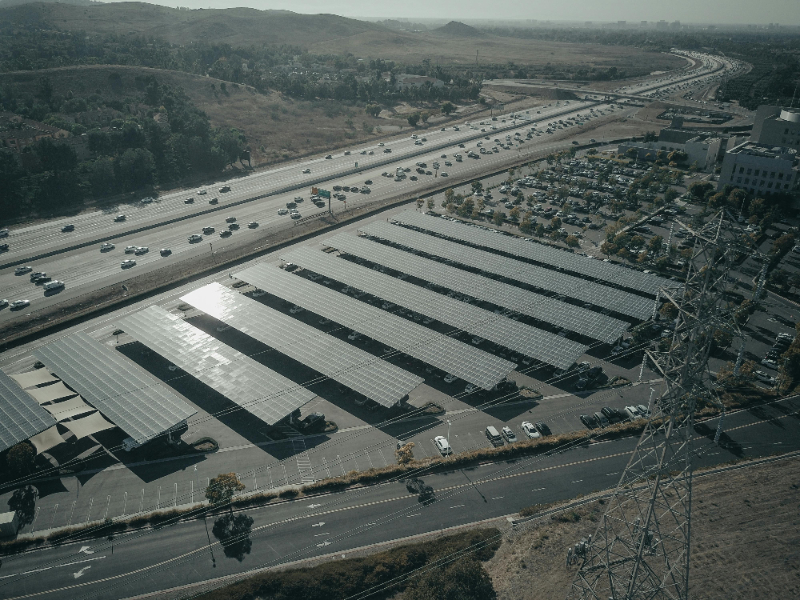
Microgrid clusters
Microgrid clusters consist of multiple interconnected microgrids that can share energy, coordinate operations and optimize distributed resources across a wider area. Unlike stand-alone microgrids, clusters use supervisory controls, synchronization mechanisms and shared storage scheduling to balance local renewable generation and maintain stable voltage and frequency conditions across several nodes. This enables collective use of solar, wind and storage assets, helping reduce variability and strengthening local operating conditions.
By linking distributed energy resources across neighboring sites or islands, microgrid clusters improve resilience, reduce operating costs and support higher renewable-energy penetration, particularly in remote or infrastructure-constrained regions. Modern clusters increasingly rely on grid-forming and grid-following inverters, adaptive protection settings and redundant communication channels to maintain safe operation, support coordinated islanding and reconnection and enable controlled power exchange over interconnection cables.
These systems are increasingly deployed to replace diesel-based generation, enhance energy security and provide more reliable, climate-resilient electricity for communities and critical loads. Through coordinated controls, shared storage capacity and intelligent dispatch, microgrid clusters support both local autonomy and multi-node optimization, enabling expanded electrification without requiring extensive transmission expansion.
Main outcomes of the solution
- Sustainability: Replaces diesel-based generation with renewable energy and storage, lowering local emissions and reducing reliance on imported fossil fuels.
- Reliability & Flexibility: Enhances continuity of supply through energy sharing across interconnected microgrids, improving operational stability during fluctuations in local renewable output or equipment outages.
- Socioeconomic Impact: Expands access to affordable and reliable electricity for remote communities, enabling more consistent delivery of essential services and supporting local economic activity.
Key deployment and scaling factors
- Integrate diverse renewable resources (solar, wind, tidal, small hydro) with appropriately sized storage to support both stand-alone operation and energy exchange within the cluster.
- Deploy robust communication and control infrastructure to coordinate dispatch, maintain synchronization, and ensure reliable voltage and frequency management across interconnected microgrids.
- Ensure reliable interconnection pathways – including submarine or underground cables – with appropriate protection schemes for safe islanding, reconnection and fault management.
- Develop operational strategies and protection settings tailored to multi-microgrid environments, including load-sharing controls, contingency procedures and resilience planning.
- Engage local communities and institutions to align design with service-reliability needs and ensure long-term operational and economic viability.
Case Studies
China Southern Power Grid (2024), China
Located south of the Pearl River estuary, the islands of Guishan, Dong’ao and Dawanshan relied for decades on diesel generators, exposing their electricity supply to fuel-delivery risks, high generation costs and weather-related disruptions. As part of the National Smart Grid Project, China Southern Power Grid deployed distributed renewable-energy systems on each island and established demonstration microgrids designed to assess the technical suitability of clean, autonomous supply for remote communities.
On Dawanshan Island, the microgrid comprises an 850 kW wind turbine, 200 kWp of solar PV, a 2,000 kWh battery energy-storage system, a 1,000 kW power-conditioning system, and two 500 kW diesel generators for backup supply. Similar configurations integrating solar, wind and battery storage were installed on neighboring islands. Each island operates an independent microgrid sized to local demand patterns, which vary significantly with seasonal tourism activity.
The three island microgrids were subsequently interconnected via submarine cables, forming a coordinated microgrid cluster that can share electricity, balance variable renewable output and optimize storage utilization across sites. This configuration improves reliability for all islands by enabling support during periods of low renewable generation on any single island and by smoothing weather-related supply fluctuations across the cluster. Reported power-supply reliability now exceeds 99.9%, and diesel-based generation has been largely displaced, reducing costs and emissions while improving service quality for residents and local businesses.
The project demonstrates how renewable-based microgrids, when linked through controlled interconnections and supported by advanced dispatch, can deliver resilient, lower-carbon electrification for remote island systems previously dependent on expensive and unreliable diesel supply.[1,2]
State Grid Jiangsu Electric Power Co., Ltd. Nantong Power Supply Branch (2025), China
The Jiangsu Nantong Microgrid Cluster Ecological Demonstration Project, commissioned in March 2025, demonstrates a digitally coordinated microgrid cluster model for enterprise customers. State Grid Nantong established Jiangsu Province’s first municipal-level microgrid management platform covering the integrated energy and carbon management ecosystem, enabling multiple customer-side microgrids across the city to be monitored, assessed and coordinated as a cluster.
Building on this platform, Nantong Power Supply Branch developed a customer-side management tool that supports coordinated control of enterprise energy resources, including photovoltaic and storage facilities. The platform uses big data to diagnose customer electricity cost, load and energy consumption patterns, and is pre-configured with strategies such as price-following logic, demand response, renewable energy optimization and grid interaction.
The platform has integrated 83 enterprises, including 410.69 MW of photovoltaic, storage and charging resources, forming an initial citywide microgrid cluster ecosystem. Reported outcomes include a 97% local renewable energy consumption rate, 425,000 tonnes of annual carbon reduction and average enterprise electricity cost savings of approximately 6.71%. The aggregated resources also provide grid flexibility, with 288.44 MW of maximum upward regulation capacity and 96.62 MW of maximum downward regulation capacity, becoming important regulation resources for the main power grid. [3]
References:
- Information provided to World Economic Forum I China Southern Power Grid (November 2025)
- Handbook on Microgrids for Power Quality and Connectivity I Asian Development Bank (July 2020)
- Information provided to World Economic Forum I State Grid Corporation (April 2026)