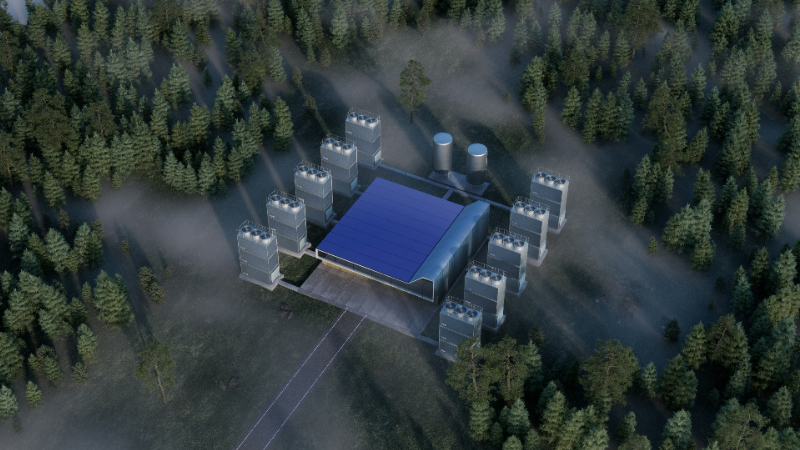
Modular direct air capture (DAC)
Modular direct air capture is an engineered carbon removal approach that uses repeatable, factory-built units to extract carbon dioxide directly from ambient air, rather than from a concentrated industrial exhaust stream. In a typical solid-sorbent system, fans move air through materials that selectively bind carbon dioxide at lower temperatures; the captured carbon dioxide is then released when the material is heated, producing a concentrated stream that can be permanently stored underground or used in products such as low-carbon concrete, synthetic fuels or industrial materials.
The modular design matters because direct air capture remains early in commercial deployment and needs faster manufacturing, lower project execution risk and easier technology upgrades to reach meaningful scale. By using standardized modules that can be connected in arrays, developers can add capacity incrementally, replicate project designs across sites and replace key components as capture materials improve. The approach also enables co-location with renewable generation, energy storage, industrial facilities and carbon transport or storage infrastructure, helping developers integrate direct air capture into broader low-carbon industrial and energy systems.
The model’s commercial importance lies in turning a capital-intensive climate technology into a repeatable infrastructure platform. Scale can come from manufacturing learning, portfolio deployment, technology upgrades and long-term offtake contracts rather than one-off project delivery.
Main Outcomes of the Solution
- Business Value: Creates a more bankable pathway for carbon removal by shifting project delivery from bespoke infrastructure builds to repeatable, manufactured assets. Long-term offtake contracts can improve investment certainty for projects located near low-carbon power, heat, carbon transport, storage infrastructure or industrial users.
- Sustainability: Supports decarbonization by creating a route to remove residual emissions that are difficult or costly to eliminate directly. Its climate value depends on using low-carbon electricity and heat, minimizing lifecycle emissions and pairing captured carbon dioxide with verified durable storage or use pathways.
Key Deployment and Scaling Factors
- Locate DAC projects where low-carbon electricity, clean heat, or waste heat can support operations without increasing system emissions.
- Standardize modular units to reduce delivery risk by enabling repeatable installation, phased expansion, and factory-based production.
- Allow component and sorbent upgrades so that projects can improve performance without replacing the full asset.
- Capture capacity paired with verified storage or utilization pathways to ensure that removed carbon dioxide delivers durable climate value.
- Long-term offtake contracts, public procurement, tax credits, and hub-based infrastructure to improve bankability and attract capital for scale-up.
Case study
CarbonCapture and True North Carbon (2025), Canada
In 2025, CarbonCapture, through its Canadian subsidiary True North Carbon, deployed the Tamarack direct air capture project at Deep Sky Alpha near Innisfail, Alberta. The project reached first capture on 22 October 2025 and is described by the company as Canada’s largest single-technology direct air capture deployment. Tamarack is designed to remove up to 2,000 tons of carbon dioxide from the atmosphere each year using modular direct air capture equipment powered by solar energy.
The implementation demonstrates a phased deployment model in which standardized capture modules are installed at a shared carbon removal facility, rather than developed as a stand-alone bespoke plant. The project is expected to generate the company’s first carbon removal credits and includes local supplier participation, community engagement and education programs with local and Indigenous communities. These project benefits should be treated as company-stated expectations until independently verified outcomes are available.
References:
- Direct Air Capture - Energy System - IEA
- CarbonCapture | World Economic Forum
- DOE Explains...Direct Air Capture | Department of Energy
- Newsroom | Carbon Capture Inc.
- True North Carbon's Tamarack Project, Canada's Largest Single-Technology Direct Air Capture Deployment, Achieves First Capture in Innisfail, Alberta
