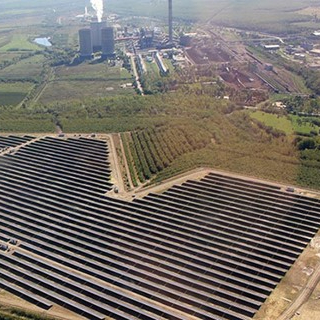
MVM Mátra Energy Ltd. (formerly Mátra Power Plant Corp.) is exploiting the potential of decommissioned mine sites for energy supply, using them primarily for solar power plants and the production of biomass.
Visonta, in Northern Hungary, accounts for nearly one-fifth of Hungary’s electricity generation. In 2004, the Mátra power plant located in the region started utilizing biomass as a first step towards the use of more renewable energy sources in power production, but also to start a new long-term strategy.
In 2015, a 16 MW photovoltaic power plant – at the time the largest in the country – was installed on the old ash deposit heap within the former Mátra mining site. Since then, the solar portfolio has been further extended with the installation of a 20 MW plant in another former mining site located in the vicinity. In the future, the expansion of the existing solar capacity is planned to reach up to 200 MW.
With the support of the European Union, and with the co-financing of the European Regional Development Fund (ERDF) (~ 1.5 million EUR), an industrial park was created to attract companies that could use surplus heat (e.g., from steam) from the power plant. Other participating organizations include the Hungarian Economic Development Center Zrt. (MAG) as well as the Ministry of National Development and Economy (NFGM).
The industrial park, Geosol Kft., is now exploring new business opportunities to further diversify its portfolio and accelerate the decarbonization of the site. Different concepts – all at different maturity stages – are being proposed such as a Refuse Derived Fuel (RDF) fired combined heat and power unit, a 450 MW gas-fired combined cycle power unit, a 100 MW biomass plant, 600 MW of pumped storage, 50 MW of battery storage. A solar panel factory is also being envisaged as a possible future development for the industrial park.
Due to the reassessment of energy security and electricity supply issues, the possibility and necessity of extending the lifetime of existing lignite-fired generation units until the end of 2029 and the conditions for their continued operation are under examination, in accordance with Government Decision 1452/2022.
Technology
• The Mátra Power Plant leveraged the decommissioned mine sites for energy supply, using them primarily for biomass production and photovoltaic power plants.
• 16 MW photovoltaic power plant was installed as a re-cultivation measure on an ash deposit heap within the former mining site.
• Biomass utilisation, made up predominantly of agricultural and forestry organic waste, is partly supplied by alternative resources such as Solid Recovered Fuel (SRF) and Refuse Derived Fuel (RDF), as well as resources from energy forests owned by the power plant.
Approach
• Multi finance products and schemes; the project was financed by the Mátra Power Plant with 50% of investment covered by tax allowances.
• National support schemes for renewables assisted the shift towards biomass and solar PV (feed-in tariff schemes and tax exemptions for PV).
• ERDF funding for companies in industry cluster.
Benefits
• Clean electricity supply for 20,000 households
• 90,000 t/a CO2 emission reduction
• National demonstration of Hungary’s renewable energy potential
• Securing employment of existing workers and generating ~250 new jobs
Just Transition
The gradual conversion of the Mátra power plant has preserved jobs while laying the foundation for a shift towards more sustainable industries. The power plant and industrial park combined are estimated to support between 6,800 jobs (2,100 direct and 4,700 indirect) and 10,000 jobs. While the coal workforce is aging and is likely to mainly benefit from retirement plans, the industrial park has created a broader range of employment opportunities for local residents.
The organization engages in the LIFE-IP North-HU-Trans project, a retraining and corporate mobilization programme with a total budget of HUF 5.2 billion/13.56 million EUR, over 9 years, much of it to be covered by EU subsidies and the EU Modernization Fund.