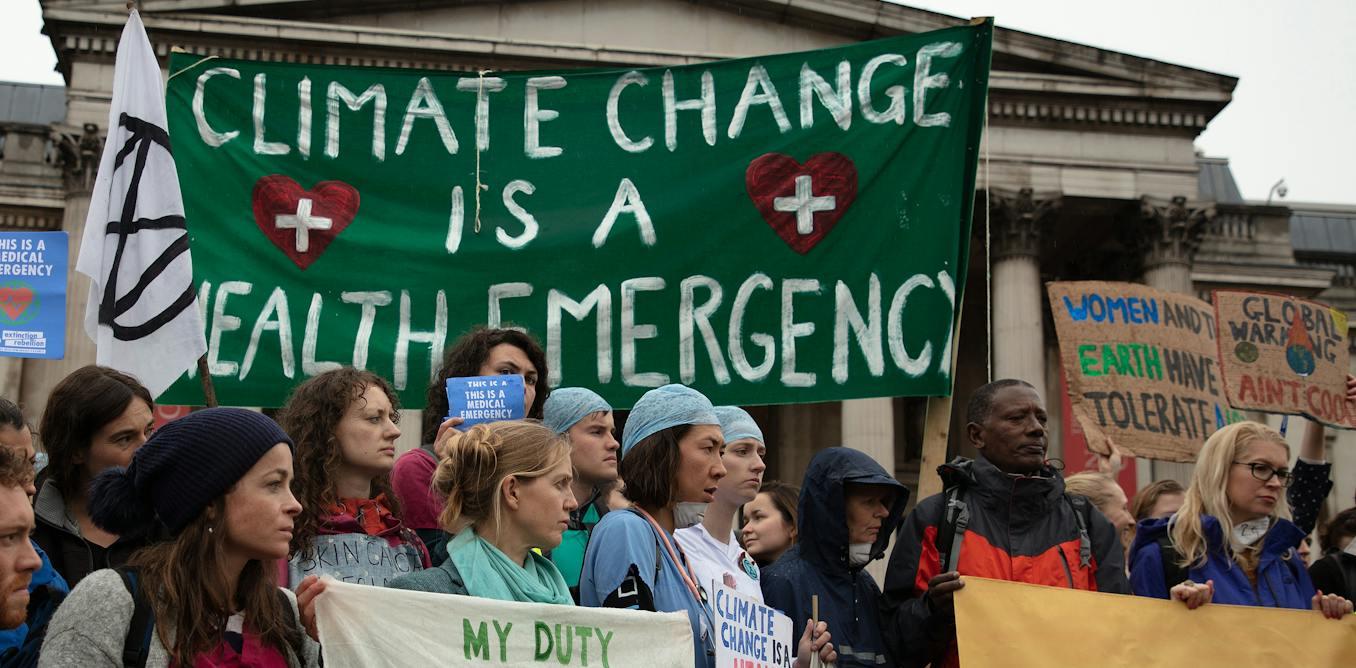
Climate change is causing hundreds of thousands of additional deaths worldwide, with heat-related fatalities reaching approximately 710,000 in 2023, 71% of which are attributed to human-induced warming. Rising temperatures exacerbate health issues like heatstroke, heart disease, and notably kidney disease, as heat stress and dehydration increase acute kidney injury risks. Despite fewer mentions of climate-health links by world leaders in recent UN debates, many national climate commitments still address health impacts. Immediate health benefits arise from actions like reducing air pollution through cleaner energy, urban greening, and sustainable healthcare practices. Protecting biodiversity is crucial for ecosystem services, human health, and future medical discoveries, underscoring the urgency of connecting climate evidence with practical policies to safeguard health.
Health
Climate change is killing hundreds of thousands – a kidney specialist’s concerns

Jonathan Swift anticipated the pitfalls of artificial intelligence in his 1726 satirical work, Gulliver’s Travels, particularly in the third voyage to the Academy of Lagado. There, a professor and his assistants operate a large mechanical device with wooden blocks inscribed with words, which they manipulate to generate combinations of text aimed at producing a comprehensive body of knowledge without requiring genius or study. This contraption parallels modern large language models, promising automatic generation of scientific and literary works regardless of user expertise. Swift’s satire critiques the blind faith in technological progress and the illusory nature of mechanized knowledge production.
Education
Jonathan Swift foresaw the pitfalls of AI in Gulliver’s Travels
Britain's chemical industry, once epitomized by the integrated powerhouse of Imperial Chemical Industries (ICI), has undergone significant transformation since its breakup in the early 1990s. ICI's model combined raw materials, energy, research, manufacturing, and skilled labor within unified sites, enabling development from molecule to market. While chemical exports grew post-ICI, recent declines reveal that shedding low-margin, bulk chemical production also eroded critical infrastructure supporting high-value sectors like pharmaceuticals and advanced polymers. The disintegration of vertically integrated operations has weakened UK's chemical manufacturing foundations, posing challenges amid global protectionism, resource competition, and tighter credit, and illuminating lessons for sustaining industrial capacity and innovation.
From industrial powerhouse to uncertain future: lessons from Britain’s chemical industry

AI increasingly participates in decision-making by moving from assisting with tasks to shaping judgments, risking users' agency and critical thinking. Studies show reliance on generative AI can diminish independent judgment and moral awareness, as users may accept ethically questionable recommendations when presented within complex data. This normalization occurs in both professional and personal contexts, with AI advice influencing moral decisions even without rational justification. The subtle shift—from seeking AI help to depending on AI for reasoning—can obscure ethical issues, making unacceptable decisions feel normal by reducing users' attention to moral consequences.
When AI Makes Unacceptable Decisions Feel Normal

BlackRock, Vanguard, and State Street, the "Big Three" index fund managers, influence corporate America primarily through persuasion rather than voting pressure. Owning about a quarter of the average S&P 500 company, their size allows them to observe corporate governance across thousands of firms and spread effective practices. Their engagement notably boosts board and workforce diversity but has limited impact on climate policy changes. Unlike active investors, the Big Three focus on governance issues like board composition and shareholder rights, leveraging economies of scale to share governance lessons, though their approach can be seen as more procedural than deeply involved.
How the ‘Big Three’ Index Fund Managers Really Influence Corporate America
Deep funding cuts within the United Nations and international cooperation budgets are weakening the statistical infrastructure essential for refugee and migration policy. Reductions in national censuses, surveys, and international data processing capacities are making global migration estimates less timely and detailed. Forced displacement data systems, already reliant on project funding and needing reform, are particularly affected. To address this, Germany and the EU should prioritize safeguarding core statistical functions, enhance national and regional capacities, and align funding with demonstrated needs and institutional coordination. The choices made about data preservation will shape the political visibility of migration and displacement issues.
Africa, Latin America | Health
Safeguarding the Statistical Evidence for Refugee and Migration Policy

New vocational GCSEs focused on clean energy skills in England will only be available from 2029, missing current year nine students choosing options now. However, foundational knowledge for clean energy careers already exists within several GCSE subjects. Science covers energy sources and electrical principles relevant to technologies like electric cars and heat pumps. Geography addresses sustainable resource management, while design and technology involves creating sustainable energy projects. Electronics and engineering teach circuit building and control systems essential for clean energy hardware. Economics and business explore market and policy factors affecting energy sectors. Together, these subjects provide education to support growing clean energy employment, which is expected to double by 2030.
Education
Vocational GCSEs won’t arrive until 2029 – but clean energy skills can be found in the curriculum now
The EU is investing heavily in shared data spaces to support AI, research, and industry by enabling organisations to combine and reuse diverse datasets. However, incompatible usage permissions attached to datasets can prevent their effective combination, limiting the potential benefits of data sharing. While machine-readable rules like the Open Digital Rights Language facilitate interpreting data-use terms, they do not ensure permission compatibility. To resolve this, the EU should promote coordinated permission profiles—standardized sets of usage terms tailored to priority use cases—that providers can adopt to ensure complementary datasets allow overlapping, compatible uses without forcing unrestricted openness. This approach balances data sovereignty with interoperability, enhancing the practical value of EU data spaces.
Health, ICT
The EU’s data spaces need compatible permissions
Fairness in computational epidemiology, essential for public health policy, remains underexplored despite extensive examination in machine learning and AI. A new mathematical framework based on social epidemiology principles enables consistent evaluation of fairness across various epidemic models and scenarios, including COVID-19 and Zika outbreaks. Incorporating fairness into immunization strategies can enhance health equity and improve intervention effectiveness. This approach offers a systematic method for quantifying and promoting fairness in infectious disease modeling.
Health
Fairness in infectious disease modeling

Sea-level rise threatens inland life by impacting food production, transport, energy, security, and costs. Flooding and saltwater intrusion jeopardize vital low-lying agricultural areas like England's Fens, risking crop loss and increased reliance on imports. Coastal flooding disrupts ports and associated transport infrastructure, delaying goods and raising prices. The UK's extensive coastal energy facilities face damage and operational risks, threatening energy supplies and increasing costs. National security infrastructure along coasts is vulnerable, with rising sea levels potentially necessitating costly relocations. Overall, sea-level rise drives substantial economic burdens across the country through infrastructure protection, insurance, and higher prices. Rapid emissions reductions and adaptation measures are critical to addressing these challenges.
Five ways that sea-level rise affects your daily life, even if you live inland
CERN was established in 1954 as a political infrastructure to rebuild European science through international cooperation, pooling resources from its 12 founding member states after WWII. Beyond its technical achievements, CERN's distinctive governance—treaty-based and intergovernmental—links scientific collaboration to shared funding and collective decision-making via the CERN Council. Its commitment to a public, nonmilitary ethos and successful large-scale collaboration have made CERN a durable and trusted scientific infrastructure and a model for building trust in international research.
How CERN Earns Trust at Scale
Anna Tumadóttir and Lisa Macpherson examine threats to the digital knowledge commons, highlighting two main forces: extractive enclosure, where dominant technology firms commodify human knowledge without compensation, and defensive enclosure, where rights holders impose restrictions to protect their content. These dynamics create an unsustainable economic model favoring large AI developers and rights holders while excluding broader public benefits. The authors propose principles for solutions to preserve fair use and protect the openness of the digital knowledge commons.
ICT, Education, Health
Creating a New Internet Bargain to Preserve Fair Use and Protect the Commons

The $6.3 billion Binance hack represents the largest recorded crypto-asset theft, largely executed by compromising Binance's withdrawal authorization systems rather than blockchain flaws. Most stolen assets were moved rapidly across multiple blockchains, with Binance freezing $3 billion and restoring 95% of losses primarily via its own funds. North Korea-linked hackers are suspected, though attribution remains provisional. The breach underscores that blockchain security differs from the vulnerabilities in centralized exchanges, which can have single points of failure through compromised staff access or system weaknesses. The theft highlights risks in custody, governance, and investor protection within the crypto ecosystem, emphasizing the need for robust security and understanding of operational and counterparty risks beyond market exposure.
Financial services
The US$6.3 billion Binance hack is the biggest heist ever – it should be a wake up call for cryptocurrency users
An AI-driven civil protection platform, developed by Fraunhofer researchers and partners in the RegioGuard-PRO project, integrates diverse data sources to provide real-time situational awareness for municipalities and public agencies. By combining AI, geodata, and statistical analysis, the system enables early hazard detection, identifies critical infrastructure vulnerabilities, and supports decision-making during extreme weather events and crises. The platform offers AI-powered what-if scenarios for optimized response plans and is tested at demonstration centers in German cities to enhance resilience and crisis management capabilities.
An AI-Driven Platform to Better Protect the Public
AI tools increase individual productivity by saving time, but employees often conceal these gains due to fears of increased workload, higher targets, or appearing less valuable. Studies, including large-scale trials like the UK government's Microsoft 365 Copilot experiment, show measurable efficiency improvements and time savings, yet organizations struggle to trace how this saved time translates into concrete value. This "AI disclosure paradox" arises because measuring AI-driven productivity at the individual level creates incentives to underreport benefits. A solution is disclosure-safe measurement focused on workflow performance rather than individual output, which reduces social risk and better captures AI's true impact on organizational productivity.
Employees have no incentive to disclose how productive AI makes them
Chinese open-weight large language models from companies like DeepSeek and Moonshot have gained popularity in the West due to their affordability and customization. However, concerns exist about their alignment with Chinese state interests and potential safety risks. Startups such as Hirundo, co-founded by Ben Luria, address these issues by surgically modifying the models’ data and parameters to remove state biases, enhance security against cyberattacks, improve fairness, and align them with Western values and business expectations. This process, known as machine unlearning, transforms these AI systems for safer use by Western companies.
Startups recalibrate Chinese AI for the West
Around half of people will experience at least one mental health disorder by age 75. Data from over 150,000 individuals across 29 countries reveal that anxiety disorders affect nearly one in three women and one in five men, while mood disorders—including depression and bipolar disorder—impact over one in three women and one in four men. Depression and anxiety are more prevalent in women, whereas alcohol dependence and substance abuse occur more frequently in men. Many individuals experience multiple disorders over their lifetime, with initial episodes often beginning in childhood, adolescence, or early adulthood.
Around half of people will experience a mental health issue in their lifetime
Public health efforts addressing chronic disease and poverty require localized, historically comparable data that communities can interpret and use effectively. Delaware’s My Healthy Community (MHC) platform integrated health and social data but its planned 2025 decommissioning highlights challenges in maintaining meaningful public data access. True access depends on ongoing stewardship, documentation, and interpretive support, not just data availability. Issues include loss of historical data, substitution with less relevant metrics, and the need for assistance with distributed data sources. Artificial intelligence facilitates data analysis but complicates verification, underscoring the need for transparent data practices and funded support to ensure communities can responsibly use public health data.
Health, ICT
Public Data as Public Health Infrastructure
Since the EU AI Act mandates each Member State to establish at least one AI regulatory sandbox, initiatives have been expanding across the EU and the EEA. As of October 2026, four countries (Denmark, Germany, Netherlands, Spain) completed sandbox pilots, with Spain notably providing detailed reports and guidelines. Three countries (Estonia, Latvia, Lithuania) launched pilots, while Sweden, Liechtenstein, and Norway appointed sandbox coordinators but had not launched pilots. The remaining 20 EU and EEA countries had neither pilots nor coordinators publicly announced, indicating varying progress in implementing AI regulatory sandboxes across the region.
AI Regulatory Sandboxes in Europe: What do we know so far?
Research information practices are rapidly evolving with the integration of generative artificial intelligence (AI) in scientific research. This study uses topic modeling and interpretive content analysis to identify six key shifts: moving from keyword to prompt-based retrieval, from human to delegated interpretation, from human innovation to algorithmic co-creation, from manual writing to generative authoring, from unregulated AI use to accountable disclosure, and from AI use to AI literacy. These changes impact research productivity, critical thinking, academic integrity, ethics, and fairness, guiding stakeholders toward developing AI literacy beyond mere AI use.
ICT, Education
Emerging research information practices in the era of generative artificial intelligence