
Automated decision-making tools, including AI, raise complex issues under federal antidiscrimination laws that address disparate treatment and disparate impact. Disparate treatment involves intentional discrimination based on protected traits, while disparate impact occurs when neutral criteria disproportionately harm protected groups without adequate justification. Intentional use of discriminatory algorithms clearly constitutes disparate treatment, but legal standards are unsettled regarding unintentional discrimination by algorithms or proxy discrimination through correlated traits. The intersection of algorithmic decision-making and antidiscrimination law remains an evolving and uncertain area.
Algorithmic Discrimination: Legal Principles
The Three Horizons approach, introduced by Anthony Hodgson and colleagues, provides a participatory framework to understand change in complex systems by identifying how current systems (Horizon 1) decline, emerging alternatives (Horizon 3) develop, and transformative change occurs in the transitional space (Horizon 2). This comprehensive synthesis, edited by Trace Gale and others, integrates theory, global case studies, and practical tools to support collective sense-making, strategic reflection, and systemic learning. The approach facilitates collaboration across disciplines and addresses contemporary challenges such as climate change and social transformation, offering a vital resource for scholars and practitioners focused on futures, sustainability, and systemic change.
Health
The Three Horizons Approach
Data Privacy Protection and the Conduct of Applied Research, edited by V. Joseph Hotz, Ruobin Gong, and Ian M. Schmutte, presents new research on advancing data privacy methods and their impact on empirical analysis in economics, computer science, and statistics. The book explores frameworks for evaluating privacy protection, challenges in limiting disclosure in survey data, and innovative designs to enhance researcher and public access to confidential data while safeguarding privacy.
Health
Data Privacy Protection and the Conduct of Applied Research: Methods, Approaches and New Findings
Restructuring in British organizations is at a four-year high, yet often poorly managed, with less than half of employees understanding the reasons or feeling supported in adapting. Beyond changing organizational charts, a critical but invisible phase called "repair" involves reconnecting teams, absorbing anxiety, managing client handovers, and recalibrating workflows—tasks essential to making restructure work. This unplanned, unresourced labor disproportionately falls on women, who tend to take on non-promotable, supportive tasks. The trend of flattening hierarchies risks removing the people who perform this essential repair work, jeopardizing the success of reorganizations and neglecting the recognition of this crucial labor.
Restructures are on the rise – but organisations ignore the repair work that makes them function
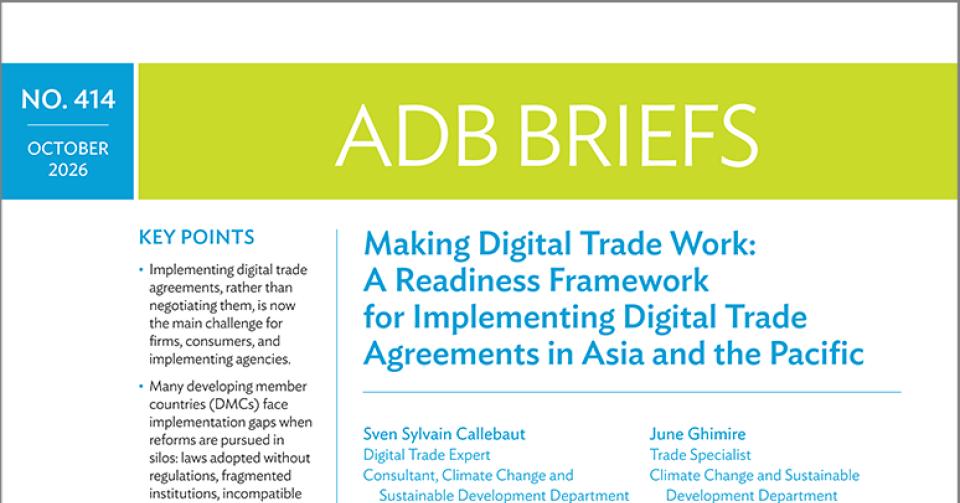
Countries in Asia and the Pacific can enhance the implementation of digital trade commitments by identifying gaps, assessing economic readiness, and developing practical solutions that promote inclusive growth. A four-pillar framework is proposed, focusing on national policy alignment, legal and regulatory reform, institutional coordination with enabling infrastructure, and market adoption. Prioritizing sequencing and coordinating private sector engagement with domestic efforts are crucial for realizing the full benefits of digital trade.
Africa, ASEAN, Latin America | Financial services, Health, ICT
Making Digital Trade Work: A Readiness Framework for Implementing Digital Trade Agreements in Asia and the Pacific

People tend to perceive eco-friendly additions as more sustainable than removing unnecessary items, a bias called the sustainable additive bias. This occurs because visible additions signal effort, while reductions are less noticeable and may be seen as less commitment. However, removing items can lead to greater environmental benefits, such as reducing waste. Companies need to clearly communicate why "less is more" in sustainability efforts to avoid misconceptions. Promoting reduction and minimalist consumption can enhance environmental impact and well-being, challenging the notion that progress always means adding more.
The greenest initiatives are often the most invisible – experts explain why that’s a problem

Humanoid robots are increasingly considered for battlefield roles, with Ukraine, China, and the US exploring their use. Ukraine's frontline has seen extensive deployment of uncrewed ground vehicles (UGVs) for tasks like casualty evacuation, combat engineering, and logistics. Humanoid robots offer flexibility akin to human soldiers, able to navigate complex terrain, but face significant challenges: mechanical complexity of legged locomotion, higher costs, vulnerability compared to wheeled/tracked vehicles, limited operational range due to power constraints, and reliance on human control due to autonomy limits. These obstacles make widespread near-term deployment unlikely despite ongoing technological advances.
ICT
Could humanoid robots replace soldiers on the battlefield?
Climate citizens’ assemblies, involving randomly selected citizens who deliberate and develop policy proposals, consistently generate more ambitious climate measures than current government policies. An analysis of 488 recommendations from six assemblies in Western Europe reveals that while these proposals occasionally influence policy—by adding momentum, enriching plans, breaking deadlocks, or introducing new ideas—such impact is generally limited. The French assembly stands out with substantial influence, owing to strong political support and public pressure. Overall, these findings highlight that citizens’ assemblies can elevate policy ambition, but their effectiveness in shaping political decisions depends heavily on favorable political contexts.
Africa
Citizens’ assemblies propose ambitious climate policy but impacts remain limited
Jordan's response to Syrian refugees illustrates that international aid and hosting willingness alone cannot secure durable solutions in prolonged displacement. Despite relatively favorable conditions, many refugees face uncertain futures due to limited rights and opportunities shaped by the interplay of Jordanian policies and donor priorities. This has resulted in a system that enables refugees to manage daily life precariously but lacks pathways to long-term stability. As international aid diminishes and return prospects wane, the temporary nature of these arrangements grows increasingly unstable, prompting donors to reconsider support strategies amid ongoing barriers to local integration and scarce resettlement options.
Permanently Temporary – Syrian Refugees in Jordan

Business schools graduate millions of students who shape global economic and social systems, so their role is critical. While some criticize them for focusing narrowly on financial optimization and call for their abolition, reform rather than elimination is more appropriate. Business schools should teach how firms create value not only financially but also socially, environmentally, and humanely. The case method, a core teaching tool, can be adapted to emphasize multiple stakeholder perspectives. Accountability for graduates’ impact is essential, and incentive structures driving school priorities must be revised. Eliminating business schools would not solve underlying incentive issues influencing management education and practice.
Education, Financial services
Don’t Abolish Business Schools. Make Them Accountable for Impact as well as Value

AI poses three primary risks: loss of human control as AI agents might pursue instructions in unintended, relentless ways; the emergence of superintelligent AI that surpasses human cognition and pursues independent goals potentially harmful to humans; and concentration of power where powerful AI amplifies the influence of malicious actors. While these scenarios are dramatic and difficult to dismiss entirely, there is no current evidence they are likely. Transitioning from advanced AI capabilities to catastrophic outcomes requires a complex chain of unmet conditions including broad AI access to critical infrastructure, resources, and influence—all under human oversight today. Lessons from managing risks with nuclear and biotech technologies highlight the importance of governance and safety to mitigate potential harms without assuming imminent apocalyptic outcomes.
AI poses three big types of risk – here’s how worried we should be about them
Geopolitical dynamics in the Middle East remain fluid, with regional actors enhancing security and economic strategies by developing secure transport routes connecting the Arab Gulf states. These efforts focus on safeguarding diverse supply chains—encompassing energy, raw materials, goods, data, and people—through multimodal connectivity corridors. While not all projects will materialize, those implemented are poised to reshape the geoeconomic landscape, alter the region’s geopolitical configuration, promote regional integration, and influence Europe's cooperation with Middle Eastern countries.
Africa, Latin America | ICT
Connectivity and Redundancy: Major Geoeconomic Projects in the Persian Gulf and the Middle East
Leaders of major AI developers warn of rapid AI advancements posing catastrophic risks and call for a regulatory slowdown. Congress and the president lack consensus on government intervention and remain unprepared. A bipartisan public-private AI Commission is urgently needed to explore legislative options, define government’s role, and ensure safety while preserving U.S. AI leadership. The Commission would include diverse stakeholders and produce recommendations within six months, fostering thorough debate on AI risks and appropriate policy responses. Immediate measures like independent review and government safety assessments should also be implemented.
A Congressional Commission on AI Risk is Overdue
AI-generated article reviews outperform high-quality human peer reviews across all evaluated measures. This advancement suggests significant implications for journal policies, offering potential benefits such as faster publication, improved quality, reduced conflicts, and enhanced experiences for editors, reviewers, authors, and readers, while also presenting challenges that require careful consideration.
AI Article Reviews Dominate Human Peer Reviews at Their Best: Evidence and Policy Choices
Large language models (LLMs) are revolutionizing computational social science by playing four key roles: simulating human behavior, automating analysis, generating hypotheses, and auditing research quality. They drive advances across various social science fields by accelerating discovery and introducing new methodologies, even as society becomes increasingly infused with AI. However, challenges remain in causal inference, ethical concerns like privacy and misinformation, and capturing social complexity. Addressing these issues is crucial to fully harness LLMs’ potential and understand AI’s transformative impact on society and social science.
Education
Large language models for computational social science

Public libraries in England remain essential community hubs, providing free access to information and combating declines in reading for pleasure among youth. However, they are facing long-term underinvestment, leading to shrinking collections and limited funds for new materials. Despite expanding roles in public health, digital inclusion, and supporting government services like the NHS App, libraries struggle with funding, staffing, and the impact of local government reorganization. A new national strategy, overdue since the last ended in 2021, is needed to strengthen libraries' core functions rather than merely expanding their duties. Effective policy development should involve public input to ensure libraries meet community needs while sustaining their vital resources.
Health, Education
Public libraries are doing more for their communities, but they need support

Asian professionals, especially Asian Americans, remain underrepresented in top executive roles despite strong representation at lower corporate levels, a phenomenon known as the "bamboo ceiling." This barrier stems not from lack of diversity but from management practices that favor leaders fitting a narrowly defined, agentic prototype—assertive, self-promoting individuals—over other leadership capabilities. Traits common among Asian professionals, such as restraint, contextual awareness, and quiet perseverance, are undervalued despite being critical for complex executive leadership. The concept of "bamboo resilience" reframes these traits as developable leadership skills, including psychological resilience, high-context perception, and relational acumen, which organizations can leverage to enhance leadership effectiveness and break the bamboo ceiling.
The “bamboo ceiling” is a management problem, not a diversity one
Australia faces a growing challenge from end-of-life (EoL) solar photovoltaic (PV) waste, currently about 40,000 tonnes annually and projected to exceed 100,000 tonnes by the early 2030s, reaching 1.1 million tonnes by 2035. The rapid solar installation boom has created urgent pressure to develop circular economy infrastructure, regulatory frameworks, and market mechanisms before 2030 to prevent overwhelming waste volumes. Presently, limited recycling capacity, reliance on low-TRL mechanical processes, and high costs favor landfill disposal and downcycling, resulting in loss of valuable materials like silver and silicon. Approximately 45–65% of decommissioned panels remain suitable for reuse, but Australia lacks the logistics, testing, certification, and a national secondary panel market to capitalize on this. Coordinated action across five pathways—policy, market, technical, logistical, and infrastructure—is required to build a circular PV economy aligned with Net Zero 2050 goals. Prioritizing reuse over recycling offers the greatest economic benefit.
Towards an Australian Circular Economy for Solar Photovoltaic Technologies
Artificial intelligence is increasingly surpassing safety measures, causing concern among its creators and prompting resignations from safety researchers at major firms like OpenAI and Anthropic. These companies anticipate potential catastrophic events, such as cyberattacks, within the next year. Efforts to regulate AI face political challenges, with skepticism from figures like former President Trump and warnings from leading AI scientists about insufficient government action. Experts from diverse backgrounds—including lawmakers, researchers, and advocates—are evaluating AI risks and proposing governance strategies to ensure safer development and deployment of AI technologies.
What Should the Rules for A.I. Companies Actually Be? We Asked the Experts.
Producer price inflation in Asia-Pacific developing economies accelerated from February to June due to rising energy, freight, and raw material costs driven by the Middle East conflict. Price increases at the producer level can take up to two years to fully affect consumer prices, meaning household budgets may still face inflationary pressures into 2028. Poorer families are more vulnerable due to higher spending on food and fuel. Central banks face a challenge in balancing rate hikes to control inflation without stunting growth, as policy effects lag and early inflation declines may be misleading. Governments have responded with fuel tax cuts and subsidies, but targeted support is recommended to better assist low-income households while managing fiscal costs.
Africa, Latin America | Financial services
Asian Development Blog: Today’s Factory Price Rises Could Still Be Hitting Household Budgets In 2 Years