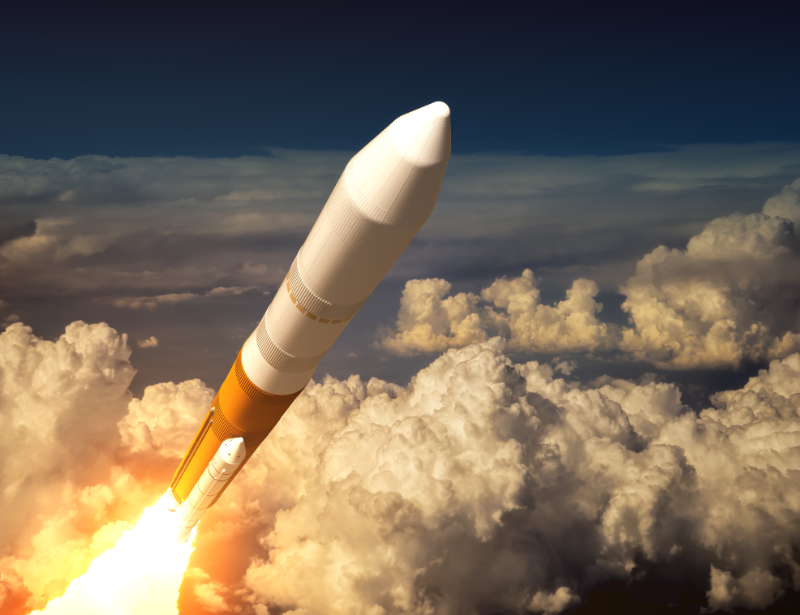
The South African National Space Agency (SANSA) successfully launched a payload from the newly commissioned rocket gantry at Denel Overberg Test Range, marking a major milestone in the nation’s suborbital launch capabilities. This infrastructure provides a foundation for expanding into sounding rocket missions. Additionally, the University of KwaZulu-Natal (UKZN) secured a grant to develop 3D-printed metal components specifically for suborbital rocket propulsion systems, as part of the South African Future Integrated Rocket Engine (SAFFIRE) programme.
Prerequisites:
• Institutional & political interest and support for access to space
• Technical and engineering capabilities for manufacturing launchers
• Ground infrastructure (engine test stands, labs, propellant facilities, AIT facilities, clean rooms, etc.)
• Suitable space for launches, ideally a coastal or desert location with clear range over uninhabited areas and testing and range facilities (or agreements to use partner facilities)
• Clear regulatory framework for launch licensing, safety, and liability
• Export-control compliance, insurance, and mission assurance processes
• Partnerships with experienced launch providers
Cost:
• Ballpark: (academic/amateur development) USD 10K-100K, (procurement or basic national development) USD 1M–10M
• Includes: procurement of sounding rockets from international providers or kits, development of small-scale national R&D rockets, design of payloads, integration and safety testing, launch services, training and capacity building
Timeframe:
• Overall: 12–36 mo
• Phase: partnership agreements and training (6–12 mo), design or procurement of rockets (6–12 mo), launches and experimentation (6–12 mo)
Pros:
• National Capability - Boosts independent space launch capability
• STEM Development - Promotes science and engineering education and skills
• Research & Innovation - Enables atmospheric, microgravity, and astrophysics experiments
• Regional Leadership - Positions South Africa as a hub for African suborbital launches
• Economic Opportunities - Opens doors for space tourism, tech spin-offs, and international cooperation
Considerations:
• High Initial Investment - Substantial upfront R&D and infrastructure costs
• Limited Market - Sounding rockets have niche use cases compared to orbital rockets
• Risk of Failure - High technical risk, especially in early phases
• Maintenance and Sustainability - Ongoing costs for facilities and skilled staff