Financial Education Resource Hub

The resource hub is an interactive online tool that provides a one-stop shop for global best practices, research, and already implemented or piloted solutions on financial education.

Money is a daily necessity, yet only one in three adults worldwide is considered financially literate.

From planning for retirement, to deciphering a credit card bill, or navigating a new fintech app, individuals make hundreds of decisions per day, many with financial consequences.  

The resource hub aims to help individuals, businesses, academics, and policymakers improve the accessibility and quality of financial education globally. It highlights best practices, research, and innovative programs from around the world.

Financial Education Across Life's Stages

Importance of financial education in  schools, workforce, and retirement.

Adaptable and Accessible Content For All

Inclusive and nuanced financial education that adapts to individuals' unique financial goals and meet people where they are.

A Tool For Economic Stability

Financial education can serve as a critical backbone to macro stability; resilient individuals power resilient economies.

Description of program:The Richmond Project commissioned Number Nation, the largest ever research study into numeracy in the UK, in 2025The work surveyed 10,000 people, including children from aged 4, and covered a range of topics. It probed respondents’ attitudes to numbers and number confidence, but also tested their number competence and financial literacyThe first report profiled number confidence and competence in the UK in detail, finding that almost 6 in 10 struggled with numbers – and that certain socioeconomic groups, age groups and women were all likely to struggle mostThis report is the second publication, the Spotlight on Financial Literacy, which looks at this important topic in more detailTo test financial literacy, the survey asked ‘The Big Three’ questions, co-authored by Professors Annamaria Lusardi and Olivia Mitchell, which have been used to test financial literacy levels in countries around the world for multiple decades. The report situates the UK’s financial literacy levels in context vs. peersAdditionally, The Richmond Project worked with Boston Consulting Group (BCG) to develop a view on best practice in financial education; not only the “what”, i.e. the content of the curriculum, but also the “how”, i.e. the most effective teaching methodologiesBenefit/impact:The report found that almost four in ten adults in the UK could answer only one or none of ‘The Big Three’ questions (on compounding, inflation and risk diversification) accurately. The UK lags most peers on this, including Germany, the Netherlands, Switzerland, Australia and Canada to name a fewIt also identified that the UK has the second largest financial literacy gender gap in the OECD; the gap starts wide even in adolescence and is over 20 percentage points by 45The report also evidenced a strong link to core numeracy skills: 82% of people who perform poorly in financial literacy also perform poorly in mathsOnly 38% of those with very poor financial literacy could raise £1,500 for an unexpected expense within a month, compared with 81% of those with very good financial literacyLooking at education best practice, the UK was benchmarked against over 20 countries, with over a dozen case studies from places including the US, Canada, India, Brazil and Singapore, several of them central banks.
United Kingdom
Number Nation
The Richmond Project
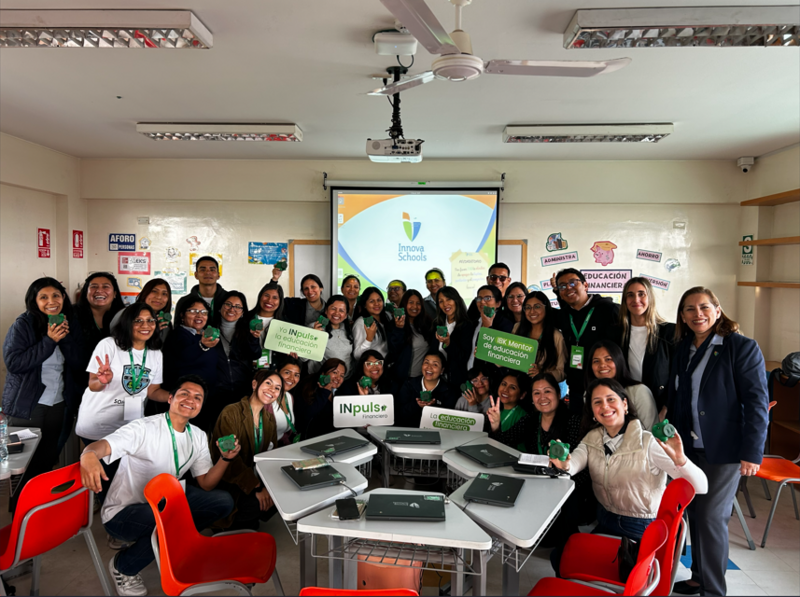
Description of ProgramINpulso Financiero is a financial education program developed by Interbank and Innova Schools to integrate financial education into the core academic curriculum of schools in Peru. Inspired by Interbank's mission, “We are side by side with Peruvians so they can reach their dreams, today,” the program seeks to equip students with the knowledge, skills, and confidence needed to make informed financial decisions and achieve their personal goals.The program involves the design and progressive implementation of a comprehensive financial education curriculum within the Innova Schools network, which comprises 82 schools and serves more than 76,000 students. Through a multi-year rollout, financial education is being embedded into the regular secondary school curriculum, beginning with 9th grade. INpulso Financiero combines curriculum development, classroom instruction, teacher training, and employee volunteering to deliver practical and engaging financial education. Using a train-the-trainer model, Interbank employee volunteers support and strengthen teachers' capabilities, enabling them to effectively deliver financial education as part of their regular teaching activities. The pilot phase launched in 2025 and reached more than 150 participants, including employee volunteers, teachers, and students, laying the foundation for the program's integration into the school curriculum at scale.Benefit/ImpactThe program translated financial knowledge into action among participating teachers, with 85% reporting concrete financial commitments such as setting savings goals or creating monthly budgets, and 95% indicating they felt prepared to deliver financial education content in the classroom. Students who participated in the pilot phase strengthened their personal finance knowledge, with all participants consolidating key financial concepts and 80% reporting that they felt ready to act as financial ambassadors within their school communities. Beyond improving financial capability, the program has established a scalable model for embedding financial education into the formal school curriculum, ensuring that financial literacy becomes part of students' learning experience throughout secondary education while helping them connect financial decision-making with their personal goals and long-term well-being. INpulso Financiero has demonstrated its potential for scale across the network. In 2026, the program expanded to more than 700 9th-grade students and will continue to grow as additional cohorts and grade levels incorporate the financial education curriculum into their academic programs. 
South America
INpulso Financiero by Interbank and Innova Schools

Interbank, Innova Schools
Description of program:Xare is a UAE-based (Dubai) fintech founded in January 2021 by Padmini Gupta, building on her earlier startup Rise. It began as a platform allowing foreign workers to eliminate remittance fees by sharing real-time access to their bank accounts and credit cards with family and friends.Xare began because financial products are traditionally designed for income earners; roughly two-thirds of the world's population does not have a regular income and instead depends on those with regular incomes for financial access. Xare addresses this gap by letting income earners create, share, distribute, and manage financial resources with dependents.Users can set daily or monthly spending limits for recipients, extend short-term credit through card sharing, set up expense accounts, or send money to children without exposing full account details.Benefit/impact:Xare has grown to over 3 million users across 170+ countries. It helps turn income earners into personal banks for their dependents, creating a new network of banks and redefining financial sharing. The platform aims to share with migrants and non-income earners critical financial services like a bank account, insurance products, investment tools and buy now pay later. Access to financial products can support financial inclusion for underbanked and unbanked individuals, support spending and saving habits, as well as facilitate usage of cost-effective, safer debt products, rather than payday loans. 
Middle East & North Africa
Xare
Xare
Description of program:PensionBee was formed in 2014 with the aim of making pensions simple for every saver. It listed on the London Stock Exchange main market in April 2021 under the ticker PBEE.Rather than asking customers to pick individual investments, PensionBee offers a range of tailored plans managed by asset managers including BlackRock, State Street Investment Management, and HSBC, letting customers choose a plan matched to their risk tolerance and values.Plans span risk levels from a cautious "Preserve" fund to a socially responsible "Climate" option, with annual fees between 0.50% and 0.95% for pots under £100,000.PensionBee's core service is consolidating old workplace and personal pensions that individuals have lost track of over time.Benefit/impact:Self-employed pension savers who contribute small amounts frequently accumulate 340% more annually than those making large, irregular deposits, averaging £7,760 per year compared to £1,763 for low-frequency savers. PensionBee's products support self-employed savers in building retirement savings, with no minimum contribution amounts.As of Q2 2026, PensionBee has approximately 327,000 invested customers and £8.6 billion in assets under administration.Each customer is assigned a named UK-based personal account manager ("BeeKeeper"), who they can contact by phone, email, and live chat, with the goal of having strong support on their pension and savings journey. 
North America, Europe
PensionBee
PensionBee
Description of program:Financial education can improve what people know without reliably changing what they do. This paper examines that 'knowing–doing' gap through neuroscience, psychology and behavioural economics.It identifies three interconnected influences on financial behaviour: stress and scarcity, shame-driven avoidance, and ingrained habits.Financial pressure can impair the cognitive resources needed for effective decision-making, while shame can discourage engagement and help-seeking.Automatic habits can override conscious intentions, even among financially knowledgeable and capable individuals. These challenges extend across income levels and educational backgrounds.Drawing on international research, the paper challenges the assumption that financial difficulties stem primarily from insufficient knowledge or discipline. It argues for a fundamental shift from simply transferring financial knowledge to supporting sustainable financial behaviour change.Benefit/impact:The paper offers policymakers, educators, financial institutions and employers a new lens for understanding why conventional financial education often falls short. It identifies practical principles for more effective interventions: reducing barriers, supporting decisions at critical moments, and enabling sustained habit formation.By recognising the influence of emotion, cognition and context, it encourages more inclusive, personalised and non-judgemental approaches to enabling financial capability.It provides an evidence-based foundation for designing and evaluating interventions that help people translate financial knowledge into meaningful action.
United Kingdom
Research Paper: Why Smart People Make Bad Money Decisions

Saïd Business School, University of Oxford
Description of program:GoHenry is a financial education company with a prepaid debit card and app for children and teens (ages 6-18), built around "Money Missions". These “Money Missions” are in-app gamified lessons covering money basics, earning, saving, investing, responsible spending, credit, and money safety, developed with teachers and financial experts. Families and schools can now access over 80 of GoHenry's Money Missions videos on YouTube for free here - helping facilitate important money conversations at home or in the classroom.Lessons are tailored by age and confidence level, moving from money basics for younger children to budgeting and credit-score topics, then advanced lessons on mortgages and investing for teens.Benefit/impact:GoHenry partnered with the University of St Andrews, with collaborators from Durham and Texas A&M, on research that found that Money Missions helped children increase their savings by 30% after the first month and continue to save 10% more in the next three months.Since GoHenry launched in 2012 it has helped over 2 million young people build money skills in the UK alone. Research from GoHenry demonstrates that if every child in the UK was taught key skills on investing, it could add £53.5bn to the UK economy every single year and drive the creation of 1.3 million new businesses and 820,000 new jobs. GoHenry was part of a successful campaign to make financial education compulsory in primary schools in England starting September 2028.
Europe, North America
GoHenry
GoHenry
Description of research:Equity is a facilitator-led financial literacy workshop built around a serious board game to support experiential learning around core personal finance concepts.Through gameplay, participants engage with everyday money decisions (income, budgeting, saving, debt and risk/insurance) and explore responsible investing concepts in a structured, low-risk setting.Equity combines a physical board game with structured facilitation to encourage discussion, reflection, and practical understanding of financial decision-making.The learning design is inspired by the 1976 serious game Bourse: Le Jeu de la Finance developed by economist Bertrand Jacquillat.Benefits/Impact:Many individuals receive limited formal education on personal finance, creating gaps in confidence and understanding when making financial decisions. Equity addresses this gap through a learning-by-doing approach that makes complex financial concepts more accessible and engaging.The workshop has engaged over 1,000 learners across different countries and educational contexts, including schools and professional settings.Facilitated gameplay and discussion help participants understand financial trade-offs and consequences in a safe, interactive environment.Equity equips educators and organisations with a ready-to-deliver, facilitated module for foundational financial capability and responsible decision-making.
Global
Equity The Board Game
Equity
Description of program:The Money Health Collective is a global, volunteer-led virtual community where people from diverse backgrounds participate in facilitated “money conversations” to openly discuss money and learn from one another.It is designed to complement traditional financial education by addressing the emotional and relational dimensions of money through peer learning and guided reflection.The community provides a psychologically safe space for individuals to speak candidly about financial challenges, learn from others in different financial situations, and access tools to help them navigate their financial journeys. In doing so, it helps reduce stigma around money while strengthening social connections.Benefit/Impact:Engages individuals from all walks of life to share and learn from each other’s financial experiences and participate in exercises to learn about managing money.Empower individuals to feel more confident in their financial decision making and meet individuals in different financial situations than their won.Supports individuals to reduce their anxiety around money and creates a wide network of individuals who are open to speaking about money.
North America
Money Health Collective

Description of research:Pocket Money from Danske Bank is a digital solution for children aged 8-12 to learn how to spend and save money with guidance from their parents. It includes an app and a card that enables parents to give their children pocket money digitally.The solution offers apps for both parents and children. Children can track their savings and spending in an interface designed for them. Parents, through their mobile banking app, can transfer money to their children and monitor their spending and saving.Children use their pocket money via the card linked to the app. Pocket Money aims to spark conversations between children and parents about personal finances.Benefits/Impact:Seven out of ten parents in Denmark give their children pocket money, averaging 137 DKK per month. In an increasingly cashless society, this digital solution helps parents track spending habits and introduces children to digital financial services early.Half of parents primarily give pocket money to teach financial responsibility or the value of earning money. Pocket Money supports children in building smart spending and saving habits from an early age.Learning by doing is proven to be an effective way to teach personal finance and foster responsible behaviour. Pocket Money helps initiate open conversations on saving and spending and equips children with skills to manage their finances in the future.
Europe
Pocket Money
Danske Bank
Description of research:Of the 1.3 billion adults who remain unbanked worldwide, the largest proportion lives in Sub-Saharan Africa, where financial exclusion continues to limit economic opportunity and resilience.Lack of access to financial services is a significant barrier to economic growth and social mobility. Financial services can enable opportunities for savings, investment, and financial protection.Financial inclusion focuses on lowering systemic barriers and supporting underserved communities so they are more resilient during economic shocks and can participate in the formal economy.This research explores the technology, governments, financial institutions, and fintech companies collaborating to create more inclusive financial ecosystems, specifically exploring the role of open-source software and instant payment systems.Benefits/Impact:Bridging the Financial Divide: An Open-Source Solution to Inclusion explores the role of open-source software in fostering interoperable payment systems. The Mojaloop open-source payment platform enables real-time, low-cost transactions between banks, mobile money services, and microfinance institutions. This platform creates a digital infrastructure that reduces transaction costs and facilitates access to financial services for millions of people who may have been previously excluded. 
Africa
Financial inclusion in practice: Insights from Africa

University of Oxford
Description of research:Planet Money Summer School is a free, recurring educational audio series that makes economics and finance engaging and accessible to everyone.Launched in 2020, the series breaks down core topics, including personal finance, macroeconomics, investing, and political economy, into story-driven, “mini-MBA”-style lessons.Episodes feature engaging storytelling, real-world examples, and interviews with experts to simplify complex concepts.Companion resources include downloadable notes, quizzes, a Tiktok cheat sheet, and practical guides, allowing listeners to deepen their learning beyond the podcast episodes.The 2024–2025 season focuses on political economy, helping listeners understand the relationship between financial systems and governance.Benefits/Impact:Breaks down barriers to financial education through free, mobile-first content available worldwide.Uses storytelling to engage diverse audiences, making learning enjoyable and relevant, and scales easily to reach millions of listeners.Reinforces financial literacy by connecting concepts to real-life decisions, empowering listeners to take actionable steps in budgeting, investing, and policy awareness.The series has a wide reach and serves as a resource to teachers. For example, the Federal Reserve Bank of St Louis uses the lessons and distributes them to high school and college economics teachers.
North America
Planet Money Summer School

National Public Radio
Description of research: Daiwa Securities Group runs multi-generational financial literacy programs to improve public understanding of investing and household finance. Its approach blends school-based education, hands-on learning, and digital content to build lifelong financial capability. Youth education: On-site school classes, original teaching materials, and workplace tours. Experiential programs: KidZania “securities pavilions” and Junior Achievement’s Finance Park provide interactive, role-based financial learning. Media and outreach: Nationwide seminars and digital resources expand access for adults and first-time investors. Benefit/Impact: Hands-on experiences like KidZania and Finance Park give students a realistic understanding of financial decision-making, such as budgeting, saving, and investing. Accessible seminars and online tools help adults and novice investors gain confidence in navigating financial products and managing household finances. Programs are delivered across Japan, ensuring resources reach diverse communities, including those with limited prior exposure to financial education. By targeting both youth and adults, the initiative creates a ripple effect, fostering informed financial behaviors within families and communities. Measurable KPIs, such as the 2.5M participant target, provide transparency and demonstrate impact at scale, supporting long-term program sustainability.
Asia
Daiwa Securities Group — Financial Education & Research

Daiwa Securities Group
Description of research: In 2016, a large-scale school-based financial education program launched in Peru to equip high school students in urban areas with vital money management skills. Financial education lessons were delivered during the regular school day, seamlessly integrated into one existing course. The program produced significant improvements in financial literacy among participating students. Compared to the control group, the treatment group achieved notably higher scores on financial literacy assessments. Remarkably, the study also uncovered a powerful ripple effect: students’ learning positively influenced their parents’ financial behaviors. Among 20,000 students and 10,000 parents studied, the study finds sizable effects on parental financial behavior within disadvantaged households. The financial literacy lessons reduce default probability by 26%, increase credit scores by 5%, and increase current debt levels by 40% among poorer households. Benefit/Impact: Demonstrates how school-based financial education can extend beyond the classroom, improving financial well-being at the household level. Offers evidence-based insights for policymakers, showing that empowering youth can be a cost-effective and scalable strategy for driving financial literacy and inclusion. Addresses barriers to adult education, such as limited time and resources, by using children as natural educators within their families and communities. 
South America
Spillover Effects of Financial Education: The Impact of School-Based Programs on Parents

Development Bank of Latin America (CAF)
Description of research:  Since 2013, CAF has implemented Financial Capabilities Surveys in 11 countries: Argentina (2017), Bolivia (2013), Brazil (2020), Chile (2016, 2023), Colombia (2013, 2019), Costa Rica (2023), Ecuador (2013, 2020), Panama (2022), Paraguay (2017, 2022), Peru (2013, 2019, 2022), and Uruguay (2022).The survey follows the OECD/INFE methodology, enabling a unified framework, enabling comparability within the region and with other OECD countries.Based on the results, CAF has built indexes on financial inclusion, financial capabilities, digital financial literacy, and financial well-being. The CAF Financial Capabilities Database includes more than 400 indicators to analyze financial inclusion, access and use of savings, investment, retirement, insurance, credit and payment products, knowledge, behaviors and attitudes that enable sound financial decisions and achieve financial wellbeing, it also incorporates emerging dimensions such as trust in digital financial services, use of digital platforms, and behaviors linked to Open Finance schemes.CAF also provides an interactive dashboard with socio-demographic breakdowns and downloadable datasets, enabling researchers and policymakers to analyze and reuse the evidence.Benefits/impact: Policy and Regulation: Serves as a key input for designing, implementing, and monitoring national financial inclusion and education strategies and policies, supporting evidence-based decision-making for regulators and public authorities.Knowledge Generation: Provides a robust data foundation for independent researchers and academic institutions to investigate and generate insights that improve financial inclusion, literacy, and well-being across the region.CAF’s Operations: Enables CAF to identify population segments with the largest gaps and develop targeted financial education and financial inclusion projects, enhancing social development and resilience in underserved populations.
South America
CAF - Financial Capabilities Surveys

Development Bank of Latin America (CAF)
Description of research: The Big Three and Big Five are sets of standardized financial literacy questions developed by Global Financial Literacy Excellence Center (GFLEC) with a team of academic collaborators to measure individuals’ understanding of fundamental financial concepts. Big Three: Focus on interest rates, inflation, and risk diversification. Big Five: Expand on the Big Three by including mortgages and bond pricing concepts. These questions and, in particular the Big Three, are used globally to assess baseline financial literacy and to support research on financial decision-making and policy design.  Benefits/Impact: Establishes a consistent, comparable benchmark for measuring financial literacy across diverse countries and populations that remains consistent and applicable over time.  Equips researchers and policymakers with the insights needed to pinpoint knowledge gaps and design targeted, effective financial education programs. Proven and influential, having already been integrated into many national surveys in the US and around the world, including the U.S. National Financial Capability Study and the Survey of Consumer Finances and global studies such as the S&P Global Financial Literacy Survey, shaping strategies that advance financial well-being and contribute to long-term economic stability. 
Global
The Big Three and the Big Five

Stanford University
Description of research: Bolsa Família is Brazil’s flagship conditional cash transfer (CCT) program, designed to reduce poverty while promoting human capital development.  By providing stable, regular cash transfers to low-income households, contingent upon meeting health and education requirements, such as school attendance and vaccination, the program strengthens both short-term financial stability and long-term opportunities for children. The program’s structure demonstrates how integrating income support with behavioral incentives can create meaningful improvements in health, education, and overall well-being; it also offers an operational platform to reach Brazil’s poorest families possibly providing an avenue for financial education as well.  Bolsa Família has become a model for how social protection initiatives can strategically combine financial support with human-capital development goals. Benefit/Impact: Improves long-term welfare by linking income stability to education and health outcomes. Offers a scalable and adaptable social protection framework, inspiring similar programs in other countries. Reached over 20 million households, and more than 60 million people, with the dual goal of reducing current poverty and incentivizing families to invest in their children, aiming to break the cycle of intergenerational poverty.Lays the groundwork for enhancing financial literacy, saving, and responsible borrowing behaviours among low-income households. However, research demonstrates that Bolsa Familia recipients face systematic or structural barriers in accessing financial services, including insurance, credit, and savings accounts.
South America
Bolsa Família
Brazil Government
Description of research:Aflatoun International develops age-progressive social and financial education programs for children and young adults aged 3–24. Programs are delivered in 45+ languages and adapted to local cultural and economic contexts. The four core curricula include: AflaTot (early childhood, ages 3–6) AflaToun (primary school, ages 6–14) AflaTeen (adolescents, ages 14–18) AflaYouth (young adults, ages 18–24) Topics include financial decision-making, entrepreneurship, employability skills, green literacy, and digital literacy. Curriculum delivery relies on local NGOs, schools, and government partnerships (Ministries of Education and Central Banks), creating a global network of educators. Programs are backed by impact evaluations, showing improvements in children’s financial skills, self-confidence, and entrepreneurial thinking. Benefit/Impact: In depth research and impact measurement on Aflatoun programs provides policymakers, NGOs, educators, and other local and global partners to assess effective financial education curriculum and programs.  Provides inclusive, scalable education that reaches vulnerable and out-of-school youth. Equips young people with the tools to navigate financial challenges, has reached 42.4 million children and young people through national integration, has reached 2.8 million children in 2024 through the partner network, and is in 110+ countries, and with over 400 partners.  Demonstrates the power of global collaboration to reduce inequalities and promote economic resilience, combining both financial and social education with the goal of youth empowerment and prosperity.  
Global
AflaTot, AflaToun, AflaTeen, and AflaYouth

Aflatoun, Child Social and Financial Education
Description of research:Population aging is a pressing issue both for developed and developing countries, especially in Asia.As aging populations grow, pension funds face increasing strain, and individuals bear greater responsibility to secure their financial future as they age.To support adequate savings for older individuals and to ensure retirement funds are used effectively, this paper proposes three policies: 1) Enhance financial literacy, 2) Improve the design of financial incentives to save for retirement and, 3) Facilitate the deaccumulation of wealth after retirement Benefit/Impact:Enhance Financial Literacy: Ensure equal access to financial education from a young age; strengthen coordination among educators, regulators, and financial institutions; and improve evaluation of school-based programs to deliver more effective interventions. Improve retirement incentives: Incorporate automatic enrolment and automatic contribution escalation in pension plans; and design financial incentives that are simple, stable, and easy to understand.Facilitate decumulation of wealth: Develop safe and actuarially fair financial products to help older adults manage drawdowns; make information on these products more accessible; and build institutional capacity to support elderly individuals with declining cognitive skills in making sound decisions. These policy proposals equip policymakers, financial institutions, academics, and other various stakeholders with actionable next steps to take to ensure that elderly populations have the tools and knowledge they need to retire with security and resilience.
Global, Asia
Policy, Innovation and Incentives to Address Population Aging

Asian Development Bank
Description of research:The TIAA Institute-GFLEC Personal Finance Index (P-Fin Index) is the most comprehensive annual barometer of financial literacy among U.S. adults, measuring knowledge and understanding across eight common financial activities: earning, consuming, saving, investing, borrowing, insuring, understanding risk and gathering information.  The 2025 report found that only 49% of U.S. adults correctly answered financial literacy questions, with women (45%) and younger individuals (38%) performing even lower. Comprehending risk is the functional area where adult financial literacy remains low, across groups, only 36% of questions were answered correctly in 2025.  The study has tracked financial literacy since 2017 creating comparable data year over year. The findings have found a clear link between financial literacy and financial well-being, with those with low levels of financial literacy 2x more likely to be debt-constrained, and 3x less likely to cope with a $2,000 financial shock.  Benefits/Impact:Provides policymakers, educators, and financial institutions with annual, data-driven insights that inform the design of targeted programs and policies to improve financial literacy, strengthen retirement readiness, and promote long-term household financial security in the United States. Pinpoints knowledge gaps across demographic groups with detailed breakdowns by age, race, gender to help ensure interventions are equitable and inclusive Establishes a trusted national benchmark for personal finance knowledge and preparedness, allowing year-over-year comparisons to help guide strategies that advance financial well-being for all Americans.

North America
2025 TIAA Institute-GFLEC Personal Finance Index
Teachers Insurance and Annuity Association (TIAA)
Description of research: MoneyAfrica provides a digital-first platform for financial literacy, designed specifically for African individuals, families, and businesses. The platform includes a wide variety of resources Courses and workshops on budgeting, investing, and debt management Articles and videos covering regional economic issues like inflation and foreign exchange  “MoneyAfrica Kids,” a specialized track for youth financial education The curriculum emphasizes localized and culturally relevant content, addressing the unique financial contexts of African economies. MoneyAfrica also supports SMEs and entrepreneurs through training modules that strengthen business financial management skills. Its digital-first model allows scalable access, reaching millions through mobile devices and online communities.Benefit/Impact: Expands financial literacy access across multiple demographics, from children to business owners. Builds stronger financial ecosystems by improving both individual and business decision-making and creates sustainable, long-term change through community-focused learning and peer support. Provides a blueprint for how digital tools can transform financial education on a continent-wide scale. 
Africa
MoneyAfrica Content Library
Money Africa

Strategic Approach

This resource hub draws on insights and strategies from the 23 members of the Global Future Council on Financial Education. 

Resources are organized using the Council's guiding principles: 1) Financial Education Across Life's Stages, 2) Adaptable and Accessible Content For All, and 3) A Tool For Economic Stability. 

Global Future Councils

A World Economic Forum Initiative