Solution: Design a public-private Coastal Adaptation Fund and property-linked levy mechanism, held within local authorities, that pays out to homeowners as coastal properties become uninhabitable and funds long-term adaptation rather than reactive disaster recovery.
Key challenge: Unlike flood risk, homeowners and businesses in coastal erosion zones cannot buy insurance against the loss of their property, so exposed communities face an intensifying protection gap with no financial safeguard while local authorities carry a growing coastal management deficit.
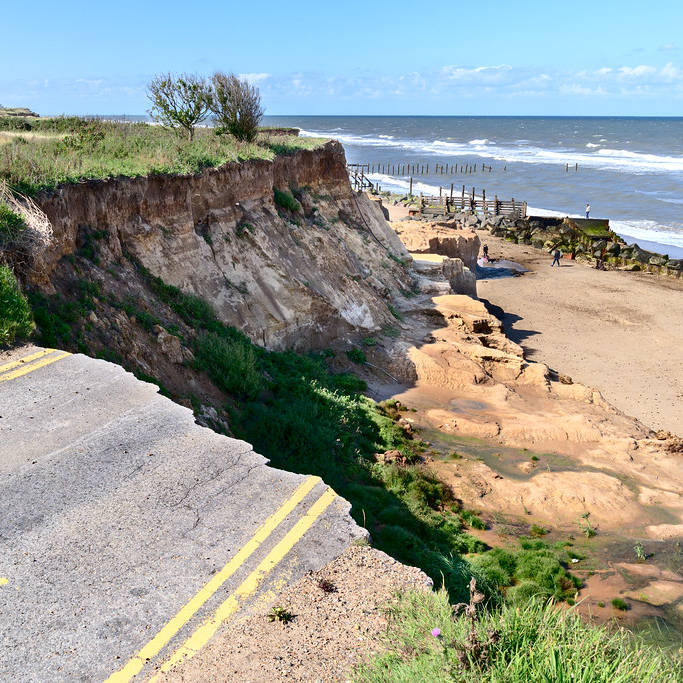
Context: About 1,500km of England's coastline is at risk of erosion, threatening communities, economies and infrastructure. The National Coastal Erosion Risk Management (NCERM) assessment shows that even with government coastal protection schemes, roughly 19,700 properties remain at risk by 2055 because of climate change; without ongoing investment the number exposed could exceed 100,000 by 2105. For many communities it is not technically, economically or environmentally practical to keep defending against erosion. Because erosion is excluded from property insurance, affected homeowners have no risk transfer route at all. The affected areas are rural and small coastal settlements along the Norfolk and Suffolk coast, among the fastest eroding in Europe, with over 2,500 homes at direct coastal risk. Defra, the Environment Agency and several local authorities led by East Suffolk Council commissioned a series of studies with Marsh to design innovative risk financing mechanisms that could offer additional fiscal support to authorities and communities exposed to erosion. The most recent is delivered through the Resilient Coasts Program, led by East Suffolk Council with delivery partner Great Yarmouth Borough Council, one of 25 pilots under Defra's GBP 200 million Flood and Coastal Innovation Program, running to 2027.
Solution in practice: Marsh first ran a scoping study to shortlist risk financing mechanisms against an appraisal framework covering national government priorities, alignment to local authority funding models, operational risk management approaches and financial viability. Two mechanisms were recommended: a Coastal Adaptation Fund (CAF), ring-fenced capital managed through local authorities to encourage public-private investment supporting exposed residential communities; and a levy model, property-linked financial products funded through a levy-style mechanism such as property insurance, designed to pay out once coastal properties become uninhabitable. Marsh then developed a target operating model for the CAF covering 173km of coastline in East Suffolk and Great Yarmouth, assessing fund structures, government administration responsibility, private investment opportunities, and payout designs that enable voluntary relocation and reduce erosion exposure. The fund is designed to finance long-term measures including shoreline management, property roll-back, nature-based coastal protection and sustainability-linked investment into carbon credits and biodiversity net gain. Technical analysis found that without the CAF, erosion costs to local authorities and homeowners could exceed GBP 100 million by 2100; pre-emptive direct-to-community payouts could save East Suffolk and Great Yarmouth GBP 10-20 million by 2100 against current-state disaster recovery costs; and long-term resilience interventions could generate GBP 13,000-21,000 per home per annum into the fund, creating recurring cash flow for ongoing coastal risk management.
Impact / outcome: Pre-emptive payouts could save GBP 10-20m by 2100; resilience interventions could generate GBP 13,000-21,000 per home a year into the fund.
Next steps: The Resilient Coasts Program is now looking to implement the Coastal Adaptation Fund, as there is strong evidence it will help achieve the strategic and operational objectives of East Suffolk and Great Yarmouth councils to address funding gaps, improve longer-term plans for community protection and develop improved financial resilience. Marsh's work has been shortlisted for the UK's national Flood and Coast roundtable, to improve visibility across national government, the Environment Agency and local authority senior leadership. The wider Resilient Coasts project, which runs to 2027, is continuing to: explore funding and financial mechanisms enabling those whose homes are likely to be lost in the immediate future to move in a planned way; work with infrastructure providers to understand and agree risk and develop robust investment plans to secure funding for the resilience of their assets and the communities they serve; and gather evidence to identify and influence policies that need to change to allow adaptation to take place, raised at government level through the Local Government Association Coastal Special Interest Group, All-Party Parliamentary Groups and key influencers.
Organizations involved:
Authoring: East Suffolk Council
Actors: Great Yarmouth Borough Council; Department for Environment, Food & Rural Affairs (Defra); Environment Agency; Marsh
Implementation partners: Local Governments; Regulators & Policymakers; Insurers; Investors & Banks; Civil Society Organizations