Solution: Apply catastrophe flood modelling under low- and high-emissions climate scenarios to quantify how flood defense standards of protection erode by 2040, and to test the cost-effectiveness of defense-strengthening versus complementary adaptations, informing investment decisions and the post-Flood Re insurance transition.
Key challenge: As climate change erodes the effectiveness of flood defenses over the Flood Re scheme's lifetime (ending 2039), cities face growing residual losses that defense investment alone cannot fully offset — requiring evidence-based prioritization of defense upgrades alongside complementary measures before the transition to risk-reflective pricing.
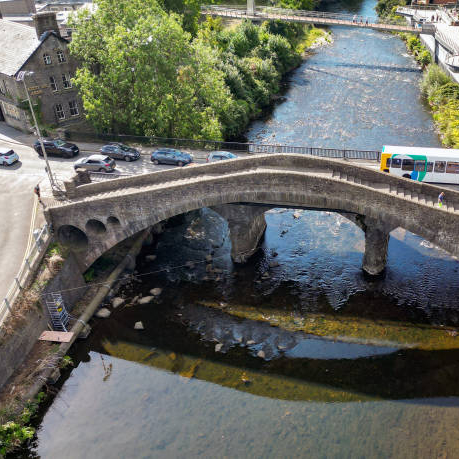
Context: York (population ~200,000) and Pontypridd (population ~30,000) are two urban UK communities with different flood defense standards: York is largely protected to a 100-year return period, while Pontypridd ranges from 25 to 100 years. Pontypridd was severely flooded during Storm Dennis in 2020, with more than 150 properties inundated to depths of up to 1.8 meters. The study models a 1-in-50-year flood scenario in 2040 — the year after the Flood Re scheme ends — under both low-emissions (RCP 2.6) and high-emissions (RCP 8.5) climate pathways, with existing defenses as a baseline.
Solution in practice: Moody's applied the RMS UK Inland Flood HD Model and UK Inland Flood HD Climate Change Model to York and Pontypridd. Under the chosen flood scenario, climate change by 2040 produces £11m–£20m of additional losses for York and £8m–£17m for Pontypridd. The study tested two defense-strengthening scenarios (50% and 100% increase in standard of protection): a 50% SoP increase yields the greatest loss reduction for both cities because even the largest embankments cannot protect against surface water flooding. For Pontypridd under RCP 2.6, a 50% SoP increase reduces losses by £14m, while a further 100% increase adds only £5.5m more in reduction. The study concludes that defense investment is cost-effective only to a point, and that property-level flood resilience and surface water management are also necessary for a successful 2039 transition.
Impact / outcome: A 50% increase in defense standard gives the biggest loss reduction (e.g. GBP 14m in Pontypridd under RCP 2.6); further increases add little.
Next steps: Apply this defense-performance modelling framework across additional high-risk UK communities to build the evidence base for prioritizing defense investment and complementary adaptations ahead of Flood Re's 2039 wind-down. Findings may be used to advocate for integrated resilience standards that link quantified defense performance to insurance affordability outcomes, such as the new piloted Flood Protection Certificate, and to demonstrate the value of catastrophe modelling as a planning tool for government flood risk programs.
Organizations involved:
Authoring: Moody's RMS; Flood Re
Implementation partners: Data Providers; Insurers; Regulators & Policymakers; Local Governments