Description financing model: Intermediated Financing Facility
Commercial capital is channeled through a facility that extends loans to farmers. These facilities often pool funding from both commercial and catalytic sources, enabling greater scale while balancing risk and return
Applicability: Well-suited for a range of asset owners (e.g., pension funds, institutional investors) who seek to support farmer financing without direct engagement
Considerations: Success is dependent on effective matching of stakeholders with different risk-return expectations
Description of de-risking tool(s):
Tranching: Investment structure split into tiers with different risk-return profiles, enabling blended capital participation by matching investor risk appetite
Ecosystem outcome monetization: Positive environmental outcomes (e.g., carbon sequestration) of farmers are quantified and monetized through ecosystem outcome credits (e.g., carbon credits). This creates an additional revenue stream for projects and links sustainability outcomes directly to financial returns
Case study description:
Acorn supports smallholder farmers transition from monoculture to agroforestry and thus enhancing biomass growth
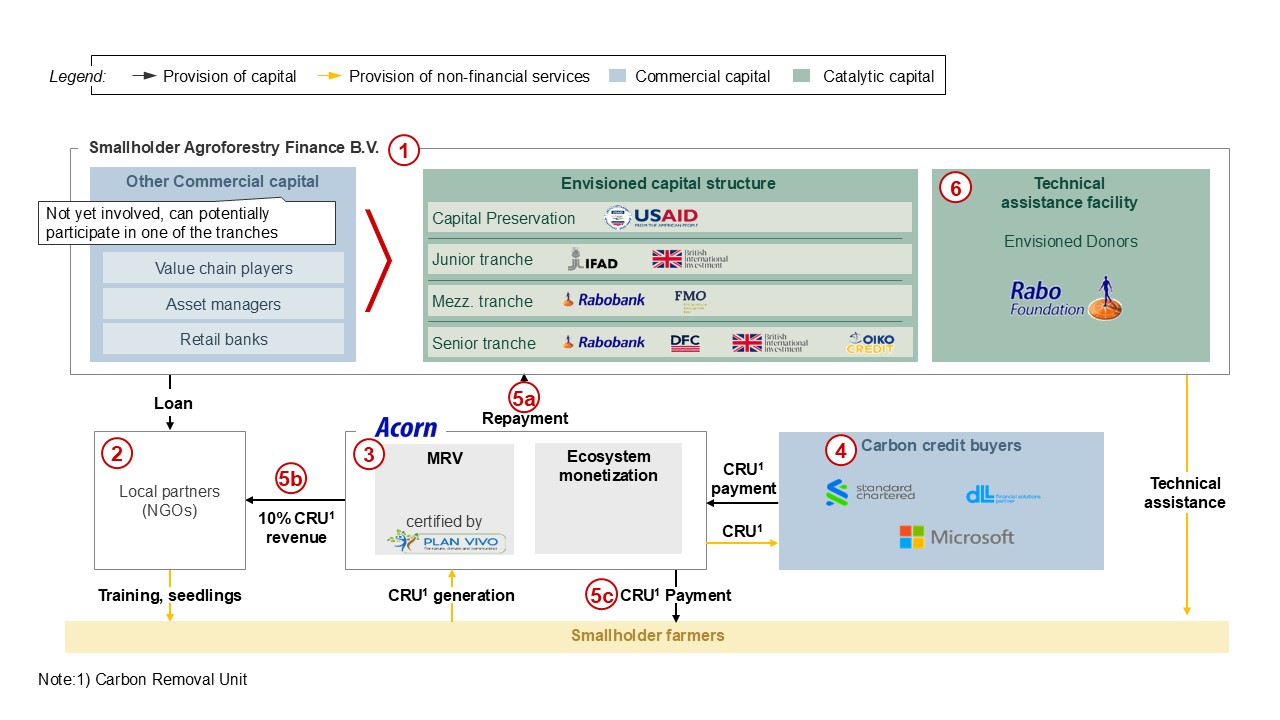
(1) Smallholder Agroforestry Finance blends catalytic and commercial capital via tranching (bearing non-performance risk of farmers)
(2) This capital pre-finances local partners to cover upfront costs, i.e., seedlings, which are provided to farmers starting agroforestry practices
(3) Farmers generate carbon removal units (CRUs) through planting trees, which is monitored, verified & sold by Acorn and independently certified by Plan Vivo
(4) Corporate off-takers buy Carbon Removal Units from Acorn
5(a) Acorn retains 10% of CRU proceeds and repays loan to SAF’s financiers (based on certain % of CRU proceeds)
5(b) 10% of CRU proceeds is transferred to local partner
5(c) Farmers receive remainders of 80% after loan deduction, either via local partner or directly via digital payment solution
(6) Technical assistance can be provided to farmers
Onboarded ~470K farmers; Raised ~€17M soft loans/grants, and ~€100M for SAF