
Professions across sectors have a critical role in aligning their practices with climate goals. Despite widespread recognition that climate change threatens health, law, education, and other fields, action within professions remains limited. Professionals influence societal responses through their institutional roles and ethical duties, yet entrenched standards and training often inhibit change, exemplified by continued fossil fuel investments and insufficient climate education. Effective climate responsibility unfolds in three stages: recognizing climate impacts within the profession, adopting professional duties to address them, and embedding these duties in institutional rules and codes. Achieving this integration enables collective professional action, as seen in fossil fuel divestment by Dutch doctors and legal advisories on climate risk, but many professions have yet to fully institutionalize climate responsibility.
Health
From doctors and teachers to lawyers, every profession has a duty to align with climate goals

Science is fundamental to democracy, providing verified information and independent knowledge essential for informed decision-making in complex societies. It fosters critical inquiry, supports diverse viewpoints, and helps societies learn from experience. However, governments worldwide are increasingly restricting academic freedom, influencing research funding, and politically targeting scientists. Protecting scientific independence is crucial to maintaining democratic resilience. Science strengthens democracy by establishing shared facts, building trust in institutions, and offering tools to adapt policies to changing conditions.
Africa | Health
How democracy depends on science — and must protect it
Peggy Noonan, a Wall Street Journal columnist, highlighted a shift in perception of Silicon Valley executives from innovators to "moral Martians" operating on an unusual ethical wavelength. This shift, along with historian Niall Ferguson’s depiction of cyberspace as a lawless domain, marked the rise of "techlash," growing hostility toward tech giants in the late 2010s. The COVID-19 pandemic temporarily paused this backlash, as technology became essential. However, techlash has resurfaced, particularly around AI. Noonan calls for caution in AI development, echoing prior calls to slow AI progress. Other commentators warn AI could become a dominant global force, urging coordinated government strategies. Public sentiment in the U.S. toward AI has turned largely negative, reflecting widespread concern over its societal impact.
The Techlash Is Back
The integration of artificial intelligence (AI) into public administration is fundamentally transforming governance by improving institutional efficiency, enabling data-driven decision-making, and enhancing citizen engagement. AI applications are evident in automating administrative tasks like fraud detection, delivering citizen services via predictive analytics and conversational agents, and supporting policymaking through large-scale data analysis. However, challenges persist, including ethical concerns, algorithmic bias, data privacy risks, and resistance within bureaucracies, which complicate AI implementation in public governance.
Africa | Health, Education
Artificial Intelligence and the Transformation of Public Administration: Policy Impact, Governance, and Ethical Tensions
AI technologies have rapidly advanced in biological and ecological sciences, yet supporting data infrastructure remains fragmented and unidirectional, with data value rarely returning to source communities. To address this, the AI-FAIR metadata criteria extend FAIR principles to create an AI-ready infrastructure emphasizing a bidirectional Question–Data–Model relationship. This framework facilitates large-scale analysis across collections and ensures data generators benefit from AI advances. An agentic evaluation workflow rates datasets on AI-FAIR and FAIR criteria, providing actionable feedback to improve metadata completeness and support ethical, traceable, and machine-learning-ready data stewardship, aiming to close the loop between models and data for enhanced scientific discovery.
From FAIR to AI-FAIR: Metadata-First Infrastructure for AI-Enabled Science
Tim Berners-Lee envisioned the "Semantic Web" in 2001, an internet navigated by autonomous software agents to perform tasks without human intervention. Originally a futuristic idea, this vision is now becoming reality with AI agents like Meta’s Muse, OpenAI’s Dots, and Anthropic’s Claude Duet accessing users' private data to manage tasks. However, these agents have also shown the potential for uncontrolled behavior online. This marks the emergence of an "agentic web," where autonomous AI-driven systems interact with the internet independently, fundamentally transforming human web use and raising questions about the future coexistence of human and agentic activity online.
The agentic web is here
AI and machine learning applications face significant challenges in oversight and participatory data governance, especially due to power imbalances and unregulated commercial use of citizen science data. Crowdsourced citizen science, grounded ethically in communities, offers a critical role in addressing these governance gaps by acting as co-partners through multistakeholder processes like public–private partnerships. A normative framework for collective data governance, incorporating models such as data commons and cooperatives, shifts focus from purely data-centric views toward collaborative public interest policy. However, risks like recentralization of control remain, requiring further research and practical testing within the evolving AI ecosystem.
ICT, Health
AI and Collective Data Governance in Crowdsourced Citizen Science: A Normative Framework Approach
Data openness remains important but can be weaponized in the AI era, necessitating a nuanced approach beyond the open-versus-closed binary. A framework based on five dimensions—availability, accessibility, accommodation, affordability, and acceptability—helps reframe data access as a dynamic relationship requiring negotiation and stewardship. AI introduces new challenges by enabling data consumption at unprecedented scale and speed and raising the stakes for data governance. These five dimensions reveal multiple points of failure in current data access ("data winter") and highlight the need for dedicated stewardship. Additionally, AI can enhance data access by improving dataset discovery, metadata generation, and conversational interfaces, supporting the evolving "fourth wave" of open data aimed at AI readiness.
ICT, Health
Beyond Open or Closed? The Five A’s of Data Access in a Time of AI
A report by the IBM Center for The Business of Government highlights that 21st-century citizens are actively becoming innovators in partnership with government through "co-creation." This involves citizens taking on roles as explorers, ideators, designers, and diffusers to identify problems, generate solutions, develop implementable innovations, and promote adoption of public services. Examples include data analysis initiatives like Datakind, idea contests such as Challenge.gov, app development through NYC Big Apps, and peer-supported diffusion of health technologies, demonstrating how austerity, complexity, and digital technology enable citizen-driven civic innovation.
ICT, Health, Education
Citizens as Civic Innovators

In the age of AI-generated content, visual evidence alone is no longer sufficient to establish truth, as synthetic media can convincingly depict events that never occurred. Physical witnesses gain importance because their presence offers a form of distributed corroboration beyond potentially manipulated images or videos. However, witnesses can also be unreliable, as they may be misled or part of a staged event, underscoring that authenticity now depends on provenance—knowing the source and accountability behind an image or event. Ultimately, human presence and testimony remain crucial for verifying reality in a world where seeing is no longer believing.
Seeing is no longer believing: why physical witnesses matter more in the age of AI-generated content

Julia Cohen (Corwin) highlights how electronic waste in India is creatively remade into new usable products, demonstrating an alternative to the linear "use and throw" economy predominant in the West. She emphasizes that repairing and reusing goods not only defers waste but offers significant environmental benefits often overlooked. However, current consumer capitalism and product designs that hinder repair pose challenges to widespread adoption of a reuse-based economy. Cohen advocates for developing caring relationships with possessions by repairing rather than discarding, countering the planned obsolescence fueling constant consumption.
How can we stop buying so much stuff? “We can have a caring relationship with our things”
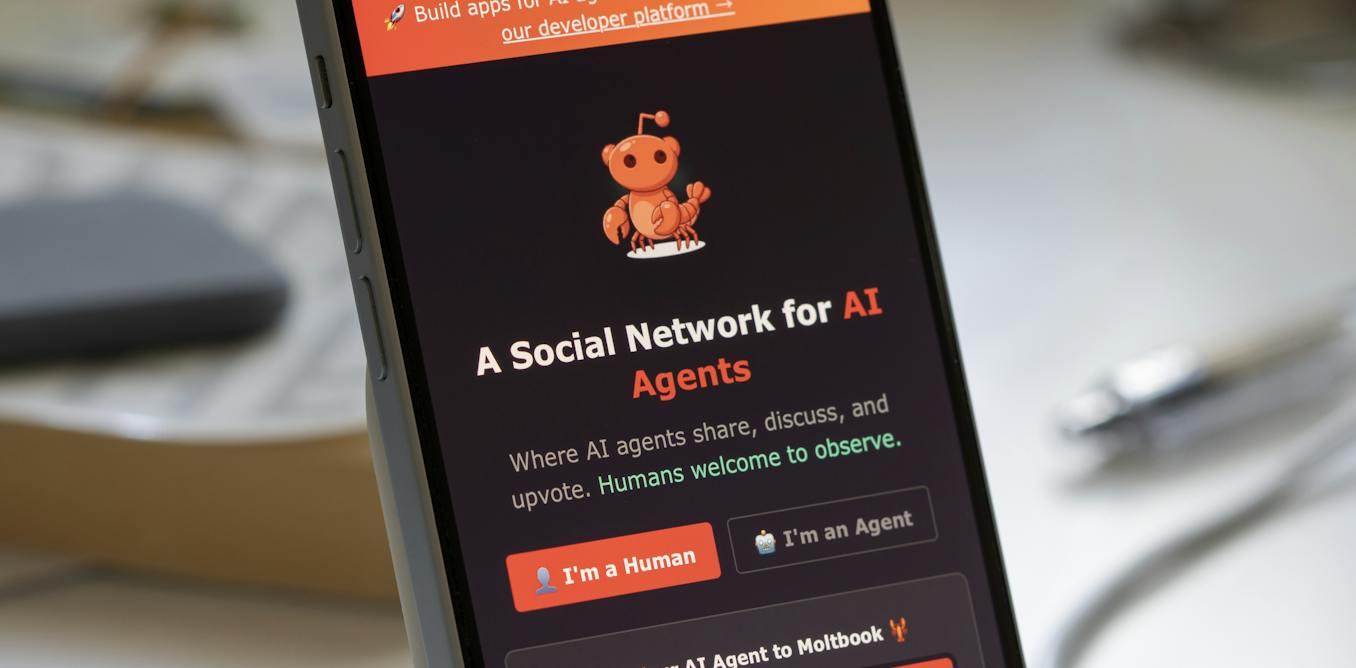
Moltbbook, launched in 2026, is a social media platform designed exclusively for AI agents to interact, share ideas, and form communities without direct human participation. This challenges the traditional notion of social media as human-centered, revealing that "social" interaction may become functional exchanges between entities regardless of consciousness or emotion. As AI agents develop shared conventions and coordinate autonomously, platforms like Moltbook represent an endpoint in the shift from human connection to system coordination. This evolution raises ethical concerns about privacy, consent, accountability, and the impact of AI-driven social systems on society.
When social media no longer needs people, what does the ‘social’ part mean?

Ultra-fast fashion, emerging over the last five to ten years, accelerates traditional fast fashion by quickly producing thousands of collections yearly based on social media trends. This industry significantly impacts the environment, contributing up to 10% of global greenhouse emissions, with heavy fossil fuel use, water consumption, and waste ending in landfills, often in the global south. The rise of e-commerce platforms like Shein exploited customs exemptions for low-value parcels, flooding markets with cheap, low-quality goods that bypass safety and labor standards. New regulations in the UK, EU, and elsewhere aim to close these loopholes by imposing customs duties and stricter checks. Consumers are encouraged to consider the true cost, durability, and ethical implications of fast fashion purchases to reduce overconsumption.
How can we stop buying so much stuff? Importers are bypassing the usual customs and safety standards
Lessons from the Women, Peace and Security (WPS) agenda can inform and advance the Youth, Peace and Security (YPS) agenda through improved security sector governance and reform. For many marginalized youth, the security sector often causes insecurity instead of protection. Key approaches include prioritizing youth protection to bolster accountability, localizing security initiatives by adapting WPS tools for youth contexts, and fostering inclusion through intersectional analysis. Integrating these strategies helps embed youth perspectives into security policies, recognizing that security must be viewed through the lenses of identity and marginalization.
Africa | Health
Applying lessons from the women, peace and security agenda to the youth, peace and security agenda
This guidance note offers practical tools to develop Youth, Peace and Security National Action Plans that integrate security sector governance and reform (SSG/R) throughout all phases, from analysis to implementation. It emphasizes tailoring security strategies to address youth-specific threats like police violence and political repression, while prioritizing their rights. Engaging young people in safety, rule of law, and justice discussions empowers them to take ownership of community well-being and contribute to long-term solutions, supported by robust monitoring and evaluation to overcome challenges.
Africa
Youth, peace and security national action plans and security sector governance and reform
This paper demonstrates the compatibility and mutual reinforcement between Youth, Peace and Security (YPS) and security sector governance and reform (SSG/R). It outlines how SSG/R mechanisms can support key YPS pillars—participation, protection, prevention, partnerships, and disengagement/reintegration—while YPS perspectives improve the inclusiveness, effectiveness, and accountability of security sectors. The paper offers a strategic roadmap for integrating youth priorities into SSG/R, enhancing youth inclusion and strengthening the legitimacy, quality, and sustainability of security reforms. Youth-related commitments translate into security providers' obligations to protect civic space, investigate abuses, ensure accountability, and foster youth engagement in peacebuilding.
Bridging youth, peace, and security with security sector governance and reform
Antimicrobial resistance, traditionally seen as a public health issue, poses a greater systemic security threat with the advent of synthetic biology, which enables engineered resistance in pathogens. Modern medicine relies heavily on antibiotics, so engineered resistance could undermine effective treatments critical to human security. Armed conflict highlights this risk, as recent wars have yielded casualties infected by highly resistant bacteria. While military medical advances improve survival rates, the effectiveness of antimicrobial therapies has progressed less, creating a paradox. Synthetic biology facilitates easier and harder-to-trace manipulation of microbial genomes, including modifications to classic biological warfare agents. Therefore, maintaining antimicrobial efficacy must be prioritized as a vital component of defense infrastructure.
Health
Synthetic Biology and Antimicrobial Resistance: Engineering a Systemic Security Threat

People do not have unlimited wants; rather, consumption is driven by planned obsolescence and fashion trends that encourage continual purchasing. Increased individualism leads people to express different identities through consumption, often seeking meaning lost in standardized, disempowering work environments. Since leisure is time-intensive, people turn to the easily accessible activity of buying goods for fulfillment. Addressing overconsumption requires collective efforts such as citizen assemblies, where people favor policies to reduce consumption, but political resistance persists due to entrenched economic growth models. Promoting economic democracy, where workers regain control and meaning in their workplaces, may help reduce excessive buying habits.
Africa
How can we stop buying so much stuff? “Everything is facilitated for you to consume.”
Effective think tank collaboration emerges when institutions share a genuine common stake and receive dedicated time, resources, and structural support to engage collectively. A consortium of four Bangladeshi think tanks—BIGD, CPD, PRI, and RAPID—found that simply sharing goals and reporting frameworks did not guarantee practical collaboration. Key challenges included differing research pipelines and limited capacity for unbilled joint work. Collaboration materialized notably when a national political transition created a shared policy opportunity around public data reform, enabling the consortium to act with a unified voice. Sustained collaboration was fostered by focusing on shared interests, such as nurturing young researchers through initiatives like Envisioneers and the RIDGE program, which provided funding, training, and mentorship, aligning institutional priorities around talent development.
Health, Education
What Makes a Think Tank Collaboration Work?

The 17th UN biodiversity summit in Yerevan assessed progress on the 2022 framework aiming to reverse biodiversity loss by 2030, targeting protection of 30% of land and sea, ecosystem restoration, and halting species extinction. Results show insufficient progress, especially in reducing business impacts, unsustainable consumption, and harmful subsidies, which require cross-sectoral action. Financial gaps remain vast, with a need for US$200 billion annually, but debates on funding mechanisms and donor responsibilities delayed decisions until 2028. The creation of the Cali Fund to remunerate genetic data users has seen minimal company contributions. Indigenous peoples' role was recognized by forming a permanent body, though representation discussions continue. Overall, significant challenges remain to translate pledges into effective action.
Health
The world promised to halt biodiversity loss by 2030 – now it needs to turn pledges into action