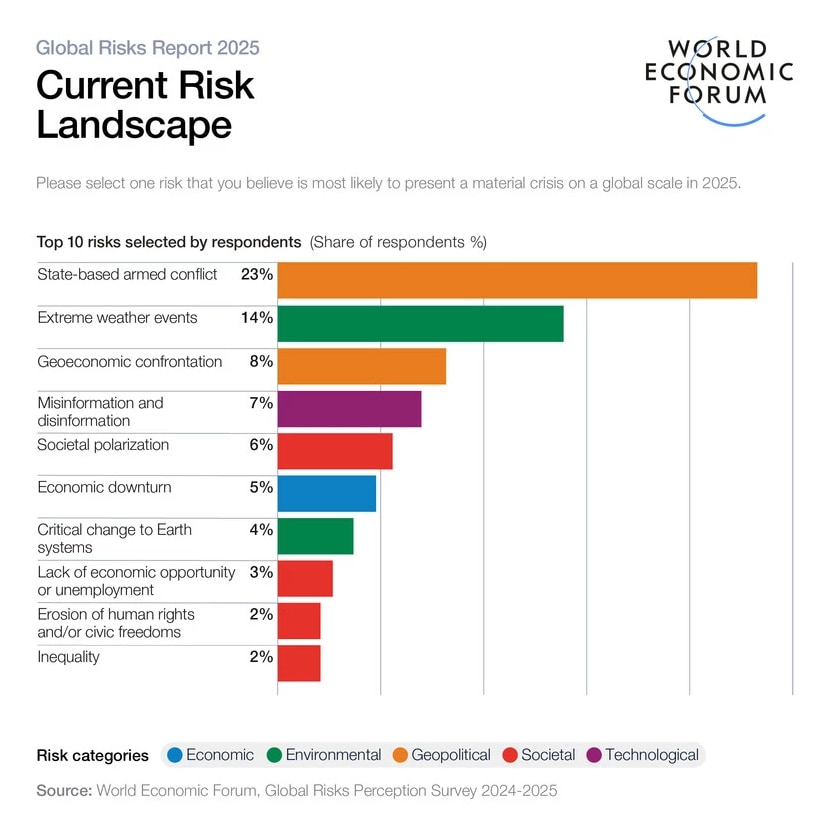
The International Day of Peace, observed on September 21, holds extra significance this year as the United Nations celebrates its 80th anniversary amid increasing geopolitical tensions. The theme "Act Now for a Peaceful World" comes during a time of heightened risks, with state-based conflicts identified as a major concern in the World Economic Forum’s 2025 Global Risks Report. UN Secretary-General António Guterres emphasizes the urgent need for global cooperation to combat escalating instability. Activities to mark the day include community actions for peace, reflecting on the collective responsibility to foster dialogue and understanding.
Health
Why is the International Day of Peace particularly significant this year?

The World Economic Forum's Sustainable Development Impact Meetings (SDIM) will occur in New York from September 22-26, focusing on advancing the UN Sustainable Development Goals (SDGs). This year marks significant anniversaries for both the UN and the 2030 Agenda. The meetings will address critical global challenges, including humanitarian crises and economic growth, emphasizing the need for strong public-private cooperation. Key sessions include discussions on geopolitics, resilience in Africa, energy transition, and economic growth under pressure, with diverse stakeholders participating to foster inclusive collaboration for sustainable development.
Africa | Health, ICT
Our meetings in New York: Who's coming and what to expect

The number of Indian migrants in Germany has significantly increased, tripling from 86,000 in 2015 to 280,000 projected by 2025, primarily addressing the STEM skills shortage. India is now the leading source of labor and education migration to Germany. The Migration and Mobility Partnership Agreement (MMPA) established in 2022 aims to enhance migration conditions and streamline visa processes. Despite fewer experts arriving on EU Blue Cards, the influx of students and qualified professionals continues. Effective regulation of private recruitment and fostering collaboration in sectors like digitisation and climate protection are essential for mutual benefits in German-Indian relations.
Germany, India | Education
A Migration Miracle? Indian Migration to Germany

Agentic AI enables organizations to transcend traditional business practices, fostering sustainable models that enhance both environmental and financial outcomes. It functions by allowing AI agents to autonomously learn and share information across various business domains, breaking down silos that hinder sustainable practices. This technology aids in understanding resource relationships, gaining proactive supply chain insights, and streamlining compliance processes. By leveraging multi-agent systems, businesses can effectively navigate complex sustainability challenges and uncover correlations often missed by human stakeholders, ultimately promoting resilience in a rapidly changing landscape.
Why agentic AI presents a turning point for business resilience

Healthcare systems are fragmented, primarily serving institutions rather than patients, resulting in escalating costs and ineffective care. Unbundling rigid structures into modular services tailored to patient needs can improve health outcomes. By reorganizing around patient journeys, utilizing technology, and aligning financing with prevention, health systems can provide coordinated care. A shared infrastructure is essential for effective data flow and service integration, allowing for seamless patient experiences. Low- and middle-income countries can leverage this opportunity to create patient-centric systems, learning from transformations in other sectors like banking and telecommunications.
Financial services, Health, Education
Why healthcare needs to be unbundled and rebundled

OpenAI is enhancing its robotics initiatives by recruiting experts to develop AI algorithms for humanoid and various robots. This effort focuses on training systems through teleoperation and simulation, particularly targeting humanoid robots that can perform complex tasks. Recent hires include researchers with significant robotics backgrounds, indicating an accelerated push towards building robots or developing training systems. OpenAI aims to achieve general-purpose robotics and AGI-level intelligence, believing physical interaction is essential for this goal. Competitors, such as startups and major companies, are also active in developing humanoid robots, heightening competition in the field.
OpenAI Ramps Up Robotics Work in Race Toward AGI

The UN is prioritizing action against non-communicable diseases (NCDs) such as heart disease, diabetes, and mental health disorders at an upcoming summit. A new Political Declaration is set to push for collaboration across sectors to address underlying causes of NCDs and significantly increase health financing. A recent study highlights a slowdown in progress against major causes of death, necessitating renewed public health policies. Additionally, the Global Fund is reallocating resources to support impoverished nations amid funding shortfalls, while China is enforcing strict measures to manage a chikungunya outbreak.
Africa | Financial services, Health
UN pushes for action on major chronic diseases, and other health stories

National governments often must accept externally imposed policies from supranational institutions, especially during economic crises, which can undermine democratic processes. Membership in the EU requires countries to relinquish some policy autonomy in exchange for economic stability, but this trade-off becomes precarious in times of crisis. The 2010 sovereign debt crisis in Europe exemplified this strain, as financial bailouts imposed stringent conditions that led to public discontent and electoral consequences, shifting support towards anti-establishment parties. The political impact of these dynamics has informed the EU's approach to subsequent crises, reflecting a wider global concern about democracy under strain.
Latin America | Financial services
Democracies under strain – the political effects of financial bailouts

The digital economy is reshaping livelihoods rapidly, with digital services comprising over half of global services exports. Developing countries increasingly rely on digital labor as a key export, prompting an urgent need for trade policies that ensure fair job standards and protection for workers. Many digital jobs lack formal contracts, minimum wage guarantees, and social protections. As countries invest in AI and digital infrastructures to compete globally, the resulting legal and labor challenges necessitate policies that balance worker protections with flexibility, addressing the complexity of varied business models and international dynamics in digital labor.
Germany, Kenya, South Africa, United Arab Emirates | Financial services, Education, ICT
How trade policy can help create a fairer digital economy

Research by S&P Global indicates that without adaptation, climate change could cost companies $1.2 trillion annually by the 2050s. Yet, only 35% of companies have context-specific adaptation plans. Sectors like utilities and real estate lead in adaptation planning, at 58% and 50%, respectively, while industries such as IT and finance lag behind. The findings underscore an adaptation gap, despite the growing recognition of climate risks within the corporate sector. Events like the upcoming UN General Assembly aim to highlight these escalating climate costs and the urgent need for comprehensive adaptation strategies.
Financial services
Mind the adaptation gap: Despite rising climate costs, few companies have adaptation plans

Nature is a critical asset for sustainable economic growth, yet current financial systems often overlook its value. A three-step approach—discover, quantify, and recognize—can integrate nature into financial decision-making and balance sheets. Recognizing nature’s economic worth can uncover significant financial risks and opportunities, particularly in sectors like agriculture, where natural capital loss poses multi-trillion dollar threats. Effective natural capital accounting can translate ecological value into quantifiable metrics, demonstrated by Forico's success in Tasmania. Ultimately, building a robust market infrastructure will allow land custodians to formally recognize and manage natural assets as vital components of economic development.
Financial services
Nature’s value: 3 ways land custodians can factor nature into their balance sheets

Japan's ageing population, with over 36 million individuals aged 65 and above, is driving growth in the healthcare, nursing care, and lifestyle industries. The longevity economy is projected to expand from JPY 96 trillion ($652.5 billion) in 2023 to JPY 115 trillion ($780 billion) by 2040. Advances in technology, such as care robots and AI platforms, are enhancing elderly support services. The growing market includes sectors like conversation partner services, catering to increasing single-person households among seniors. Japan's experience offers valuable lessons for other nations facing similar demographic challenges.
Japan
How Japan’s longevity economy is creating new opportunities

Global trade is undergoing significant changes driven by geopolitical shifts, evolving regulations, and rapid technology advancements. Non-compliance with new trade requirements poses risks to hundreds of billions in trade flows. Effective compliance is crucial for maintaining business continuity, preventing supply chain disruptions, and gaining a competitive edge, while also reducing risks of penalties and reputational harm. Companies need to reassess their international trade management strategies, ensuring resources and coordination across departments. This white paper, created with PwC, serves as a practical guide to today’s trade compliance challenges, leveraging insights from global companies and trade compliance professionals.
Denmark, Germany, Japan, Malaysia, Republic of Korea, Switzerland, Tanzania, Thailand, United Arab Emirates, United Kingdom | Financial services, Health, ICT
Trade Compliance for Leadership: Navigating a Shifting Global Landscape

Global trade is transforming due to geopolitical shifts, changing regulations, and technological advancements. Non-compliance with new trade requirements threatens hundreds of billions in trade flows, making compliance essential for business continuity, supply chain stability, and competitive advantage. Companies must reassess their international trade management strategies, ensuring these functions are well-resourced and strategically integrated. This white paper, created with PwC, offers a practical guide to overcoming today's trade compliance challenges, drawing on insights from global leaders and trade compliance professionals.
Denmark, Finland, Germany, Japan, Kenya, Malaysia, Switzerland, Thailand, United Arab Emirates, United Kingdom | ICT, Financial services, Health
Trade Compliance for Leadership: Navigating a Shifting Global Landscape
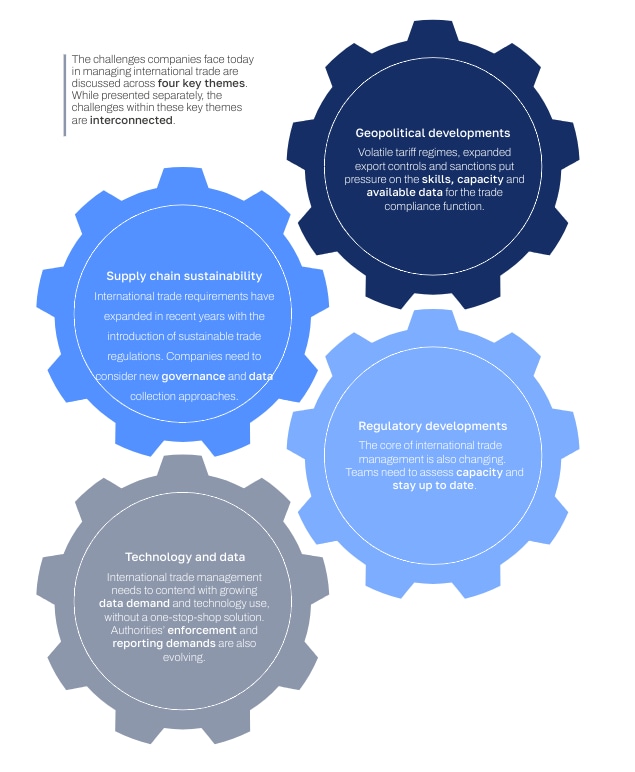
Global trade is undergoing significant transformation due to geopolitical shifts, changing regulations, and technological advancements, increasing complexity and risks for companies. Emerging compliance requirements threaten hundreds of billions in trade flows. A white paper from the World Economic Forum and PwC offers insights for navigating this environment. Companies face challenges like evolving trade laws and sustainability regulations, leading to potential non-compliance and operational inefficiencies. To thrive, businesses must integrate trade intelligence into their strategies, enhance cross-functional collaboration, and proactively manage regulatory changes, turning compliance into a competitive advantage.
Argentina, Belgium, Bulgaria, Chile, Costa Rica, Croatia, Denmark, Eswatini, Ethiopia, Finland, Georgia, Germany, Ghana, Iceland, India, Israel, Japan, Kazakhstan, Kenya, Kyrgyz Republic, Latvia, Luxembourg, Malaysia, Malta, Morocco, Namibia, Netherlands, Norway, Oman, Panama, Poland, Portugal, Republic of Korea, Romania, Russian Federation, Slovakia, Slovenia, South Africa, Sweden, Switzerland, Tanzania, Thailand, Türkiye, Uganda, United Arab Emirates, United Kingdom, Viet Nam | Financial services, ICT, Health
Global trade is changing. Here is how companies can stay ahead

Sustainable value chains encompass the entire product lifecycle, positively impacting the economy, environment, and society. Companies adopting sustainability strategies capture market share and enhance customer loyalty. Effective emissions reduction requires strategic alignment, data-driven insights, and collaboration across the ecosystem. A focus on training for green talent addresses the skills gap in sustainability roles. The World Economic Forum's checklist aids companies in engaging with scope 3 emissions, promoting transparency and resilience, while emphasizing the importance of cooperation for systemic change across industries. Sustainable practices are crucial for long-term profitability and climate performance.
Denmark, Netherlands, United Arab Emirates | Financial services, Health, ICT, Education
Five reasons why sustainable value chains are good for business

The higher education system in Uttarakhand, India, faces significant challenges, including a lack of alignment between traditional degree programs and labor market needs. With only one-third of students completing their degrees and few securing employment, issues of equitable education, teaching quality, and degree standards are prominent. The publication proposes a RISE framework—reimagining academic delivery, enhancing inclusion, reforming governance, and empowering students—as a strategic approach to improve employability and foster economic growth in the region.
Education
Beyond Degrees: Pathways to Reforming Higher Education in Uttarakhand, India

Organizations may struggle to identify disparities in AI model performance across demographic groups without certain sensitive data categories, compromising fairness and equitable AI benefits. For example, a bank must be able to discern customer ethnicity to prevent biased mortgage assessments. Regulators recognize the necessity of sensitive data for monitoring discrimination risks and improving model performance. However, stringent data protection laws and consent requirements may hinder organizations from incorporating crucial sensitive data into AI training sets, impacting model effectiveness.
Rethinking Sensitive Data in the Age of AI

Trump hosted a White House dinner featuring CEOs from the "Magnificent Seven" tech firms—Apple, Amazon, Microsoft, Google, Meta, OpenAI, and Oracle—to highlight U.S. AI ambitions. Despite the show of unity, the event revealed significant economic reliance on these seven companies, which dominate capital and infrastructure in the AI sector. They account for 34% of the S&P 500 and are investing heavily in AI technologies. However, this concentration raises concerns about vulnerability and sustainability, as the tech future may hinge on a precarious foundation limited to a few key players.
Seven CEOs in Trump’s AI dinner shape America’s tech destiny
Government's ability to effectively manage societal issues relies heavily on the collection and use of information, as demonstrated during the dismantling of federal agencies under the second Trump Administration. The reduction of expert advisory commissions and funding for research institutions has left a gap in policy guidance. Think tanks, alongside universities, play a crucial role in producing knowledge and policy ideas. They now face challenges in maintaining relevance and utility in an environment where informed decision-making is increasingly undermined by a focus on raw power.
Financial services, Education
Think Tanks in an Authoritarian Moment