Myanmar is facing a severe food security crisis exacerbated by political instability, economic challenges, and environmental issues. Agricultural output has significantly declined, with projected decreases in rice and maize production due to rising input costs and ongoing conflict, which has displaced millions and disrupted farming activities. The depreciation of the kyat has further strained farmers financially, limiting their ability to invest in crops. Logistics disruptions hinder market access, while climate-related disasters, including floods and earthquakes, have caused extensive damage to infrastructure and farmland. Urgent emergency support and sustainable agricultural solutions are essential to address these challenges.
Bangladesh, Myanmar, Nigeria | Financial services
Addressing Food Insecurity Amid Conflict and Climate Shocks in Myanmar

Advancements in artificial intelligence (AI) and geospatial analysis are revolutionizing poverty mapping by utilizing satellite imagery and machine learning to provide more accurate and timely estimates. A collaboration between the World Data Lab and the Asian Development Bank applied AI techniques to enhance poverty understanding in Indonesia and the Maldives. By using convolutional neural networks, researchers created high-resolution poverty maps that reveal localized economic disparities, outperforming traditional survey methods. The study found unique poverty patterns based on geographical and socioeconomic factors, demonstrating potential for optimizing targeted government interventions. However, the model's transferability to the Maldives faced limitations due to differing socioeconomic conditions.
Bangladesh, Mali
How AI and Satellites are Transforming Poverty Analysis
Small and medium-sized towns in the People’s Republic of China are pivotal for driving the country’s energy transition and achieving carbon neutrality by 2060. The brief identifies challenges such as coal dependency and inadequate infrastructure, while highlighting pilot projects in Hebei and Anhui provinces. It emphasizes the need for enhanced government support and innovative financing to create business opportunities. Key policy initiatives include improving energy efficiency and expanding distributed renewables and biomass heating as part of the PRC’s clean energy action plan.
Supporting Low-Carbon Energy Transition in Small and Medium-Sized Towns of the People’s Republic of China

China is enhancing its adaptation to climate change through improved policy frameworks and the use of AI technology. Despite significant progress, such as the National Action Plan on Climate Change and the National Climate Change Adaptation Strategy 2035, more urgent and detailed implementation is required. Severe weather events, including record heat and flooding, have prompted the need for localized responses. China is leveraging AI tools like Fengwu and Lingxi to improve forecasting and risk management. Additionally, the Mazu initiative aims to provide comprehensive early warning systems, benefiting both China and other nations globally.
Nigeria | Financial services
China’s extreme weather AI tools can help countries adapt

The OECD report examines the concept of openness in artificial intelligence (AI), detailing relevant terminology and varying levels of openness. It critiques the term "open source," highlighting its inadequacy in capturing the complexities of AI. The report analyzes current trends in open-weight foundation models through experimental data, noting their potential benefits and risks. It also introduces the concept of marginality to enhance understanding and aims to inform policy discussions on balancing the openness of generative AI models with responsible governance.
AI openness
Community banks play a vital role in the transition to net-zero greenhouse gas emissions by providing relationship-based lending and local market insights that larger institutions lack. They enable tailored financing solutions for green initiatives—such as energy efficiency upgrades and renewable energy projects—particularly in underserved areas. Despite their potential, community banks face challenges like regulatory burdens, capital constraints, and a competitive landscape. Policymakers need to create supportive regulations and incentives that enhance the capacity of community banks to mobilize capital for climate-aligned investments, ultimately fostering a more inclusive and effective decarbonisation effort.
Financial services
Why local banking matters for net zero
New technologies provide companies and politicians with unprecedented means to manipulate individuals, creating an illusion of freedom through choice while actually limiting wealth, health, and democracy. In "Manipulation," Cass R. Sunstein gives a modern definition of manipulation, highlighting its dangers to personal agency and well-being. He differentiates harmful manipulation from acceptable influences like 'nudges,' and addresses risks from AI, algorithms, and deepfakes. The book offers insights from behavioral science and suggests strategies to combat manipulation in everyday life, aiming to empower consumers, investors, and workers.
Manipulation: What It Is, Why It’s Bad, What to Do About It
The adoption of immersive technologies is primarily characterized by niche use cases rather than general-purpose applications. These specialized applications enhance specific tasks in various sectors and have seen significant enterprise investment, market growth, and improved capabilities despite waning interest from regulators and media. Many uses are concentrated in high-impact industries, raising safety and ethical concerns, particularly for vulnerable groups. Effective governance may require regulators to focus on specific use cases instead of a broad approach, given the challenges that hinder widespread adoption.
Education
Reality check: Key trends in the development and adoption of immersive technologies

Blended finance can enhance sustainable development by mobilizing private and philanthropic investments when public budgets are strained. For success, sovereign bodies must transition from risk absorbers to risk strategists, employing targeted interventions to reduce perceived risks and enhance the bankability of projects. Examples like Indonesia's SDG Indonesia One platform show how strategic roles can catalyze investment. Key strategies include deploying grants, stabilizing returns through interest subsidies, and providing capacity building for beneficiaries. Sovereigns should also facilitate collaborative financing ecosystems and adapt policies to reduce risks in emerging sectors and support infrastructures.
Health, Financial services
Redefining the sovereign's role in blended finance for sustainable development

Successful AI adopters exhibit three key attributes: 

1. Strategic Integration of AI: Leaders embed AI within their core strategies, prioritizing long-term transformation and innovation. Nearly 80% report that their AI investments have met or exceeded expectations, with significant ROI realized.

2. Opportunity in Uncertainty: These companies leverage market uncertainties to enhance customer service and operational efficiency. For instance, one retailer effectively used AI for inventory management during supply chain challenges.

3. Employee Activation: Leading firms invest in training employees on AI tools, facilitating daily use and collaboration. Employees in these companies are more likely to report positive impacts from AI on job satisfaction and workflow efficiency.
Education
The three attributes common to successful AI adopters
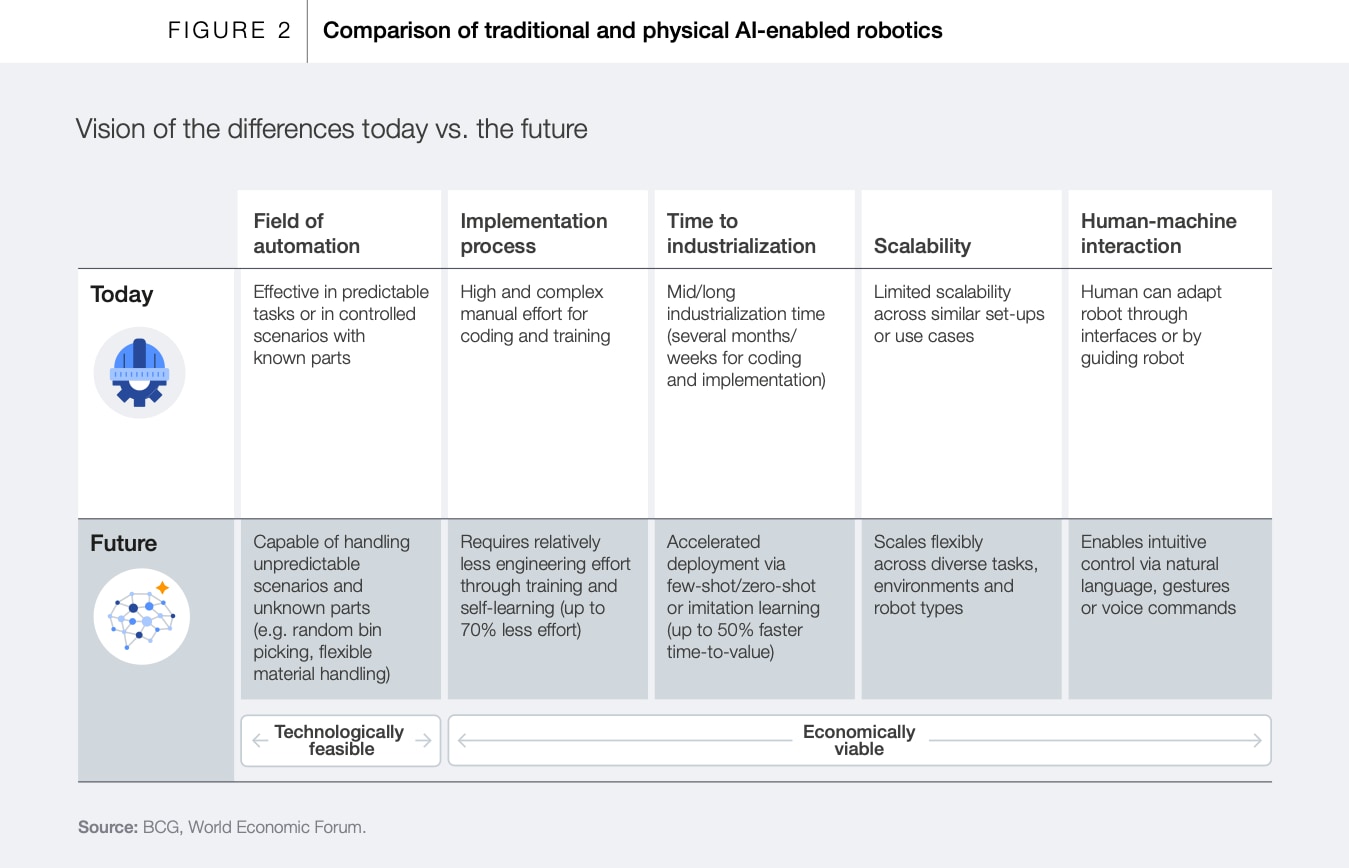
Physical AI is revolutionizing manufacturing by addressing key challenges such as rising costs, labor shortages, and shifting consumer demands. Advances in AI, sensors, and robotics are leading to smarter and more flexible industrial robots, allowing manufacturers like Amazon and Foxconn to improve efficiency and create skilled jobs. Unlike traditional robots, which focus on repetitive tasks, Physical AI enables robots to learn from their environment, perform diverse tasks, and make autonomous decisions. This evolution is crucial for enhancing operational flexibility and resilience in a volatile market while requiring a skilled workforce to manage the transition effectively.
Education
Physical AI is changing manufacturing – here's what the era of intelligent robotics looks like
People displaced by conflict are particularly vulnerable to climate risks due to their diminished resources and lack of adaptive capacity. An example from Sudan highlights how IDPs suffered catastrophic losses during a landslide, illustrating their precarious living situations. While displaced individuals often settle in disadvantaged areas prone to extreme weather, they are frequently overlooked in disaster management plans, which can undermine their ability to respond effectively to climate threats. Solutions require integrating IDPs into disaster risk reduction strategies and incorporating local knowledge to enhance resilience against climate impacts.

Nigeria
Why people displaced by conflict are particularly vulnerable to climate risks
Perplexity's $34.5 billion bid for Google's Chrome was impacted by a recent court ruling, allowing Alphabet to retain Chrome but requiring data-sharing with competitors. The ruling raises privacy concerns for Google and highlights the influence of generative AI on traditional search engines. Herbert Hovenkamp argues in his analysis that assessing antitrust issues should focus on specific products rather than the size of firms. He emphasizes the need to consider both e-commerce and offline markets together, as companies like Amazon and Walmart compete directly across product categories. Effective antitrust policies should target monopolistic practices rather than merely large firms.
Reframing the E-Commerce Antitrust Debate

AI's rapid advancement poses significant energy efficiency challenges for data centers, which consume substantial power. Experts from Penn University have convened to explore solutions, emphasizing the need for better coordination among stakeholders and innovative policies. Key areas of focus include creating data centers powered by renewable energy, enhancing grid capacity, and developing specialized AI models to save energy. Participants highlighted the importance of improving carbon accounting in the tech sector to shape sustainable investments and policies. Without addressing these complexities, future energy demands may increase costs and carbon intensity.
Can AI Be Energy Efficient?
Spain has joined the First Movers Coalition, a global initiative launched in 2021 to accelerate the development of low-carbon technologies essential for achieving net-zero emissions by 2050. As the 14th government partner, Spain aims to enhance decarbonization efforts in its heavy-emitting industries. The coalition has grown to over 100 members who have made 125 purchasing commitments, targeting an annual demand of over $16 billion for zero-emission products by 2030. Spain's Prime Minister emphasized the country's commitment to climate action and sustainable innovation, highlighting its significant reduction in greenhouse gas emissions and current status as a leading sustainable economy.
Spain joins the First Movers Coalition – but what is it and what has it achieved so far?

Gabon must transform its oil-dependent economy to avoid decades of fragility, with one in three citizens currently living in poverty. Following the 2025 elections, Gabon has an opportunity to pivot towards economic diversification, as oil revenue is projected to decline. Manufacturing and agriculture, accounting for only 18% and 4.8% of GDP respectively, need significant development. Strengthening trade ties and infrastructure, alongside better governance, are essential for reducing poverty and attracting investment. Successful diversification could lead to enhanced economic resilience, addressing inequalities created by past oil reliance.
Angola, Bangladesh, Benin, Botswana, Burkina Faso, Burundi, Cameroon, Democratic Republic of the Congo, Gabon, Ghana, Guinea, Kenya, Mozambique, Namibia, Nigeria, Senegal, South Africa, Uganda, Zambia | Financial services
Can Gabon break the resource trap?

AI is creating significant disruption in the workplace, particularly targeting managerial, analytical, and creative roles. Estimates suggest that by 2030, automation could displace 400 to 800 million jobs, affecting various sectors, including administrative and customer service roles. Effective leadership in this transition requires transparency, employee engagement, and proactive strategies. Companies like Indeed and PwC are implementing AI upskilling programs, focusing on higher-order skills to prepare employees for the evolving job landscape. Leaders must confront the reality of AI's impact and involve employees in shaping the future of work, fostering a culture of resilience and adaptability.
Education
Leading through AI disruption: What no CEO wants to talk about
The 2025 Myanmar earthquake revealed significant systemic vulnerabilities, including unsafe housing, weak infrastructure, and underfunded health services. The 7.7-magnitude quake devastated regions like Mandalay and Sagaing, resulting in thousands of casualties and extensive destruction. Contributing factors included political instability, economic decline, and inadequate disaster preparedness, despite existing building codes. The healthcare system faced severe strain, with hospitals destroyed and limited financing for treatment. This disaster exposed interconnected risks, emphasizing the need for integrated resilience and risk management to prevent future crises.
Financial services, Health
What the Myanmar earthquake reveals about hidden risks

Soviet Communism did not successfully reduce inequality compared to other regimes, as evidenced by current and retrospective measures of welfare showing that individuals exposed to it are worse off than those in non-communist countries. Although some evidence suggests higher social mobility under Soviet communism, significant disparities in health, living conditions, and bureaucratic privileges persisted, producing new hierarchies and hidden inequalities. Ultimately, broader social and economic dynamics, rather than ideology alone, influenced inequality outcomes across regimes.
Soviet Communism was no more successful at reducing inequality than other regimes
European perspectives on semiconductor technology transfer are analyzed through four potential 2029 scenarios. The assessment highlights implications for economic security and innovation, considering Europe's strategic interests in the semiconductor sector. Insights from Joris Teer, a research analyst at the EU Institute for Security Studies, underscore the importance of tech diplomacy and collaboration in shaping future policies. The paper aims to inform stakeholders on navigating the complexities of global tech transfers within the semiconductor industry.
ICT
Semiconductors: European Views on Four 2029 Tech Transfer Regime Scenarios