
The Trump administration's tariff strategy is examined, highlighting its theoretical justifications and real-world impacts on trade, business strategies, and global economic stability. Joao Gomes, a finance professor, provides insights into the complexities of these economic policies and their implications.
The Trade War Playbook: Tariffs, Uncertainty, and U.S. Economic Policy

Governments, businesses, and civil society seek alternative platforms to compete with big tech, emphasizing not-for-profit, open, decentralized, and community-based governance. This article examines the dynamics of interoperability between Threads and Mastodon, highlighting potential competition and risks of converging governance practices. It also discusses how Wikipedia's openness enables Google to gain value from their interaction while the Wikimedia Foundation attempts to address this imbalance. Suggested interventions include asymmetric interoperability, digital taxes, and regulatory measures to support alternatives without mimicking big tech governance.
ICT
Interoperability and Openness Between Different Governance Models: The Dynamics of Mastodon/Threads and Wikipedia/Google

China has significantly reduced the availability of key economic data, including land sales, foreign investment, and unemployment statistics, impacting the ability to assess its economic health amid struggles such as excessive debt and a declining real estate market. The National Bureau of Statistics has ceased publishing certain figures without explanation, complicating forecasts as the nation faces challenges from the ongoing trade war with the U.S. While official GDP growth figures claim around 5% for 2022 and 2023, economists suspect these numbers may be inflated. Alternative data sources, such as satellite imagery and private company analytics, are now being used to gauge economic activity.
How Bad Is China’s Economy? The Data Needed to Answer Is Vanishing
Local councils are facing significant financial challenges and declining public satisfaction due to resource cuts over the past 15 years, leading to inefficiencies in service delivery. Artificial intelligence offers a solution by enabling faster, more efficient operations, transforming bureaucratic processes, and alleviating staff burdens. AI can enhance citizen engagement and support better long-term decision-making, ultimately driving economic growth and improving public service outcomes.
Financial services
Governing in the Age of AI: Reimagining Local Government
"Nonprofit AI" by Nathan Chappell and Scott Rosenkrans provides a thorough guide for purpose-driven organizations to leverage artificial intelligence effectively. It explores the benefits and challenges of AI in the nonprofit sector, offering case studies, ethical frameworks, and practical tools for successful implementation. The book includes templates for strategic planning, project management, and data governance, alongside resources for AI training to enhance organizational capacity. It emphasizes best practices for maintaining transparency and accountability in AI systems to align with nonprofit missions and values.
Nonprofit AI: A Comprehensive Guide to Implementing Artificial Intelligence for Social Good

An AI fashion show in Pakistan illustrates the profound impact of digital access on women's empowerment. Women in Pakistan are 38% less likely to own mobile devices compared to men, severely limiting their engagement in the economy. Programs like PTCL’s “Ba-Ikhtiar” are bridging this digital divide by providing women with smartphones, digital wallets, and e-commerce training, enabling them to start online businesses. The fashion show served as a platform for female artisans, merging tradition and technology, and demonstrating that digital inclusion fosters economic opportunities and challenges gender barriers. This represents a transformative shift towards a more equitable digital economy in Pakistan.
ICT, Education
AI fashion show highlights how digital access can empower women in Pakistan
Semiconductors are central to global geopolitics, reflecting US-China tensions and broader economic trends. The Trump administration is likely to pursue a phased, China-specific tariff regime, influenced by bipartisan concerns over China's chip market ambitions. Proposed restrictions aim at Chinese chip imports, especially in sensitive areas like consumer electronics. Meanwhile, China is increasing its domestic production capacity, enhancing its position in the global market despite challenges in advanced chip manufacturing. Europe and allies face interconnected challenges from US tariffs, export controls, and China's market influence, prompting calls for coordinated trade responses.
Canada, France, Italy, Republic of Korea, Switzerland, Taiwan, China | Financial services
Three Questions to Chris Miller: Navigating the Geopolitics of Semiconductors in a New Trump Era

Turkey faces a significant risk of descending into autocracy, exemplified by the arrest of İstanbul Mayor Ekrem İmamoğlu and the subsequent crackdown on the opposition Republican People’s Party (CHP). Resistance from the CHP has temporarily thwarted further state control over local governance, but broader public support is essential to prevent full autocratisation. Political instability jeopardizes economic growth, urging a unified EU response to avoid destabilization. The EU can influence Turkey by proposing customs union talks and visa facilitation, contingent on Ankara's adherence to democratic principles. Protests against Erdoğan’s government signal growing public dissent amidst declining economic conditions.
Türkiye | Financial services
Turkey on the Path to Autocracy
Wartime resistance histories in Italy significantly influence contemporary political attitudes toward far-right ideologies. Areas with active anti-fascist movements during WWII exhibit stronger civic engagement and reduced support for far-right parties. Research shows that these communities mobilized substantially for a campaign to ban fascist glorification, collecting over 240,000 signatures, particularly from those with strong resistance legacies. Local memory initiatives, such as remembrance gardens and partisan trails, help maintain these values and foster a connection to democratic principles in daily life, particularly in response to rising far-right sentiments.
Italy’s areas of wartime fascist resistance remain less susceptible to the far right today
Pope Francis, characterized as a "global South" leader, profoundly influenced the Catholic Church's geopolitical landscape, emphasizing a North-South orientation while marginalizing traditional European strongholds. His tenure, marked by a critical stance against Western policies, especially regarding the Ukraine conflict and Gaza, raised questions about the future direction of the Church. The upcoming conclave will not only navigate the legacy of Francis but also grapple with the rise of Trump-inspired Catholicism, which poses significant ideological and financial challenges to post-Vatican II Catholicism.
A Geopolitical Conclave in the Vatican

Data is essential for innovation and efficiency in agriculture, especially in addressing food security and climate change. In India, emerging data platforms such as VISTAAR, AgriStack, ADeX, and Krishi DSS are transforming the agri-tech landscape by providing access to vital datasets for farmers and stakeholders. However, the data remains fragmented, hindering scalability. To maximize the potential of these digital platforms, a robust data management ecosystem is necessary, addressing business value, technology, project strategies, and legal frameworks to encourage data sharing and engagement among users.
Financial services, Education, ICT
Beyond data: How to unlock agriculture's full potential
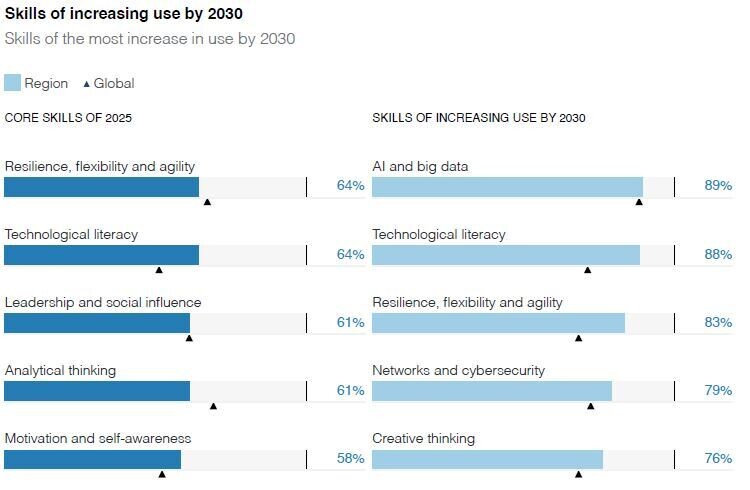
Sub-Saharan Africa’s population is forecasted to grow by 79% over the next 30 years, creating a potential talent hotspot due to its young workforce, especially in Nigeria where 70% are under 30. Employers are optimistic about talent availability, with many intending to enhance workforce development and invest in diversity initiatives. However, a skills gap poses challenges, particularly for roles in AI, big data, and cybersecurity. Remote work opportunities are increasing, allowing the region's labor force to influence the global job market, while enhancing education and skills development can improve national competitiveness and attract investment.
Burkina Faso, Republic of Korea, Senegal, South Africa, Zimbabwe | ICT, Education
The Future of Jobs in Sub-Saharan Africa: population boom can make the region a talent hotspot

AI and human-centered design are being leveraged to enhance financial inclusion in rural Colombia. A significant portion of adults in these areas lack access and usage of financial products. To address this, DataKind and Fundación Capital initiated a program utilizing AI-driven tools, LISTA and Con-Héctor, to deliver personalized financial recommendations and education primarily to underserved women, including Venezuelan refugees. Challenges such as low digital literacy and connectivity were mitigated through community engagement and integration with WhatsApp. Positive outcomes included improved savings behavior and increased financial confidence, demonstrating the potential of AI in fostering sustainable financial habits while emphasizing the necessity of human-centered approaches.
Financial services
How AI and Human-Centered Design Can Transform Financial Inclusion in Colombia

Recent advancements in digital banking, insurance, and pension systems are essential for enhancing resilience, reducing inequality, and promoting sustainable growth in Asia and the Pacific, the fastest-growing global economic region. Challenges such as insufficient disaster-risk coverage, inadequate infrastructure, and climate change threats underline the region's vulnerabilities. Financial innovations like parametric insurance and AI-driven banking solutions facilitate rapid responses to economic disruptions, while pension reforms aim to support an aging population. These efforts, particularly from the private sector, are crucial in maximizing the “resilience dividend” and ensuring long-term stability.
Latin America | Health, Education, ICT, Financial services
The Resilience Revolution: From AI Bankers to Insurance That Thinks Ahead
Value Sensitive Citizen Science (VSCS) is a framework merging Value Sensitive Design principles with citizen science to ensure community values are integrated into AI system development. It employs culturally grounded participatory methods and structured cognitive scaffolding to enable community members to co-create and operationalize local values into technical requirements. VSCS emphasizes ongoing governance for adaptability and accountability throughout the AI lifecycle, aiming to reflect community priorities rather than top-down perspectives. It also addresses challenges like power dynamics and epistemic justice, providing actionable strategies for policymakers and practitioners to enhance participatory, value-driven AI development.
Co-Designing AI Systems with Value-Sensitive Citizen Science
Nations are increasingly engaging in AI nationalism, implementing policies that may discriminate against foreign competitors and violate international trade norms. Strategies include excluding foreign firms from incentives, mandating local content, and enforcing export controls on essential technology. These actions can hinder the AI capabilities of other countries while disadvantaging their own developers and eroding international trust. The findings suggest that such policies primarily benefit countries with established technology firms and are counterproductive for building cooperative global AI ecosystems.
The Dangers of AI Nationalism and Beggar-Thy-Neighbour Policies
Social sector leaders are increasingly seeking advice on utilizing AI effectively. Jim Fruchterman, with experience in both for-profit AI and nonprofit social enterprises, often advises against overestimating AI's potential while encouraging sensible applications. He highlights "Retrieval-Augmented Generation" (RAG) as a promising approach for social impact, offering practical solutions and protective measures for integrating large language models into organizations.
Glorious RAGs : A Safer Path to Using AI in the Social Sector
Governments use AI systems to assess citizens' privacy, mobility, access to benefits, and public speech. Eduardo Albrecht's book, "Political Automation," investigates citizen input in algorithmic governance across areas like policing and national security, based on interviews with rights activists. He proposes a "Third House," a virtual legislative chamber dedicated to AI decision-making, governed by direct democracy principles. Digital replicas of citizens would serve as their representatives in this framework, addressing the implications of automation in public policy and suggesting pathways for citizen engagement.
AI Agents in Global Governance: Digital Representation for Unheard Voices
AI's rapid advancement highlights a critical focus on human choices and freedoms, essential for true human development. The UNDP Human Development Report 2025 emphasizes that development should prioritize people's ability to make meaningful choices over merely showcasing AI's capabilities. Success in a world shaped by AI relies on harnessing human creativity to transform economies and societies, aiming to create new pathways for development that benefit everyone.
Education
A matter of choice: People and possibilities in the age of AI

Artificial intelligence (AI) and natural intelligence (NI) collaborate to form hybrid intelligence, which drives hybrid creativity in the workplace. This symbiotic relationship enhances innovation by combining human insight with AI's analytical capabilities. Examples include drug discovery and music composition, where AI expands possibilities and human expertise guides implementation. Organizations must cultivate an environment that promotes collaboration between humans and AI, establishing workflows that encourage experimentation and learning. Emphasizing the human element ensures that innovations remain responsible and aligned with societal values, paving the way for true creative breakthroughs.
Education
How AI Can Unlock Hybrid Creativity in the Workplace