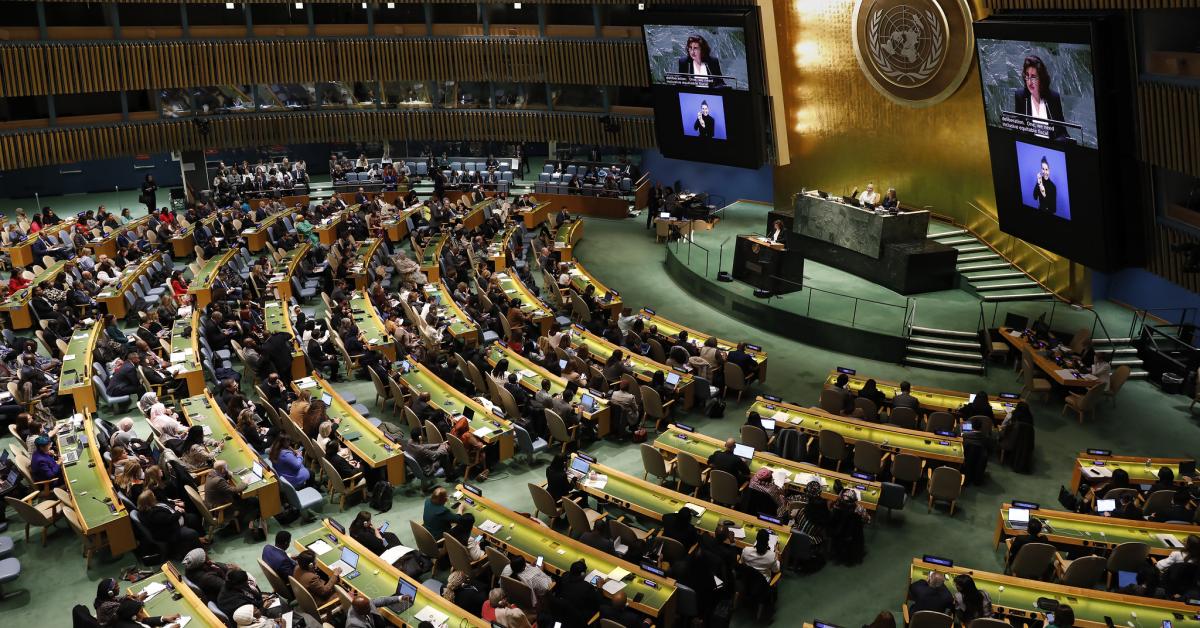
At CSW68, calls to address the global care crisis emphasized the gendered nature of unpaid care work and its impact on gender equality. Highlighting staggering statistics, such as women spending 12.5 billion hours on unpaid care work daily, participants underlined the need for this work to be recognized and valued. Key strategies discussed included reducing unpaid care work through support measures like childcare facilities, encouraging men to share care responsibilities, and implementing policies for better working conditions for paid care workers. The conversation also highlighted the importance of redefining care work as a fundamental human right.
Health, Education
Shifting narratives and norms around unpaid care work at CSW68 | Align Platform
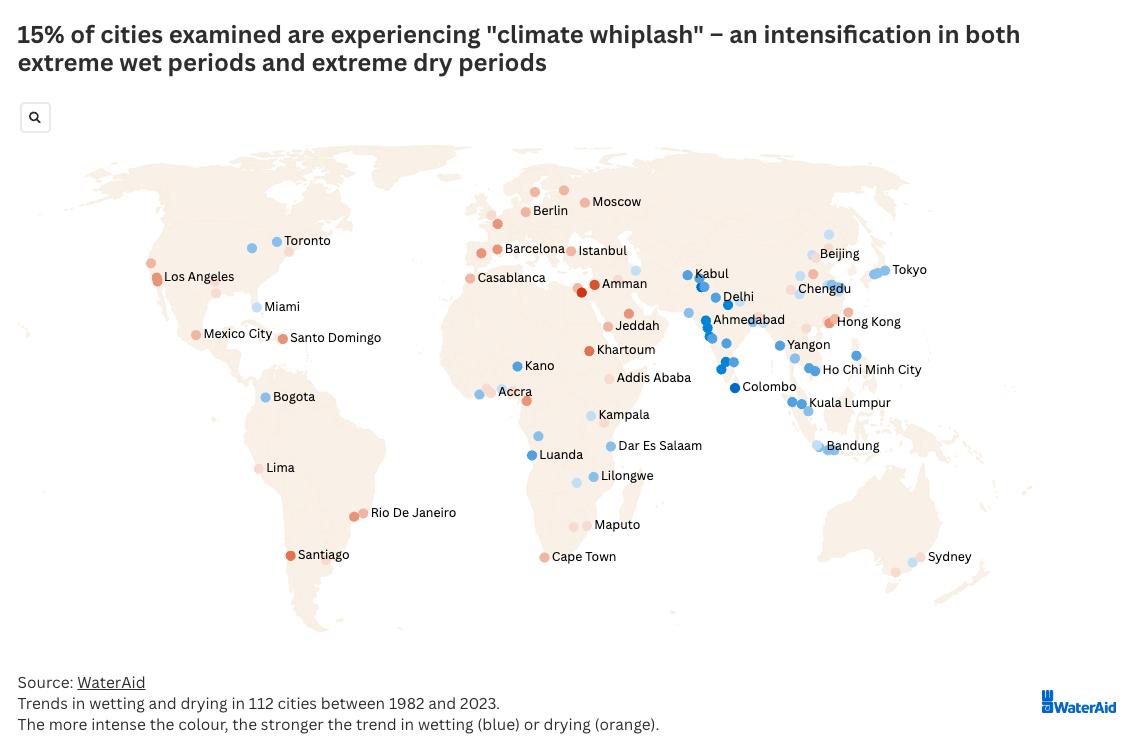
Cities worldwide, including Jakarta and Addis Ababa, face "climate whiplash," marked by alternating severe floods and droughts due to rising global temperatures. A report analyzing over 42 years of weather data indicates 15% of cities are significantly impacted, with Southern Asia experiencing increased flooding and Europe facing drying trends. Additionally, only seven countries met WHO air quality standards in 2024, while rising temperatures raise the risk of human exposure to mycotoxins. Conservation efforts are yielding positive outcomes for endangered species like the Javan slow loris, and India recorded its hottest February in 125 years.
Nigeria
Cities hit by ‘climate whiplash’, and other nature and climate stories you need to read this week

Georgia faces significant threats to its water security due to changing seasonal availability, droughts, floods, and an aging irrigation system. Modernizing water management and storage, along with sustainable agricultural investments, is crucial for maintaining rural livelihoods and food security. Although Georgia has abundant water resources, distribution is uneven, with some areas suffering from flooding and others from prolonged dryness. The retreat of glaciers exacerbates water availability issues, making traditional farming increasingly unsustainable. A comprehensive approach integrating water management, community governance, and data-driven decision-making is essential to enhance resilience and secure the agricultural future.
Georgia
Adapting to a Thirsty Future: Sustainable Water Solutions for Georgia’s Agriculture

Open innovation technology, particularly through tokenization, fosters secure global collaboration and knowledge-sharing across industries. It shifts power from centralized corporate structures to transparent, community-driven ecosystems, promoting trust and equitable value distribution. Tokenization enhances innovation by enabling shared technologies and decentralized incentives, driving sustainable growth. The ongoing "hyper-tokenization" trend, supported by increasing crypto adoption, positions open innovation as essential for tapping into global talent and creative solutions, transcending traditional industry boundaries. This evolution highlights a cultural shift towards greater creativity and collaborative problem-solving in the business landscape.
Africa | Financial services, Health, Education, ICT
How open innovation technology is driving collaboration across borders
Kazakhstan aims to establish itself as a regional leader in artificial intelligence through initiatives like the development of a supercomputer cluster. The country seeks to bolster its domestic AI industry for both economic growth and the preservation of the Kazakh language. Current major AI language models prioritize dominant languages, undermining smaller languages like Kazakh, which faces data scarcity. Efforts are underway to create homegrown models, such as KazLLM, which will operate in multiple languages and help promote Kazakh cultural narratives, enhancing local control over AI usage.
Kazakhstan
Kazakhstan’s Bid For AI Sovereignty

Decarbonization in real estate is primarily driven by sound business logic rather than political pressure. Effective decarbonization reduces energy costs, manages risks, and protects long-term asset value. With rising energy prices, companies can achieve significant cost savings through energy efficiency upgrades. There is a strong demand for low-carbon office and industrial spaces, but supply is currently insufficient. Compliance with emerging regulations presents a pressing financial reality, as non-compliance could lead to substantial penalties. Furthermore, tightening financing rules are incentivizing proactive decarbonization strategies among property owners.
Financial services
Why the economic case for decarbonization of real estate outweighs the politics
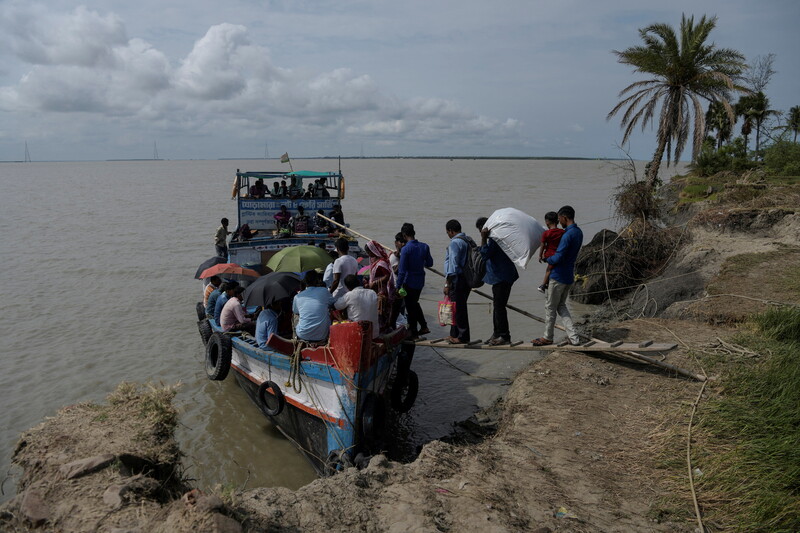
Accelerated climate change is driving unprecedented global migration due to extreme weather, rising sea levels, and uninhabitable conditions, with projections of 1.2 billion displaced by 2050. To manage climate migration effectively, four strategies are essential: climate vulnerability mapping to identify high-risk areas, establishing comprehensive early warning systems, providing timely cash transfers to at-risk populations, and implementing planned relocation for communities facing imminent threats. These measures aim to reduce poverty cycles and enhance resilience among displaced individuals, ensuring proactive and inclusive responses to climate-induced displacement.
Nigeria
4 ways to prevent and manage climate migration

The UK Labour government aims to boost housing construction through relaxed planning regulations, but this may lead to increased car-dependent suburbs that undermine their goal of achieving net zero by 2050. Critics warn that empowering developers could exacerbate environmental degradation and promote unsustainable growth. A focus on retrofitting existing urban areas by improving energy efficiency and enhancing public transport is crucial. Proposed reforms acknowledging the need for sustainable affordable housing exist, but without serious changes in planning approaches, the push for low-density developments could prevail, locking more people into unsustainable lifestyles.
Financial services
Starmer’s plan to ‘build baby build’ risks more American-style car-dominated sprawl

Russia’s frozen assets, totaling up to $300 billion, could be utilized to support Ukraine through a "Reparation Loan" mechanism. Instead of outright confiscation, this approach would involve lending Ukraine money secured by its claim for war damages against Russia. An International Compensation Commission would assess Ukraine's claims, and if Moscow fails to pay, lenders could set off their claims against the frozen assets. This strategy circumvents legal uncertainties linked to outright seizure, preserving international investor confidence while upholding Russia’s obligation under international law to compensate for damages caused by its invasion of Ukraine.
Russian Federation | Financial services
Squaring the Circle: How to Use Russia’s Frozen Assets for Ukraine

India's philanthropic collaboratives have surged in number and investment, especially post-COVID-19, with involvement from diverse stakeholders, including government agencies. From 2020 to 2023, the number of collaboratives tripled and investment grew to $266 million. Successful examples include the Collaborators for Transforming Education (CTE) and the 10to19 Dasra Adolescents Collaborative. CTE, initiated by the EdelGive Foundation, expanded its reach from 25,000 to over 21 million students through partnerships with the Maharashtra government. These models demonstrate effective collaboration can drive significant systemic change in education and youth services across India.
Bangladesh, Cambodia, Cape Verde, Chad, Egypt, Eswatini, Ethiopia, Georgia, Ghana, Haiti, India, Indonesia, Lesotho, Madagascar, Mali, Nepal, Nigeria, Singapore, South Africa, Sweden | Health, Education
How Collaboratives in India Partner With Government to Support Systems Change (SSIR)
AI is becoming a major driver of growth, with 72% of businesses adopting it and projections indicating it could constitute 21% of US GDP by 2030. However, concerns about job displacement and wage stagnation are rising. Authentic Intelligence, which enhances human capabilities through AI collaboration, is necessary to ensure human ingenuity prevails. Governments must build inclusive infrastructure that democratizes access to AI, while corporations need to develop skills like critical thinking and creativity to foster effective collaboration. Investing in these areas can lead to new opportunities instead of job redundancy, ensuring socioeconomic stability in an AI-driven era.
Education
AI will drive growth. But only Authentic Intelligence can empower the world

Governments are seeking actionable guidance to enhance Indigenous trade, as highlighted in a white paper that outlines various government measures at both international and domestic levels, with explanations and practical examples. Indigenous-owned businesses significantly contribute to economic growth while addressing issues like biodiversity loss, climate change, and cultural heritage preservation. The paper emphasizes the importance of meaningful engagement with Indigenous Peoples in developing supportive trade policies and programs.
Enabling Indigenous Trade: Actionable Guidance for Governments
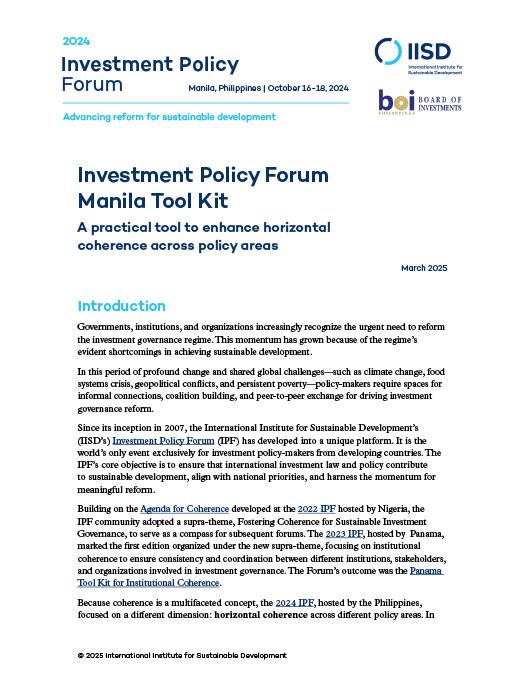
The Investment Policy Forum Manila Tool Kit aids governments in enhancing coherence in investment governance by helping them map and navigate intersections between international agreements and sectoral policies, including mining and public health. It underscores the complexity of aligning investment treaties, national laws, and contracts with international commitments to achieve sustainable development. The toolkit is adaptable to various domestic contexts and aims to improve internal coordination among policymakers, addressing the challenges of regulatory inconsistencies and fostering a more effective investment environment.
Angola, Ghana, Guinea, Haiti, Indonesia, Paraguay, Philippines, Poland, Tanzania | Health
Investment Policy Forum Manila Tool Kit
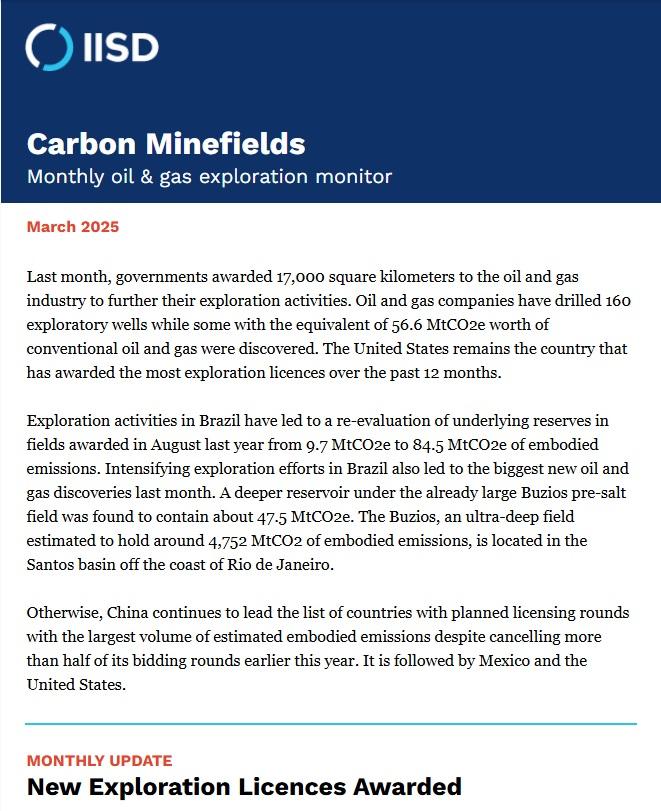
In March 2025, 22 oil and gas exploration licences were awarded across six countries, yielding an estimated 45.4 million barrels of oil and 10.4 billion cubic feet of gas. Notable discoveries in Brazil included a new reservoir beneath the Buzios pre-salt field, estimated at 47.5 MtCO2e. Türkiye awarded licences with significant climate impact, totaling 19.8 million tonnes of embodied CO2 emissions. Over the past year, 1,069 licences were granted, potentially releasing 1,399.3 million tonnes of CO2. China leads with the highest estimated emissions from planned licensing rounds. Global exploration capital expenditure reached USD 746.9 million last month.
Belgium, Bolivia, Burkina Faso, Canada, Denmark, Egypt, Gabon, Ghana, Iceland, India, Netherlands, Norway, Poland, Tunisia, Uganda, United Arab Emirates, United Kingdom
March 2025 | Carbon Minefields Oil and Gas Exploration Monitor

Access to freshwater is rapidly diminishing, impacting billions and threatening economic stability. Increased frequency of droughts, floods, and rising water pollution necessitate urgent action to prevent a tipping point. The rising demand for water, driven by population growth and consumption shifts, compounds the challenge, with water's economic value at approximately $58 trillion. Collaborative efforts through the World Economic Forum’s Water Futures Community, alongside McKinsey & Company, aim to enhance water resilience by promoting multi-stakeholder action and investment to secure water for societies and global economies.
Financial services, Education, Health
Water Futures: Mobilizing Multi-Stakeholder Action for Resilience

Access to freshwater is under significant threat due to increasing water stress, affecting billions globally. Frequent droughts, floods, and rising pollution necessitate urgent action to avoid reaching a critical tipping point. Water resilience is vital for economic stability and business continuity, with demand intensified by population growth and the energy transition. Valued at $58 trillion, water's significance is immense. The World Economic Forum’s Water Futures Community aims to mobilize multi-stakeholder collaboration for sustainable solutions, emphasizing the need for collective action to enhance water resilience effectively.
Financial services, Health
Water Futures: Mobilizing Multi-Stakeholder Action for Resilience

AI is increasingly being utilized in the art world to assess the authenticity of paintings, assisting art experts rather than replacing them. Its data-driven analysis can align with expert opinions, enhancing the credibility of attributions. A notable case involved a painting acquired for under $50 that is claimed to be a lost Van Gogh, stirring controversy due to its questionable quality and the financial incentives influencing authentication efforts. The scenario reflects a broader issue in art history, where authentication can be affected by subjective opinions, competing interests, and the pursuit of monetary gain.
Is That Painting a Lost Masterpiece or a Fraud? Let’s Ask AI

Zimbabwe is leveraging its extensive lithium reserves to drive economic growth and achieve Vision 2030 by implementing a lithium beneficiation policy. This policy bans raw lithium exports to encourage local processing and attract investments in refineries and battery manufacturing. Significant investments from Chinese firms in various lithium projects reflect their dominance in the sector. However, challenges such as infrastructure deficits, capital constraints, and governance issues hinder effective policy implementation. Addressing these challenges could enhance Zimbabwe's growth potential, with predictions indicating GDP could increase significantly by 2030 through successful lithium industrialization initiatives.
Barbados, Bolivia, Bosnia and Herzegovina, Botswana, Burkina Faso, Burundi, Democratic Republic of the Congo, Egypt, Eswatini, Ethiopia, Georgia, Ghana, Hungary, Lesotho, Liberia, Lithuania, Madagascar, Malawi, Mali, Moldova, Mozambique, Namibia, South Africa, Tanzania, Venezuela, Yemen, Zambia, Zimbabwe
Zimbabwe’s lithium beneficiation policy: a catalyst for Vision 2030
AI has the potential to transform healthcare through improved diagnostics and operational efficiencies. However, rapid implementation without a strategic framework can lead to poor patient outcomes, wasted resources, and diminished trust. Key challenges include siloed data, privacy issues, and algorithm biases. A structured approach involving baseline assessments, strategic roadmaps, pilot projects, stakeholder engagement, and sustainable scaling is essential for effective AI integration. Successful examples, like Kaiser Permanente’s phased rollout of HealthConnect, illustrate the benefits of prioritizing strategy over speed in AI adoption.
Health
Why strategy beats speed in introducing AI for healthcare

Global crises highlight the need for a transformative approach to societal issues through a focus on questions. A new science of questions, utilizing participatory methods, is proposed to prioritize the most critical inquiries. An Interdisciplinary Committee has identified the importance of questions for policy and innovation, while also highlighting challenges such as inadequate recognition and skills. The concept of The QLab is introduced as a global center for advancing the research and practice of questioning, with five core functions aimed at enhancing the understanding and application of effective questioning in various domains.
Financial services, Health, Education
Beyond Answers Presented by AI: Unlocking Innovation and Problem Solving Through A New Science of Questions