Big Tech companies have deeply penetrated everyday life through products like Apple smartphones, Amazon services, ChatGPT, and Meta's smart glasses. Cecilia Rikap’s book, The Rulers: Corporate Power in the Age of AI and the Cloud, reveals that contemporary corporate dominance differs from traditional monopoly capitalism. Instead of vertical integration, Big Tech exerts control via networks of nominally independent organizations, creating "intellectual monopolies." These companies manage extensive ecosystems that appear separate but are coordinated under a single corporate influence, expanding their power across various sectors and everyday interactions.
ICT
Big Tech and the rise of intellectual monopolies
The Arctic plays a crucial yet underemphasized role in Europe's pursuit of digital sovereignty. The EU’s upcoming Arctic Strategy should extend beyond traditional security concerns to address hybrid threats, especially in the Baltic Sea region. Central to this are projects expanding Arctic submarine cable infrastructure, which is vital critical infrastructure. Success depends on an ambitious EU commitment to innovation and sustainability, particularly through green technology development.
Antarctica | ICT
The EU’s New Arctic Strategy
Digital technology is increasingly employed across all stages of peacebuilding, including conflict prevention, mitigation, mediation, and post-conflict transitions. The concept of apomediated peacebuilding highlights how authoritative knowledge about conflict and peace emerges from decentralized, peer-to-peer networks involving humans and machines, emphasizing the socially embedded nature of technology. The book provides comparative empirical research from South Sudan, Sri Lanka, and Northern Ireland, examining applications such as social media monitoring to counter harmful speech, mobile-based early warning systems, AI-supported peace dialogues, and online interactions fostering reconciliation and political change. It also critically explores how digitalization levels and political contexts influence peacebuilding outcomes.
Health, Education, ICT
Digital Peacebuilding? The Socio-Technicality of Transforming Armed Conflict

As people age, strength, balance, stamina, and reflexes decline due to physiological changes like decreased muscle mass, falling peak heart rate, and stiffening arteries. Notably, leg strength diminishes faster than muscle mass, impacting mobility despite appearances. While peak aerobic capacity declines steadily and similarly in active and inactive individuals, maintaining a higher fitness level from midlife offers functional advantages. Resistance training remains effective for improving muscle strength and bone density even in the elderly and is recommended twice weekly with progressive overload. However, preventing falls requires combining strength with balance exercises, such as tai chi, as strength alone is insufficient. Stretching shows minimal evidence of reducing fall risk.
What happens to strength, balance, stamina and reflexes as you age – and what you can do about it

The rapid expansion of AI data centers in the U.S. is causing unprecedented electricity demand, challenging the aging power grid and prompting infrastructure and energy policy questions. From nearly flat growth in electricity use over 15 years, demand has surged by about 2% annually recently, with AI data centers accounting for half the increase. These centers, concentrated in a few states, significantly impact grid load and contribute to electricity price rises of 30-35% between 2020 and 2025. Addressing this requires coordinated action on grid modernization, energy storage, utility regulation, and electricity pricing to sustain AI growth and maintain U.S. competitiveness.
ICT
The AI Boom Is Testing America’s Power Grid

British voters’ frustrations are supported by data from the World Bank showing declines in key governance metrics since the 1990s, notably in political stability, government effectiveness, and control of corruption. Political stability decreased sharply after 1997, influenced by events like the Iraq war, while control of corruption worsened post-2007-8 financial crash and again after the 2016 Brexit referendum. Government effectiveness has steadily declined from 84 in 1996 to 74 in 2024. This deterioration aligns with Mancur Olson’s theory that increasing influence of special interest lobbyists prioritizes their gains over public good, weakening governance. Lobbying in the UK has expanded substantially, making it harder to counterbalance these interests.
Latin America | Health, Financial services
If British voters seem impatient and angry, data shows they might have a point

Lower sugar consumption during the first 1,000 days of life, as seen in British postwar sugar rationing, is linked to reduced risks of several cancers—including breast, prostate, liver, rectal, and lung cancer—and slower biological ageing indicated by longer telomeres and lower granzyme B levels. Early sugar exposure also influences long-term dietary habits, with those exposed to rationing maintaining healthier diets and lower sugar intake into adulthood. These effects suggest that early nutrition shapes metabolism, immune function, and taste preferences, impacting health outcomes well into old age.
Babies born under sugar rationing grew into adults with lower cancer risk
Climate adaptation remains a critical priority for Asia and the Pacific as governments aim to enhance resilience in vulnerable sectors and communities, minimize losses and damages, and integrate climate risk management into national planning and investments. Analysis of 21 NDC 3.0 submissions from Asian Development Bank member countries shows progress in adaptation ambitions but reveals uneven readiness for implementation. The study highlights seven priority areas crucial for transforming adaptation goals into effective, inclusive, and scalable actions.
Africa, ASEAN | Health
Advancing Climate Adaptation in Nationally Determined Contributions (NDC 3.0): Progress, Challenges, and the Way Forward for Asia and the Pacific

Investing in women's leadership enhances climate resilience by combining technical climate knowledge with confidence, agency, and leadership skills. In Pacific island countries, women’s participation in decision-making improves environmental outcomes but is often limited by barriers to leadership. The ASPIRE for Women initiative by the Asian Development Bank and UK Government supports women through integrated training linking gender equality, climate resilience, and personal development. Early results from training in Fiji show increased confidence and climate knowledge among participants. Effective climate leadership programs should integrate leadership with technical skills, measure long-term impacts, foster enabling institutional environments, and build sustained local partnerships to empower women to lead climate adaptation and resilience efforts.
Africa
Development Asia: How Investing in Women's Leadership Strengthens Climate Resilience
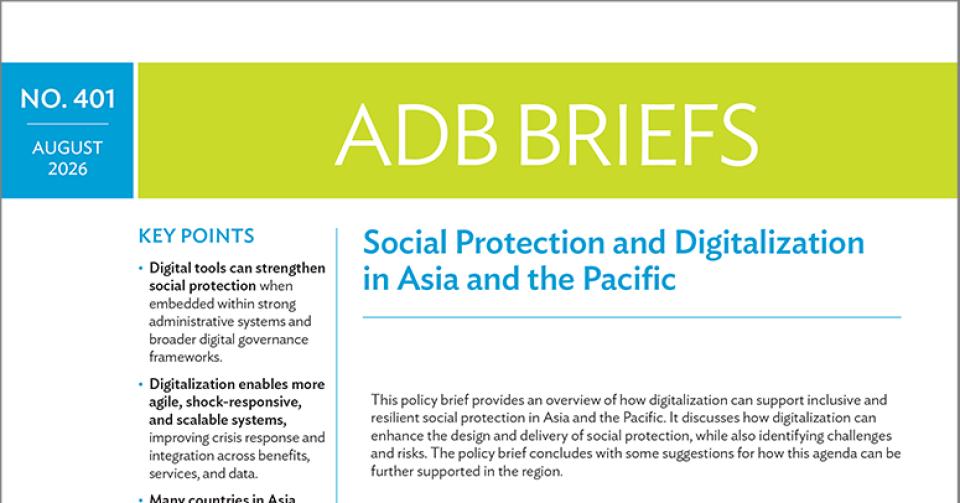
Digitalization enhances social protection in Asia and the Pacific by improving the design, delivery, and coordination of programs. Key factors include digital governance, connectivity, digital identification, interoperable systems, and payment platforms, which expand coverage and boost shock responsiveness. Efforts focus on building inclusive, resilient systems while addressing privacy, security, and exclusion risks to protect vulnerable populations.
Africa, ASEAN | ICT, Financial services, Health
Social Protection and Digitalization in Asia and the Pacific
The public debate on new data center construction has intensified, leading to moratoria due to concerns about energy and water use benefiting large corporations. However, not all AI requires massive, resource-intensive data centers; many AI applications run efficiently on smaller-scale or edge devices like phones and laptops. Numerous labs and companies, including Rootcomputer, Sakana.ai, Liquid.ai, Alibaba's Qwen, and Apple ML Research, focus on developing small, efficient AI models suitable for everyday devices. The conversation often overlooks these efforts, with polarized discourse obstructing productive discussion. As AI advances, fewer applications need the largest models, driving more cost-effective and targeted AI deployment.
ICT
What the data center conversation is missing
Alessandro Crimi’s book examines the intersection of artificial intelligence and medtech as a pathway to achieving the United Nations’ Sustainable Development Goals. It highlights how innovations—from AI-designed drugs to quantum computing—are transforming society but remain largely inaccessible in low-income countries. The book analyzes social, political, and economic barriers, presents case studies on improving healthcare, agriculture, and sustainability, and emphasizes ethical considerations. It advocates for interdisciplinary solutions that address global challenges and support innovation in resource-limited settings across diverse economies.
Education, Health, ICT
Innovate for Impact: A Roadmap to Sustainable Technology Beyond AI
Christoph Igel has been appointed Director of the Fraunhofer Institute for Communication, Information Processing and Ergonomics FKIE as of August 15, 2026, co-leading with Peter Martini. Fraunhofer FKIE specializes in advancing defense and security technologies for the armed forces and civilian agencies, focusing on data processing, cybersecurity, and human-machine systems. Igel brings extensive experience in information technology and cybersecurity, previously leading the Federal Agency for Innovation in Cybersecurity. His leadership aims to enhance research, technology transfer, and innovation, strengthening ties between research and practical application to support the Bundeswehr, emergency services, industry, and society.
Education, ICT
Christoph Igel Joins Fraunhofer FKIE’s Institute Management

Communities in South Asia, including India and Bangladesh, are increasingly forced to relocate permanently due to climate change impacts like coastal erosion and cyclones. While planned relocation offers safety from recurring disasters, simply moving people is insufficient. Successful resettlement requires rebuilding livelihoods, social ties, and cultural connections. Many relocated people lose access to traditional work like fishing or farming, leading to economic insecurity and increased migration for income. Effective relocation involves community participation, ensuring access to jobs, infrastructure, education, healthcare, and spaces for cultural practices. Without these, relocation risks trading one set of hardships for another.
Africa
Climate change is driving some entire communities to relocate – but simply moving isn’t enough

Artificial intelligence in farming offers significant potential to improve animal welfare by enhancing understanding of animals' needs and enabling positive welfare indicators like detecting play behavior. However, many current AI applications prioritize production efficiency over animals' natural behaviors, exemplified by technology restricting hens' nesting choices or breeding sows to fit confinement systems. The EU’s Livestock Strategy promotes AI adoption to improve welfare, but success depends on policy frameworks ensuring animals' needs are genuinely prioritized rather than overridden by industrial farming goals. Steering AI use toward enhancing animals' positive experiences is crucial for ethical and sustainable farming.
AI in farming must put animal welfare first
Entry-level hiring in white-collar jobs has declined sharply since 2017, often attributed to generative AI reducing the need for junior roles performing routine tasks. However, research analyzing millions of hires and job ads across Australia, Canada, the UK, and the US reveals that increased work-from-home (WFH) adoption may be a significant, overlooked factor. Roles most exposed to AI overlap strongly with those shifted to remote work, such as software developers and accountants. Firms offering remote or hybrid work have disproportionately cut junior hires, suggesting that remote work, rather than AI alone, is driving the decline in early-career opportunities.
Education
ChatGPT or Zoom – which broke the career ladder?
The 2026 NPT Review Conference ended without consensus for the third consecutive time, marking an unprecedented series of failures in its 56-year history. Despite concerns, this does not signal the collapse of the treaty or the nuclear order. The NPT remains a vital foundation for global nuclear governance, although tensions persist due to the division between five nuclear-weapon states and 186 non-nuclear-weapon states. The treaty’s survival depends on curbing escalating Russian and Chinese challenges and maintaining US leadership.
“The NPT Is Dead, Long Live the NPT!”
Maternal mental health is a critical but often overlooked issue in Asia and the Pacific, affecting one in five women during pregnancy and postpartum. Poor maternal mental wellbeing can lead to adverse outcomes including preterm birth, impaired child development, and long-term economic and social impacts. Addressing maternal mental health requires more than clinical care; it demands integrated approaches that consider social determinants like gender inequality, financial insecurity, and climate change. Countries like Thailand, Indonesia, Nepal, and India demonstrate that embedding mental health support into routine maternal and child health services, community programs, and early childhood development initiatives enhances accessibility and effectiveness. Strengthening primary healthcare, social protection, and gender-responsive policies are essential for sustainable improvements.
Africa | Health
Development Asia: Beyond Birth: Integrating Maternal Mental Health into Every Stage of Care
Many countries, especially in Europe and East Asia, have already passed their peak populations due to sustained low fertility rates, leading to structural population decline. By 2026, 64 countries had peaked, including Japan and Italy over a decade ago, with others like Thailand and Uruguay showing similarly low birth rates. Projections suggest that by mid-century, many South American and South Asian countries, including India, will also experience peak populations. Population trends are highly sensitive to fertility, life expectancy, and migration assumptions. For example, the U.S. population remains stable only because of immigration; without it, the population would decline significantly. In some countries, like South Korea, reversing population decline appears nearly impossible given current demographic trends.
Africa | Health
Which countries have already passed peak population, and when will the rest do so?

Gen Z is increasingly choosing entrepreneurship over traditional careers due to shifting expectations, a challenging entry-level job market, and a desire for flexibility. AI tools are lowering barriers by making it easier to develop ideas into products, though they also heighten competition. Insights from venture capital, failure experiences, the creator economy, and programs like VentureLab offer valuable lessons for aspiring founders navigating this landscape.
Education
Why Gen Z Is Choosing Entrepreneurship Over Traditional Careers