Forum Spaces
Product
Use Cases
Get involved

Insights

The unfolding heat crisis in Thailand and Southeast Asia poses significant risks due to rising global temperatures and increased heat stress vulnerability. This report highlights challenges in scaling heat resilience and presents emerging regulatory, policy, technical, and financial solutions. It offers a detailed Heat Action Plan roadmap for Thailand that prioritizes protecting vulnerable populations, mobilizing public and private finance, and accelerating coordinated cross-sectoral responses to build inclusive, evidence-based, and sustainable heat resilience.
Health
The Unfolding Heat Crisis in Thailand and Southeast Asia: Challenges and Emerging Solutions

Public participation in democracy has long been underestimated and treated as a problem to control rather than a valuable resource. Historically, skepticism about citizens’ capacity to engage meaningfully led institutions to prioritize public relations over genuine power-sharing, focusing on participation rates rather than policy impact. However, Brazil’s experience shows that participation gains significance only when linked to real decision-making. Advances in artificial intelligence now offer unprecedented potential to analyze and act on widespread public input, transforming mere talk into actionable insight. The current challenge lies in developing institutions that can effectively listen and respond to collective public intelligence.
Education
Democracy has a listening problem. These AI tools could actually help
Effective digital service teams require a clear, multi-level strategy focused on a few pivotal objectives that drive substantial outcomes. Currently, federal digital teams lack a shared long-term strategy, causing confusion, resource competition, and limited impact. Strategy should articulate how digital services contribute to societal goals, align government-wide priorities, and coordinate diverse functional teams. Without this, efforts become siloed, and success is measured by activity rather than meaningful progress. In an era of rapid technological change, such as AI adoption, establishing and communicating strategic priorities is critical to achieving lasting, user-centered government improvements.
What We Recommend for Building Better Digital Service Teams, Initiatives, and Results
The book edited by Jane E Fountain, Sorin Dan, and Niina Mäntylä explores how artificial intelligence reshapes power dynamics within government and between the state and its citizens. It brings together experts from public policy, law, information technology, and public management to analyze AI's impact on governance. Key themes include power exercise, liability, ethical policymaking, surveillance, and AI applications in public organizations. The work assesses AI's influence through legal, policy, and management lenses across global government contexts and outlines future research directions on AI and governmental power.
Artificial Intelligence and Power in Government
AI-generated content currently makes up a significant portion of online platforms, comprising 16.0% of the internet overall, 18.4% of Substack posts, 34.3% of Medium articles, and 11.6% of content on X. Tools like AI Vision by GPTZero scan millions of posts daily, highlighting AI-written text and predicting that AI-generated content will dominate major platforms within a decade.
The internet is filling up with AI.
SimPolitics by Fenwick McKelvey explores how computer models have become integral to political practice, from winning elections to managing global affairs. Tracing the history from the 1960s to the late 1980s, the book reveals how various actors—programmers, consultants, academics, and activists—developed simulations to forecast political events, predict coups, and make politics as quantifiable as data on a spreadsheet. McKelvey compares U.S. efforts to simulate domestic and international politics, uncovering the connections and tensions between them. The book critically examines longstanding claims that technology and AI will revolutionize politics, highlighting the persistence of such promises over decades.
SimPolitics
Full Stack Spies explores how elite hackers employ common technologies to steal state secrets, revealing complex ties to their nation-state sponsors. The book highlights the paradox of cyber espionage, where nations must collaborate to maintain global internet stability while simultaneously engaging in covert cyber operations against each other. It examines the intricate relationships among hackers, cyber defenders, tech companies, and governments competing for influence in geopolitics, trade, military, and critical infrastructure. This ongoing cyber rivalry complicates security efforts and erodes trust, threatening the stability of digital societies worldwide.
Full Stack Spies
Geoff Mulgan's paper integrates perspectives from diverse disciplines—including economics, psychology, computer science, political science, law, and anthropology—to explore how insights from biology and computation can reconceptualize organizations as living ecosystems that both compete and collaborate. He highlights the need for interdisciplinary engagement and knowledge exchange to drive essential reforms in public institutions at all levels, aiming for more adaptive and sustainable institutional futures.
Education
Shaping future institutions
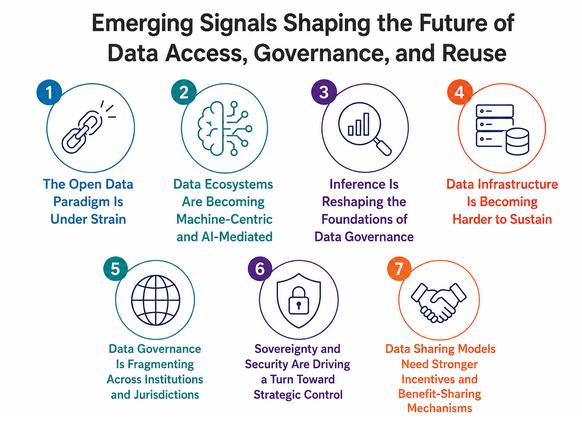
Artificial intelligence is rapidly transforming the global relationship with data, fueling excitement for its ability to address public challenges, enhance decision-making, and generate social and economic value. However, AI also intensifies debates on data access, ownership, privacy, labor rights, security, and the responsible use of public-interest data, moving these issues to the forefront of policy discussions. Governments, organizations, and companies are developing diverse governance strategies, including regulations and international agreements, yet distinguishing short-term shifts from fundamental changes remains challenging. Expert forums have identified seven emerging signals indicating that AI advancements, combined with evolving expectations about trust, stewardship, infrastructure, sovereignty, reciprocity, and public value, will significantly shape the future of data governance and policy frameworks.
ICT, Health, Education
Anticipating Data Policy in the Age of AI
Jibu Elias’s book, The New Divide: Power, Control & the Cost of AI, critically examines how artificial intelligence reshapes society, concentrating power, displacing jobs, embedding biases, and causing environmental harm. Drawing on extensive experience in AI governance, Elias highlights the gap between AI’s promises and its realities, especially in the Global South. The book calls for urgent ethical governance and regulation to reclaim human agency before AI systems increasingly govern economic and social life.
The New Divide: Power, Control & the Cost of AI
Jeremy Siegel evaluates Alan Greenspan’s significant influence on monetary policy and draws lessons from the 2008 financial crisis. He analyzes early leadership under Federal Reserve Chair Kevin Warsh and highlights the potential of forward-looking economic data to guide future interest rate decisions. Additionally, Siegel revisits the long-term economic impacts of Brexit, emphasizing ongoing shifts in global economic dynamics.
Financial services
Evaluating Greenspan’s Legacy and the Evolution of Monetary Policy

1.3 billion disabled people, who face higher risks from climate emergencies, currently lack formal representation in UN climate negotiations. Disabled individuals, especially those with psycho-social disabilities, experience disproportionately high mortality in heatwaves due to medication side effects and inadequate emergency responses. Steps to improve inclusivity include: integrating research led by disabled experts to inform climate adaptation; granting the UNFCCC Disability Caucus full observer status to ensure equal participation; and enhancing accessibility at climate policy meetings by addressing physical and communication barriers. These measures are essential to protect disabled people and ensure their meaningful involvement in climate action.
Health
Three ways climate action can be more inclusive for 1.3 billion disabled people

Investigative interviewing is crucial for reliable criminal justice, as it shapes the accuracy of witness and suspect accounts. Traditional methods often led to false confessions and distorted memories. AI has potential to improve policing by assisting information gathering, prompting unbiased questions, and training officers. However, research shows AI can also distort memories, especially through sycophantic interactions, reducing recall accuracy and risking misinformation. Vulnerable witnesses may be particularly affected. There are concerns about automation bias, where officers over-rely on AI outputs. The real impacts of AI in live interviews and courtrooms remain largely unknown, necessitating further research to assess benefits and risks.
Investigative interviews are key to solving crimes – should AI be helping police with their inquiries?
Cate Blanchett launched the “Human Consent Registry,” a voluntary tool allowing individuals to specify if AI companies can use their likeness or require permission/payment before doing so. Preferences are stored in a machine-readable format for AI systems to recognize. While not binding, the registry aims to support future laws and help regulators enforce consent. The EU’s AI Act requires respect for creators’ rights, but protecting personal identities like faces and voices remains complex, with some EU countries pursuing national measures. The European Commission is also developing legislation to address licensing and impersonation challenges posed by AI.
Cate Blanchett launches AI ‘consent’ tool in Parliament
Europe's increasing heatwaves parallel longstanding extreme heat challenges in South Asia, where temperatures frequently exceed 45°C. Research in Pakistan and India shows that informal workers and the poor are disproportionately affected, with limited access to cooling centers and inability to stop working without losing income. Pakistan has implemented heat action plans and cooling centers, but informal laborers lack adequate protection. India has started heatstroke treatment units and heat warning systems, yet informal workers face the dilemma between unsafe work conditions and income loss. Innovative solutions like parametric insurance for vulnerable informal workers are emerging to offset livelihood losses during heat crises.
How to live and work in extreme heat
China aims to peak emissions before 2030 and achieve carbon neutrality by 2060 by transforming its energy, industry, and transport sectors. The "1+N" policy framework focuses on improving energy efficiency, reducing emissions, and expanding non-fossil energy use. Addressing a green investment funding gap, the country plans to shift from expenditure-focused strategies to fiscal reforms, including developing carbon markets, implementing carbon taxes, and cutting fossil fuel subsidies. These measures are intended to reduce fiscal pressures and promote sustainable growth in a low-carbon economy.
Implementation of Dual Carbon Goals and Fiscal Sustainability in the People’s Republic of China

British politics has shifted from stable two-party dominance characterized by class-based voting to a volatile, fragmented system. Analysis of 37 general elections from 1885 to 2024 reveals that a strong class divide, with working-class areas favoring Labour and middle-class areas favoring Conservatives, solidified after 1918 and remained stable until the 1990s. This divide collapsed abruptly during the New Labour era (1997-2010), with Labour's working-class support shrinking significantly by 2024. The decline was not gradual social change but a rapid political realignment. Meanwhile, the Conservative-class link held until around 2015, before weakening sharply post-Brexit, as Conservatives gained in working-class constituencies.
The class divide in British politics didn’t erode slowly – it collapsed under New Labour

Northern Ireland’s political parties have displayed varied and evolving stances on the EU shaped by their navigation of a complex, multi-level political landscape. Sinn Féin initially opposed the EEC due to sovereignty concerns but moderated its position post-1998, opposing Brexit and supporting special status for Northern Ireland. The Ulster Unionist Party (UUP) showed inconsistency, shifting between Eurosceptic and pro-European positions before supporting Remain in 2016, though it struggled with Brexit’s impact on Northern Ireland. The Democratic Unionist Party (DUP) has consistently opposed EU integration, backed Brexit, and strongly opposed the Northern Ireland Protocol, even collapsing power-sharing institutions to challenge it. These party positions reflect deeper social and political cleavages in the region.
How Northern Ireland’s parties navigated Europe before and after Brexit

Tourists are encouraged to use sustainable transport like walking, cycling, and public transit to reduce emissions and enhance local engagement. Cities such as Paris, Copenhagen, Utrecht, and Ghent have invested in cycling infrastructure, maps, and pedestrian-friendly routes to promote active travel as part of the visitor experience. However, rising summer heat poses challenges, discouraging outdoor travel modes without adequate shade, water, and rest areas. Climate-adapted urban design including green corridors, shaded paths, and accessible facilities can support cycling and walking even in hot climates. These measures improve wellbeing, reduce congestion, and contribute to climate resilience in popular tourist destinations.
Holiday travel planning: reasons to try public transport or cycling when you get to your destination
The war in Iran disrupts oil and gas supplies, prompting China to increase coal use in the short term, raising its carbon emissions. However, energy security concerns and volatile fossil fuel prices will drive China to accelerate investment in renewables and clean technologies over the medium and long term. This shift follows a historical pattern, as China’s “Malacca Dilemma” led to early clean energy policies. The current “Hormuz Dilemma” reinforces the urgency to reduce reliance on imported fossil fuels. Although coal use may temporarily rise, China’s decarbonisation will ultimately accelerate due to cheaper renewables and growing global demand for clean tech.
How the war in Iran changes China’s decarbonisation path
Show more

Forum Spaces

© 2026 All rights reserved
Privacy Policy & Terms of Service