
The EU's Chips Act 2.0 and the Cloud and AI Development Act (CADA) establish a comprehensive framework to define "trusted partners" in critical technologies, marking a shift toward an EU economic foreign policy. This framework prioritizes companies based on ownership and trust, requiring "domestic undertakings" to meet specific obligations and allowing them preferential access to funding and strategic projects. It addresses vulnerabilities like overreliance on third countries and aims to enhance crisis preparedness. The approach reshapes market access, incentivizing alignment with EU standards and enabling foreign firms, especially from trusted partners like Taiwan, to integrate into Europe's technology security perimeter.
Barbados, Cyprus, Denmark, Estonia, Hungary, Poland, Taiwan, China | Financial services, ICT
The Architecture of Trusted Partner Alignment: Building an EU Economic Foreign Policy Through Chips Act 2.0 and CADA
Social democratic parties face declining traditional support and challenges from both the right and left. Their success varies, with parties like Labour winning significant elections but struggling in local polls. A new, practical approach to social democracy is needed—one focused on adapting to political and economic contexts rather than rigid ideology. Labour’s current strategy emphasizes immediate, workable policies over long-term socialist goals but battles internal tensions and external competition from other parties. Historical examples, like Sweden’s Social Democrats, show that balancing tax burdens and welfare ambitions is complex. Ultimately, social democracy’s future depends on its ability to pragmatically manage conflicting demands and evolving circumstances.
Left‑of‑centre parties like Labour face challenges from both right and left – here’s what they can do about it
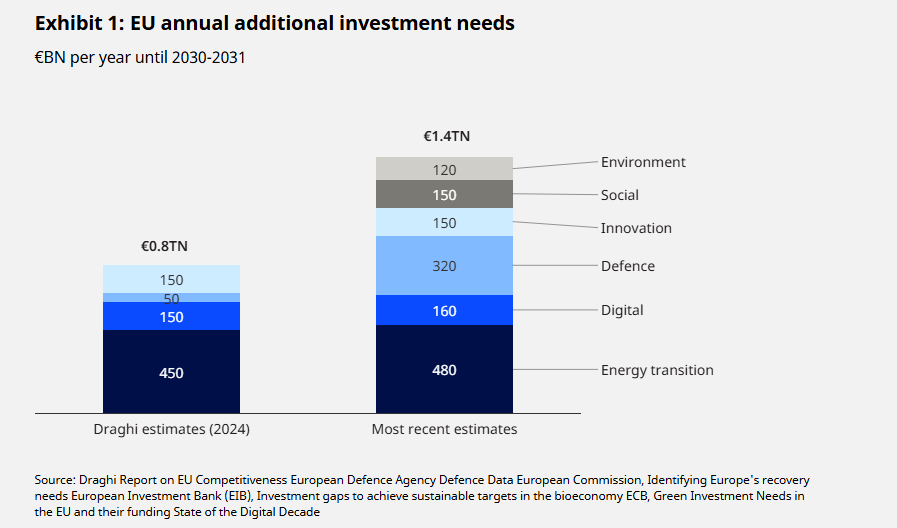
The EU faces an urgent need for €1.4 trillion in annual investment by 2030 across sectors like energy, defense, digital infrastructure, and climate resilience to reverse weak growth and enhance competitiveness. However, its underdeveloped capital markets and fragmented financial system limit efficient capital mobilization, leaving banks—already constrained by stringent regulations—to shoulder much of the investment burden. To bridge the investment gap, Europe needs a balanced regulatory framework that supports long-term corporate lending without compromising financial stability, alongside accelerated development of the Savings and Investment Union, deeper capital markets, and reduced cross-border barriers. Strengthening this financing continuum is critical for unlocking Europe’s investment potential and economic resilience.
Africa, Latin America | Education, Financial services
How banks can help solve Europe's corporate investment gap
The EU has been cautious about digital currencies, prioritizing financial stability, but recent geopolitical risks highlight the need for economic autonomy from the US. Introducing a digital euro, planned for 2029, and fostering euro-backed stablecoins could modernize payments, enhance security, and reduce reliance on US-dominated financial systems like Visa and Mastercard. These initiatives would support a multi-currency global order, increase the euro's international use, and offer a competitive alternative to US and Chinese digital currency policies. Embracing digital currencies could become crucial for the EU’s economic and geopolitical resilience.
Latin America | Financial services
Why the EU economy should embrace digital currencies to become less dependent on the US
Sarah O’Connor’s book, We Are Not Machines, explores how technological advances like AI and robotics are changing the nature of work. While machines may not always replace jobs, many workers experience their roles as lonelier, less creative, and less human. However, O’Connor also highlights examples of technology improving job safety and satisfaction when workers learn to control new tools. The book argues that the future of work is not fixed but must be actively shaped to respect human limits and dignity, drawing on historical and contemporary stories to envision more humane and empowering workplaces.
We Are Not Machines
The surge in oil and gas prices following geopolitical conflicts has prompted calls to implement permanent, higher taxes on these companies rather than temporary windfall taxes. Permanent profit taxes would better incentivize oil and gas firms to invest in renewable energy by making fossil fuel profits less attractive compared to renewables. Windfall taxes, while raising significant revenue, have failed to substantially shift investment towards green energy. Unlike carbon taxes that largely burden consumers, profit taxes mainly affect capital owners, minimizing direct consumer price impacts. Coordinated, sustained tax reforms on fossil fuel profits are needed to drive the energy transition and align investor behavior with climate goals.
It is time to permanently increase taxes on oil and gas companies
Tropical rainforests are nearing collapse, and halting deforestation requires societal shifts rather than just knowledge or regulation. Positive tipping points—where a small push causes rapid, irreversible change—are key to aligning actions for forest protection. Historical shifts, such as the collapse of the British fur trade due to changing social norms, illustrate this dynamic. Efforts like the Amazon soy moratorium significantly reduced deforestation by influencing trader behavior but didn’t alter the underlying economy favoring land clearing. Lasting forest protection depends on triggering social tipping points that motivate enough stakeholders to adopt new norms and economic incentives favoring forest conservation.
Brazil
How positive tipping points may be the key to protecting tropical rainforests
Researchers at the University of Cambridge developed the world’s first AI-designed DNA vaccine targeting conserved features of sarbecoviruses, including those causing SARS, COVID-19, and related animal coronaviruses. Unlike traditional vaccines targeting specific strains, this broad-spectrum vaccine aims to protect against current and future variants, potentially preventing pandemics. It uses DNA for increased stability and needle-free administration. Initial human trials demonstrated safety and immune responses producing antibodies against diverse sarbecoviruses, though responses were modest and long-term efficacy remains unclear. Further trials are needed, but this AI-driven approach marks a significant step toward universal vaccines.
World’s first AI‑designed vaccine explained
Technology decentralisation is increasingly advocated to create more trustworthy, accessible, and innovative digital public infrastructure, but empirical evidence of its public sector benefits remains limited. This study uses an assemblage thinking approach and a public values framework to analyze Hamburg’s Urban Data Platform, revealing that public value stems not solely from technical decentralisation but from specific combinations of architecture and governance. Decentralised and centralised practices coexist within the platform, with a leading orchestrator playing a crucial role in driving public value creation.
Financial services, ICT, Education
Decentralisation in public sector data platforms: A pathway to enhancing public value?
Artificial intelligence deployment for social impact in Asia is uneven, concentrated in select sectors and countries, often favoring technological innovation over ecosystem readiness in data infrastructure, governance, financing, and institutional capacity. Drawing on over 2,800 AI-for-impact initiatives across 10 Asian economies, this report identifies ecosystem archetypes based on state involvement and capacity. It highlights AI applications aiding community health workers, reducing administrative burdens, boosting fundraising, and improving microentrepreneur coordination. Addressing institutional, financial, and ethical challenges is key to enabling systemic change, shared infrastructure, and equitable, safe AI adoption.
Education
AI for Impact: The Role of Artificial Intelligence in Social Innovation in Asia
Earth observation (EO) contributes approximately $440 billion annually to global GDP by providing critical intelligence for addressing climate risks, geopolitical changes, and supply chain challenges. An additional $263 billion in value is untapped, primarily across data acquisition, processing, and deployment. Advancing these areas is essential for EO to evolve from a promising technology into a system-level impact driving broader economic and strategic benefits.
Georgia
Earth Observation: Unlocking the $700 Billion Opportunity
The publication “Pathways of Post-War SSR, Part I” establishes a conceptual and methodological framework for analyzing post-war security sector reform (SSR), emphasizing the complex balance between military effectiveness, democratic accountability, and institutional resilience. Through comparative research on Finland, South Korea, Taiwan, and Ukraine, it highlights how defense reforms are shaped by political, strategic, and institutional factors under prolonged insecurity and external threats. The study challenges simplistic, linear models of transition and incorporates diverse theoretical perspectives to inform democratic defense governance. Its findings offer valuable insights for Ukraine’s post-war reconstruction and broader governance challenges faced by states under geopolitical pressure.
Ukraine
Pathways of post-war SSR- PART 1:Conceptual framework and comparative research design
Artificial intelligence is reshaping executive coaching by enhancing efficiency and expanding access while preserving the essential human connection. AI tools assist coaches by automating tasks like session summarization and client analysis, and they enable a flexible coaching process beyond scheduled meetings. This hybrid approach, combining AI's data processing with human judgment, supports deeper insight and personalized guidance. AI also democratizes coaching, making it accessible to a broader audience beyond senior management by offering career advice 24/7. However, AI cannot replace the empathy, nuanced understanding, and wisdom that human coaches provide in addressing complex executive dilemmas.
Education
AI and executive coaching: Building hybrid relationships for career guidance
The Asia-Pacific Trade Facilitation Report 2026 explores how artificial intelligence (AI) is revolutionizing trade processes in the region by enhancing compliance, document processing, and risk management. It analyzes AI applications across the trade value chain, assesses adoption levels, and identifies key barriers. The report also addresses policy priorities to harness AI-driven digitalization for more efficient, resilient, and sustainable trade facilitation systems, supporting global value chain sustainability and resilience.
Asia-Pacific Trade Facilitation Report 2026: Harnessing Artificial Intelligence in Trade Facilitation
Designing public spaces with women and girls in mind makes cities safer, greener, and more resilient for everyone. Women often feel unsafe in parks and streets due to poor design, causing them to limit their use of these spaces. Incorporating features like clear sightlines, seating, clean toilets, shade, and accessible paths improves safety and usability, benefiting all community members. Involving women in planning leads to spaces that better reflect daily needs and shifts perceptions of women as leaders. Examples from Bangladesh and the Solomon Islands show flood-aware, inclusive designs and community-managed gardens enhancing safety, food access, and social cohesion. Prioritizing women and vulnerable groups in urban design fosters equity and environmental resilience.
Public Spaces Designed for Women and Girls Are Good for All-And the Planet
Risk should be integrated into corporate strategy discussions, not treated as a separate compliance task. Boards often focus on operational risks like costs and supply chains, overlooking deeper strategic risks such as technological obsolescence, faulty assumptions, and long-term market changes. Effective risk governance requires challenging underlying assumptions and considering time horizons beyond typical CEO tenures. Corporate culture also represents a critical but often neglected risk factor. The most resilient boards proactively question management, especially during strong performance periods, to better anticipate strategic risks and ensure sustainable success.
Financial services
Risk should be the language of the boardroom, not a compliance ritual
The European Commission’s Technological Sovereignty Package represents a significant shift in viewing digital infrastructure as a strategic asset critical to security, competitiveness, and geopolitical influence. It includes initiatives like Chips Act 2.0, Cloud and AI Development Act, and the Open Source Strategy aimed at strengthening Europe’s digital value chain by boosting semiconductor production, data center capacity, AI deployment, and promoting open-source technologies. However, technological sovereignty should focus not just on infrastructure but on ensuring meaningful agency for individuals and institutions over digital systems, emphasizing digital self-determination. This involves addressing three dimensions: dependency on foreign infrastructure, risks in digital openness, and systemic imbalances in agency, highlighting that power distribution and accountability in digital systems are essential.
Belgium, Estonia, Georgia, Germany, Switzerland, United Kingdom | Financial services, Education, ICT
The Triad of Tech Sovereignty: Dependency, Openness, and Agency
Generative AI tools, increasingly popular across demographics, show signs of addictive use patterns, including emotional dependency and compulsive engagement, which negatively impact users' personal and professional lives. While not formally recognized as addictive, evidence suggests generative AI shares behavioral traits with known addictions like tobacco and gambling, raising questions about responsibility. Key stakeholders include governments and regulators, big tech companies who develop AI and benefit financially, academic researchers, and civil society groups, all of whom must collaborate to address potential harms. Users also bear some responsibility to moderate use, but systemic action and clear accountability are crucial.
Health, Education
If AI is addictive, where does the responsibility lie – with big tech or its users?
ASEAN has evolved from a low-cost manufacturing base to a key player in the global semiconductor supply chain, with exports rising from 20% to nearly 30% between 2015 and 2024. Singapore leads in innovation and high-value activities like IC design and advanced materials, supported by strong R&D initiatives. Malaysia, a major semiconductor exporter, focuses on advanced packaging and manufacturing improvements. Vietnam is rapidly growing as a manufacturing hub, leveraging foreign investment and developing domestic champions linked to AI ambitions. Thailand specializes in PCBs and EV-related semiconductors with significant Chinese investment. ASEAN countries increasingly pursue targeted industrial, trade, and innovation policies to move up the semiconductor value chain amid geopolitical tensions and reshoring strategies.
Australia, Cambodia, Chile, Egypt, Estonia, Germany, Hungary, India, Indonesia, Japan, Jordan, Kenya, Malaysia, Myanmar, Philippines, Republic of Korea, Senegal, Seychelles, Singapore, South Africa, Taiwan, China, Tanzania, Thailand, United Arab Emirates, United Kingdom, Viet Nam | Financial services, Education, ICT
Three Questions to Angela Tritto - ASEAN’s Rise in Semiconductors
AI is transforming UK banking by enabling faster, cheaper, and more personalized financial services, with widespread consumer use of AI tools for managing money. The UK's advanced open banking framework supports this development by allowing secure sharing of customer data. AI helps simplify complex financial decisions and improve customer insights, as seen with banks like Starling, Lloyds, and NatWest. However, challenges persist around transparency, accountability, and explainability, especially when AI decisions affect customers without clear communication or human recourse. The UK's principle-based regulation holds firms and senior managers responsible for AI-related risks but requires careful oversight. AI will truly benefit customers only if it combines speed with fairness, clarity, and accountability.
Financial services, Education
Will AI really make banking better for customers?