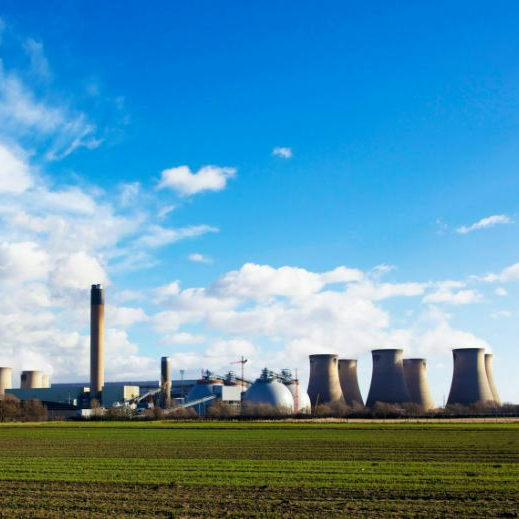
Drax Power Station, commissioned in 1971 in the North of England, was one of the biggest coal-fired power stations in Western Europe. Since 2012, Drax has cut its net fossil-based carbon emissions from power generation by 90%, compared to when it combusted coal, by converting to sustainable biomass and radically transforming the company.
Four out of six of the boilers at the North Yorkshire site have now been converted to biomass, with its two remaining coal units ceasing commercial operations in March 2021. Using sustainable biomass, the renewable capacity is now 2,595MW.
Drax Power Station provides the most renewable power of any single location in the UK and is planning to deliver the world’s largest carbon removal project at the site, using Bioenergy with Carbon Capture and Storage (BECCS). BECCS is the process of capturing and permanently storing carbon dioxide (CO2) from biomass energy generation, a technology which Drax has trialed several times at the power station since 2019.
Upon completion, the Drax BECCS project will enable Carbon Capture and Storage (CCS), delivering CO2 into a shared pipeline for permanent storage under the seabed of the Southern North Sea. Once operational, the BECCS project at Drax will capture at least 8 million tonnes of CO2 per year.
With the right engagement from the UK Government around its Energy Security Plan and with swift decision making, Drax stands ready to progress this £2bn investment programme and deliver this critical project for the UK by 2030. Recent estimates indicate that deploying BECCS at Drax by 2027 will save the UK £26bn on costs to get the UK to net-zero.
Technology
• Drax Power Station provides ~11% of the UK’s renewable power. The site provides the most renewable power of any single location in the UK, some 14 terawatt-hours or enough electricity to power the equivalent of five million homes.
• Drax plays a critical role in supporting UK energy security, providing more renewable power by output than any other company.
• The biomass units are fully flexible, consistently generate power in periods of peak demand, and have operated at the highest load factor of all technologies during peak periods over the last 3 years.
• In order to identify the fundamentally different physical and chemical characteristics of biomass versus coal, Drax chose to follow a combined approach of global technology best-practice scanning and a programme of full-scale testing at Drax power station.
• This led to confirmation of a conversion work-scope that would provide the necessary biomass generating capability and would aim to repurpose existing equipment wherever possible.
• While no significant changes were required for the steam turbine, generator or associated auxiliary systems, the repurposing project entailed the construction of a state-of-the-art fuel reception, handling and storage plant, fitted with systems to ensure that biomass can be handled safely. Modifications were also made to the pulverising mills (to break up the pellets), pneumatic fuel conveying systems and the burners in the boilers. A number of other systems were modified to control combustion and emissions.
• Further upstream in the supply chain, Drax designed and built bespoke rail wagons that could maximise the capability of the existing transport system to improve efficiency and reduce transport costs.
Approach
• 2003: Start of co-firing biomass across six units using a mix of 5% biomass and 95% coal.
• 2005: A direct injection facility was added which involved blowing crushed wood pellets into coal fuel lines from two of the power station’s 60 mills.
• 2008: Launched biomass sustainability programme.
• 2010: Completion of 400MW co-firing facility
• 2012: Extensive trials confirm unit conversion. Final investment decision on 3 unit conversion c.£350m
• 2013: First biomass unit converted.
• 2014: Second biomass unit converted.
• 2015: Third biomass unit enhanced co-firing- fully converted in 2016.
• 2018: Fourth biomass unit converted.
• 2019: Drax BECCS pilot (with C-Capture) started capturing CO2 in world first with 100% biomass feedstock.
• 2020: Second Drax pilot (with MHI) to capture CO2 from biomass feedstock installed in the autumn.
• 2021: Front end engineering design (FEED) study for BECCS at Drax Power Station began.
• 2023: Decision expected from UK Government on development consent order2024: Final investment decision made and construction of first two BECCS units begin at Drax Power Station.
• 2027: BECCS operating on at least one biomass generating unit at Drax, permanently removing 4 MtCO2/yr
• 2030: BECCS operating on two biomass units, permanently removing 8 MtCO2/yr and Drax Group becomes a carbon negative company.
• 2035: Great Britain’s power system reaches net zero emissions.
• 2040: Humber industrial cluster achieves zero carbon status.
• 2050: The UK economy reaches net zero emissions.
• 2050 and beyond: BECCS, carbon removal technology and techniques such as reforestation, remove enough greenhouse gases to go beyond net zero and begin reversing the impacts of climate change.
Just Transition
Drax Power Station currently employs ~900 people and supports a wider 4,200 jobs in the Yorkshire and Humber region of the UK. Scaling up BECCS at Drax will support 10,000 jobs at peak construction, which could start as soon as 2024.
Through the Drax Foundation, launched in February 2023, Drax is also investing in STEM education and skills development programmes, with a particular focus on under-served communities and the skills and education needed to support ‘green’ jobs for the future. The Drax Foundation launches in February 2023.