Challenges to investment
In 2003, Kenya’s energy sector was marked by unreliable electricity, coupled with significant affordability issues. The National Energy Policy in 2004 formulated detailed reforms to address the situation. This was Kenya’s first policy attempt to mandate the promotion of private sector investments in renewable energy (RE). Still, Kenya required RE regulations and investment-enabling reforms to implement the National Energy Policy of 2004, particularly those which would establish equal treatment for foreign and domestic investors and therefore attract private RE investment.
Approach
The Energy Act of 2006 liberalized Kenya’s electricity sector, repealing the Power Act of 1997, and established laws relating to RE and energy efficiency to attract private investment. In particular, the act unbundled electricity generation from transmission and distribution, allowing private sector investment in power generation via Independent Power Producers (IPPs). The Act also established the Energy Regulatory Commission (ERC) to regulate production, distribution, supply and use of renewable energy among others. Additionally, the Investment Promotion Act (2004) regulated overall investment activities in Kenya, including foreign direct investment, and established the Kenya Investment Authority (KenInvest) to promote and facilitate both domestic and foreign investments. These reforms institutionalized protections for foreign RE investors, building on the 1976 Foreign Investment Protection Act (FIPA), which ensured foreign investors’ property cannot be nationalized without full compensation and allowed for unrestricted capital repatriation and transfer of profits in approved foreign currencies.
Key Enabling Conditions
International initiatives and organizations such as Power Africa, the World Bank, Agence Française de Développement (AFD), the African Development Bank (AfDB), the British International Investment (BII), the German Development Bank (KfW), and the European Investment Bank (EIB) have provided financial support and technical assistance to IPPs to reach financial closure. Moreover, KenInvest has built on the initial success of the energy sector reforms by launching the Kenya Investment Policy and the Country Investment Handbook in 2019.
Impact / Outcomes
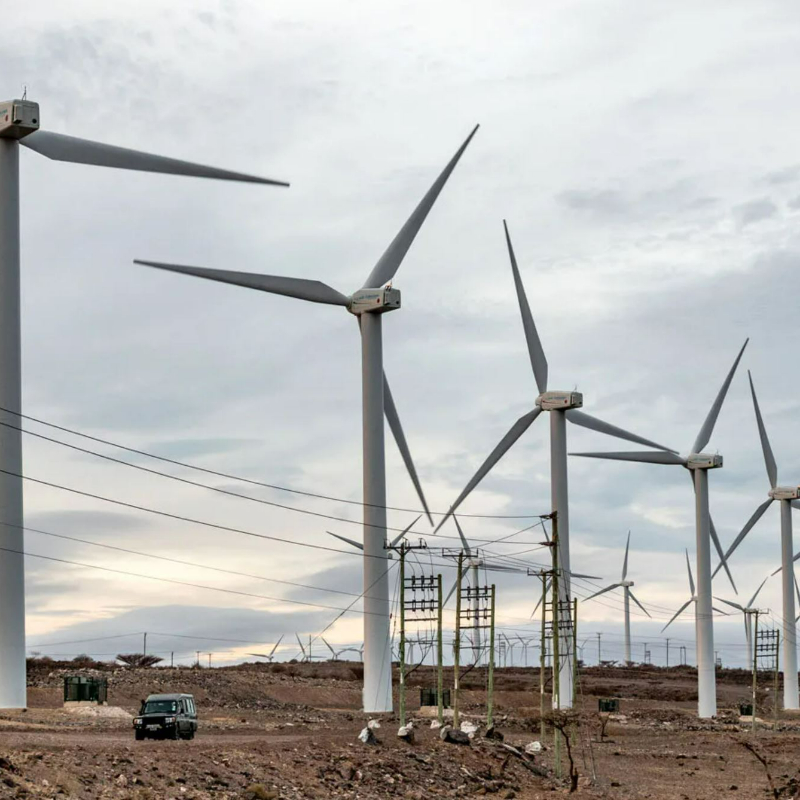
Investments in RE, though not an explicit investment opportunity category under KenInvest, qualified for investment promotion activities because they improved Kenya’s standard of living through the production and utilization of RE. In total, wind and solar grew from near-zero share of power generation in 2006 to 17.4% of Kenya's total power generation in 2021, with wind alone contributing 16%. Approved RE projects by 2021 included Cedate and Selenkei Solar (40MW each), Alten Solar (40MW) Malindi Solar (40MW), Kipeto Wind (100 MW), Chania Green Wind (50MW),and several smaller projects ranging from 0.5 to 2.0 MW. The largest private investment was the Lake Turkana Wind Power Project. The project, estimated at $800 million, began construction in 2014 and entered commercial operation in June 2018. With a contracted capacity of 310 MW, the Turkana Wind Park provided enough power for 1 million households and offset around 737,000 tons of carbon dioxide emissions annually. The steps taken by Kenya to ensure capital repatriation for investors were absolute key enablers of these developments.
Additional Sources
- Bowmans (2022). Foreign Direct Investment Regimes 2022, https://www.bowmanslaw.com/wp-content/uploads/2021/11/FDIR22_Chapter-3_Bowmans.pdf
- Energy Charter Secretariat (2016) Energy in the East African Community: The Role of the Energy Charter Treaty, https://www.energycharter.org/fileadmin/DocumentsMedia/Occasional/Energy_in_the_East_African_Community.pdf
- Eberhard, A., Gratwick, K., Morella, E., & Antmann, P. (2016). Independent power projects in Sub-Saharan Africa: Lessons from five key countries. World Bank Publications, https://documents1.worldbank.org/curated/en/795581467993175836/pdf/104779-PUB-Box394885B-PUBLIC-pubdate-4-1-16.pdf
- Eberhard, A., Gratwick, K., & Kariuki, L. (2018). Kenya's lessons from two decades of experience with independent power producers. Utilities Policy, 52, 37-49, https://www.gsb.uct.ac.za/files/KenyasLessonsFromTwoDecades.pdf
- Kapika, J., & Eberhard, A. (2013). Power-sector reform and regulation in Africa: lessons from Kenya, Tanzania, Uganda, Zambia, Namibia and Ghana. HSRC Press.
- Ministry of Planning and National Development (2003). Economic Recovery Strategy For Wealth and Employment Creation 2003-2007, https://www.dkut.ac.ke/downloads/honorary-page/Economic%20Recovery%20Strategy.pdf
- Olang, T., and Esteban, M. (2015). Sustainable Renewable Energy Financing: Case Study of Kenya, https://www.researchgate.net/profile/Miguel-Esteban-5/publication/308645481_Sustainable_Renewable_Energy_Financing_Case_Study_of_Kenya/links/59dd4a6aaca272b698e15916/Sustainable-Renewable-Energy-Financing-Case-Study-of-Kenya.pdf
- UNDP (2020). Engaging private sector in NDC implementation - Assessment of private sector investment potential in the energy sector, https://climatepromise.undp.org/sites/default/files/research_report_document/undp-ndcsp-kenya-private-sector.pdf
- IEA (2023), Energy Statistics Data Browser, IEA, Paris https://www.iea.org/data-and-statistics/data-tools/energy-statistics-data-browser
- https://www.invest.go.ke/about-us/
- https://www.invest.go.ke/2023/01/11/kenyas-renewable-power-generation-hits-86pct-total-output/
- https://www.power-technology.com/data-insights/power-plant-profile-malindi-solar-pv-park-kenya/?cf-view
- https://www.power-technology.com/data-insights/power-plant-profile-lake-turkana-wind-power-project-kenya/?cf-view
- https://theexchange.africa/industry-and-trade/foreign-direct-investments/
- https://www.state.gov/reports/2023-investment-climate-statements/kenya/