Challenges to Investment
Launched in 2014, Egypt's Feed-in Tariff (FiT) program was established to tackle key obstacles within the renewable, especially solar, energy sector. Prior to the FiT's introduction, the absence of financial incentives deterred investment in solar energy projects, rendering them unappealing to both domestic and international investors and leading to a diminished interest in solar energy. The FiT scheme offered investors assured returns, enhancing the financial attractiveness of solar projects and providing a structured approach for their installation and maintenance.
Approach
In 2014, Egypt introduced its Feed-in-Tariff (FiT) scheme over two rounds, initially setting a target of installing 2500 MW of renewable energy capacity. In its first round, the government set a rate of 14.3 US cents per kilowatt-hour for solar photovoltaic (PV) projects ranging between 20 to 50 MW to jumpstart the market. The second round adjusted these rates to reflect decreasing global prices, setting a competitive tariff of 8.40 US cents/kWh for projects from 20 to 50 MW. This effectively addressed the first round challenges, including arbitration, and successfully rolled out 1.8 GW of additional renewable energy projects.
This initiative included the Nubian Suns project, spearheaded by the International Finance Corporation (IFC), which funded 13 solar PV projects near Aswan, collectively generating 752MWp/590MWac. The IFC helped Egypt implement a strategic approach that enabled project financing for smaller-scale projects. This strategy was based on a uniform set of terms and conditions agreed by both sponsors and banks, simplifying the complicated process of consolidating multiple projects. This innovative approach for the second round of the feed-in-tariff framework secured the title of Global Multilateral Deal of the Year at the PFI Awards 2017.
Key Enabling Conditions
The Egyptian government's 2035 Integrated Sustainable Energy Strategy laid the groundwork for clean energy initiatives. This strategy, along with international collaboration and financial support helped foster broader investments in renewable energy infrastructure. Furthermore, the World Bank helped the Egyptian government create a conducive regulatory environment by introducing policy reforms and catalyse private sector investments in clean energy. The IFC also helped orchestrate a USD 653 million deal, which included syndicated loans. This innovative financial arrangement brought together a consortium of 18 developers, grouped into six sponsor teams, and 11 financial institutions, showcasing a successful model of public-private partnership for clean energy development.
Impact / Outcomes
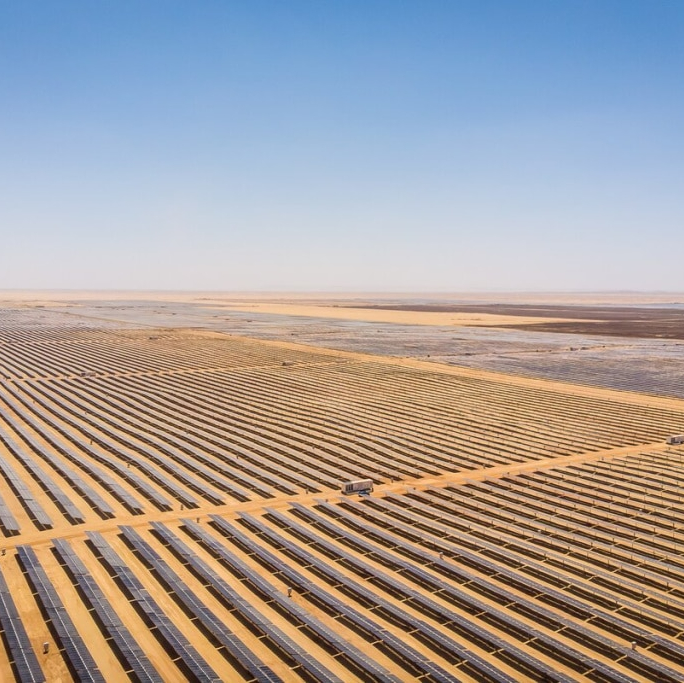
The program garnered significant interest from investors, with over 20 groups preparing proposals by early 2016, aiming to finalize Power Purchase Agreements (PPAs). The FiT program was instrumental to advancing ventures including the Benban Solar Park, which stands as one of the largest solar power installations globally, encompassing 32 power plants over an area of 37 square kilometers. This flagship project, along with others, funded through the FiT scheme, sought to produce affordable and renewable electricity, provide power to numerous households, avoid carbon emissions, and generate employment during construction. The initiative also received backing from global institutions, including key players such as the IFC,the European Bank for Reconstruction and Development (EBRD), and the French Development Agency (Proparco).
By 2017, this initiative had successfully revitalized the renewables sector, drawing in $2 billion from private investors. This influx of investment significantly boosted Egypt's renewable energy output, with an impressive addition of 28,229 MW to the national grid between December 2015 and December 2018 (total capacity to 55 GW). Additionally, the government's efforts to upgrade and expand the distribution grid were crucial in seamlessly incorporating renewable energy sources into the country's power infrastructure. This resulted in an increase in the share of renewable energy in total electricity generation, reaching 12% in 2021. Moreover, solar energy generation increased approximately twentyfold since the introduction of the feed-in-tariff in 2014, until 2021.
As private sector engagement is a top priority for Egypt, de-risking tools were deployed and have been instrumental to further enable private sector involvement. The Multilateral Investment Guarantee Agency (MIGA) provided political risk insurance for the construction, operation and maintenance of a number of solar power plants projects in support of Egypt's Solar Feed in Tariff (FiT) program.
The EBRD, on the other hand, provided up to USD 500 million in loans to multiple private developers through special purpose vehicles to develop, construct and operate their respective subprojects. Additionally, it provided the Egyptian authorities with technical assistance for the preparation of the Solar Grid Code and the Strategic Environmental and Social Assessment (SESA) for the Benban solar site in Egypt, maximising the benefits for the local population and other stakeholders.
Additional Sources
- International Energy Agency, “Energy Statistics Data Browser: Egypt”, 21 December 2023, https://www.iea.org/data-and-statistics/data-tools/energy-statistics-data-browser?country=WORLD&fuel=Energy%20supply&indicator=TESbySource
- International Renewable Energy Agency, “Energy Profile: Egypt (2023)”, https://www.irena.org/-/media/Files/IRENA/Agency/Statistics/Statistical_Profiles/Africa/Egypt_Africa_RE_SP.pdf
- UNESCAP. (n.d.). Feed-In Tariff. Retrieved April 8, 2024, from unescap.org/sites/default/files/26. FS-Feed-In-Tariff.pdf
- https://pressroom.ifc.org/all/pages/PressDetail.aspx?ID=17490
- https://www.cliffordchance.com/content/dam/cliffordchance/briefings/2018/02/egypt-solar-feedin-tariff-round-2.pdf
- https://www.ebrd.com/work-with-us/projects/psd/egypt-renewable-feedintariff-framework.html