Challenges to investment
It’s projected that the clean energy transition will require approximately 1 million new jobs across the EU by 2030. This transformation will require supporting workers in updating their skills and shifting the education system’s attention towards affected communities. In Romania, which has committed to phasing out coal by 2032, this transition involves updating existing competencies or learning a completely new set of skills. Workers in polluting industries would need to be supported with complex and integrated interventions to facilitate a transition between sectors and ensure the sustainability of new occupations.
At the time of writing, Gorj was the Romanian region the most affected by undergoing decarbonization efforts, with around 8,000 employees still active in the coal mining industry. This meant an acute need for alternative, sustainable jobs, and accompanying measures to guarantee workers’ transition.
Approach
In accordance with the EU Partnership Agreement with Romania – 2021-2027, a €31.5-billion package was allocated to Romania as part of the EU Cohesion Policy. This included a €2.14-billion contribution to social and economic impact of the green transition as part of the Just Transition Fund (JTF). From these funds, almost €300 million were allocated to workforce reskilling/upskilling, supporting six beneficiary Romanian counties. The Just Transition Fund was a fundamental pillar of the Just Transition Mechanism (JTM) announced in 2019 as part of the European Green Deal.
The Renewable Energy School of Skills (RESS) was one of the beneficiaries of this support in Romania. The RESS established the largest network of vocational training centers in the country for renewable energy sources, aimed at facilitating the transition from coal-based energy production to renewable energy sources. The RESS featured two primary locations in Constanța and Petroșani, along with four additional centers in Târgu-Jiu, Bucharest (at the Polytechnic University), Galați, and Arad, which is home to one of the largest photovoltaic parks in Europe, with an approved capacity exceeding 1,000 MW.
As part of its programs, the RESS capitalized on the transferable technical skills of mining sector technicians, equipping them with both practical and theoretical knowledge necessary to excel as technicians and specialists in the solar, wind, and energy distribution sectors.
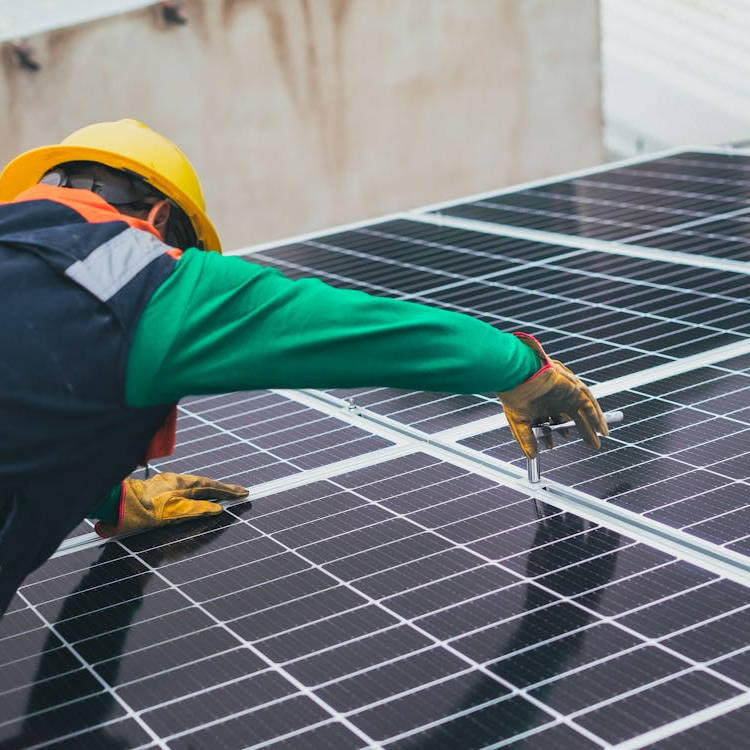
The RESS successfully implemented targeted programs such as RenewAcad—co-financed by the EU, and set up in partnership with of Oltenia Energy Complex (OEC) and the Equal Opportunity Foundation. The program notably launched a comprehensive counseling and professional retraining initiative in Rovinari, Gorj. The course aimed at preparing OEC employees to take part in the construction of new photovoltaic parks. In 2024, RenewAcad marked the completion of the 4th vocational training course of the RenewAcad – Targu Jiu project, with 100 people originating from the coal industry specialized in the installation of photovoltaic systems. Following massive over-subscription, this program was continued.
Key Enabling Conditions
Several key factors drove the success of the development and implementation of the RESS in Romania.
In Romania, skills anticipation studies undertaken by government ministries and agencies – namely the Ministry of Education (Ministerul Educației), the National Institute of Statistics (Institutul Naţional de Statistică), and the National Commission for Strategy and Prognosis (Comisia Naţională de Strategie şi Prognoză) – were critical in assessing and forecasting future needs for the power sector.
The financial support provided by the EU was also key to enabling a long-term commitment and building the infrastructure necessary to boost upskilling and reskilling programs.
Lastly, integrated partnerships between public institutions, the private sector, educational institutions, and civil society were of the utmost importance. Grassroots and bespoke support measures, although time- and resource-intensive, ensured that the workforce would undergo a more engaged and accepted transition. These initiatives were complemented by policies and programs that encouraged the development of high value-added skills to reintegrate workers into the labour market.
Impact / Outcomes
At the time of writing, the RESS in Constanța alone had trained over 5,000 wind energy technicians in Romania. Additional programs and locations were expected to add to this number, with the intention to retrain up to 800 coal miners as technicians in the renewable energy and energy distribution fields annually, for a total of 8,000 technicians over the entire programs’ lifespan. The awarded certifications would provide technicians with employment opportunities in installation, operation and maintenance of renewable energy and grid projects both in Romania and abroad.
Additional Sources
- European Commission, 2022 The Possible Implications of the Green Transition for the Labour Market (europa.eu)
- European Commission – Cohesion Policy for Romania, 2022 https://ec.europa.eu/commission/presscorner/detail/da/ip_22_4662
- European Commission – Partnership Agreement with Romania – 2021-2027, 2022 https://commission.europa.eu/publications/partnership-agreement-romania-2021-2027_en#details
- World Economic Forum, 2020 Case Study Details - Mobilizing Investment for Clean Energy in Emerging Economies - EU Just Transition Mechanism (weforum.org)
- BZEE e.V. (Training Centres for Renewable Energy Non-Profit Association, or in GermanBildungszentren fürErneuerbareEnergieneingetragenerVerein) BZEE e.V.Industry Standard for Trainings in Wind Energy (bzee-association.org)
- Energy Industry Review – RenewAcad Completes 4th Training Course for Specialists in Green Jobs of the Future https://energyindustryreview.com/renewables/renewacad-completes-4th-training-course-for-specialists-in-green-jobs-of-the-future/
- Solar Energy Bucharest Summit. https://solarenergy-expo.ro/en/sponsor/ress-renewable-energy-school-of-skill/
- IEA Skills Development and Inclusivity for Clean Energy Transitions, 2022 https://iea.blob.core.windows.net/assets/953c5393-2c5b-4746-bf8e-016332380221/Skillsdevelopmentandinclusivityforcleanenergytransitions.pdf
- Associated Press - As coal plants shut in Romania, some miners transition to green energy while others are reluctant, 2024 https://apnews.com/article/coal-energy-transition-romania-715c79d312dc62bf5a5ef0d68e32d6fd