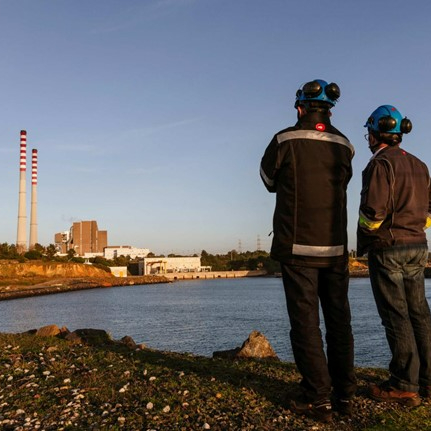
Sines was one of the largest coal power plants in Portugal, operating with a 1,256 MW capacity, from 1985 till 2021. EDP aims to repurpose the decommissioned plant into a green hydrogen hub including a collaborative lab to promote hydrogen know-how, a 100MW green hydrogen production facility and a green ammonia pilot project. To mitigate the impact of those changes for its workers and the workforce of its suppliers, EDP designed an innovative just transition programme called Futuro Ativo Sines.
Key elements
• 100% of EDP workers benefited from individualized plan including reskilling/upskilling, retirement or internal mobility.
• Individualized interviews for suppliers’ workers impacted by plant closure to plan future work possibilities including reskilling/upskilling. Solar systems training was provided to 22 for these workers.
• Social investment programme with dedicated entrepreneurship programme to incubate new projects with capacity building and 2-year follow-up.
• Study conducted with two Portuguese universities to identify the main dynamics of future development in the region as well as highest opportunity employment segments.
• Creation of a local office for social action in partnership with the municipality and state employment and training services, providing psychological, employment, training and social support for workers, their families and the local community.
• Dedicated programme to strengthen local NGOs social actions and foster a more robust local community.
Benefits
• Inclusion of suppliers in the impact mapping and solution designing following the powerplant closure.
• 360° approach mitigating impacts on workers, suppliers, and communities while looking out for new development opportunities.
• Fast tracked reskilling and job placements along with continuous contact and follow-up via the local office for social action.
• Close monitoring of the local context and continuous readjustments according to ongoing results.
Enabling conditions
• National system of unemployment allowance
• Strong anchor in and participation of the local community, beyond plant workers
• Aggregate local critical mass in different domains (employment, training, social, psychological) through partnerships with main local agents.
• Existing strong relations with the local communities through social investment programmes.
• Deep knowledge of the local context in the universities involved and the European Business Innovation Centre.