Challenges to investment
In 2015-16, the power sector in Zambia – characterized by 90% hydropower electricity production – experienced power supply shortages due to low rainfall and drought. After being forced to import expensive energy, the Government of the Republic of Zambia (GRZ) was motivated to increase its power generation capacity and diversify the energy mix. In particular, the GRZ hoped that solar generation could resolve some the nation’s energy challenges but faced several challenges to installation. Zambia’s electricity market was limited in scale and controlled by the state-owned utility, which retained its monopoly despite being financially distressed. Potential solar investors also faced delays and uncertainties in the procurement process and lacked stable institutional or regulatory support. As a result, solar PV projects risked potential non-payment of electricity bills or insufficient tariffs to cover investment and operating costs.
Approach
In August 2015, GRZ leveraged the International Finance Corporation’s (IFC) “Scaling Solar” programme to tender two solar PV plants with a combined capacity of up to 100 MW. The "Scaling Solar" programme was initiated by the IFC in 2015, with the aim of facilitating rapid development of privately-owned, utility-scale solar PV projects in sub-Saharan Africa. “Scaling Solar” was a “one-stop-shop” package that consolidated various services provided by the World Bank Group (WBG) into a single standardized engagement (e.g., advisory, contracts, financing, guarantees and insurance). The package enabled governments to procure solar transparent and low-cost power, based on the principle of tariff minimization and using a competitive auction process.
Key Enabling Conditions
The “Scaling Solar” programme was successful in Zambia for several reasons. First, it enabled rapid bid assessment and implementation by providing fully templated documents and streamlined processes. Second, the “one-stop-shop” approach of the programme combined a wide range of WBG services and helped to mitigate different risks associated with the projects. The programme was able to attract reputable developers and financiers to Zambia’s solar auctions because it offered guarantees and insurance against political risks, which were much sought after by investors.
Impact / Outcomes
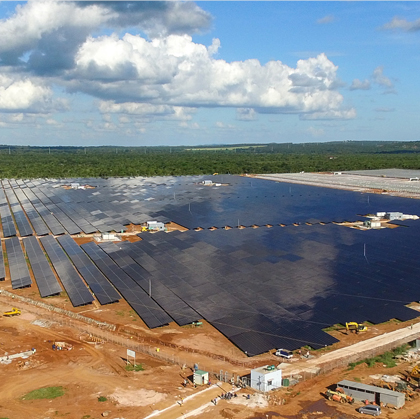
The competitive auction organized by the GRZ, alongside the “Scaling Solar” programme, attracted 48 solar power developers, of which seven submitted final proposals. Nine months after the start of the process, the GRZ awarded the 47.5 MW (55 MWp) West Lunga Project to Neoen SAS and First Solar Inc. The GRZ offered a tariff of US¢6.0/kWh – the lowest tariff for solar energy in Sub-Saharan Africa at that time. The 28.2 MW (33 MWp) Ngonye project was also awarded to Enel Green Power with a bid of US¢7.8/kWh. Notably, both winning bidders concluded a power purchase agreement (PPA), selling at a flat price for 25 years. To attract more potential investors, maximize the demonstration effect, and mitigate execution risks, the GRZ decided to award two separate projects to different bidders instead of a single lowest bidder. As of October 2019, both solar plants were successfully constructed, although their combined operational generation capacity of 75.7 MW fell slightly below the target due to delays in reaching financial closure.
Additional Sources
- Global Infrastructure & Natural Resources Department (2018), Scaling Solar: An Update, https://www.mofa.go.jp/files/000340295.pdf
- IFC (2023), Scaling Solar in Africa, https://www.ifc.org/content/dam/ifc/doc/2023-delta/infra-factsheet-scaling-solar-2023.pdf
- United Agency for International Development (2018), Review Study of the Zambia Scaling Solar Programme – Final Report, https://pdf.usaid.gov/pdf_docs/PA00ZX2Z.pdf
- WB (2020), Implementation Completion and Results Report (G-2470, G-2550) on IDA partial risk guarantees in the amount of SDR 4.18 million (US$5.7 million equivalent) to the Republic of Zambia for the Zambia Scaling Solar Energy Project (P157943) and Second Scaling Solar Guarantee (P163958), https://documents1.worldbank.org/curated/en/865501602254044494/pdf/Zambia-Scaling-Solar-Energy-Project.pdf
- WBG (2018), Financial Solutions Brief Zambia – Scaling Solar, https://thedocs.worldbank.org/en/doc/208821518200595153-0100022018/original/BriefsGuaranteesZambiaScalingSolar.pdf
- https://www.greentechmedia.com/articles/read/can-the-world-bank-groups-scaling-solar-programme-unlock-utility-scale-solar#gs.3S7_K0I
- https://www.iea.org/policies/5973-zambia-scaling-solar-programmeme?s=1
- https://projects.worldbank.org/en/projects-operations/project-detail/P163958?lang=en&tab=procurement&subTab=notices
- https://www.pv-tech.org/ifc-zambia-solar-auction-sees-record-low-6-price-benchmark/
- https://www.pv-tech.org/world-bank-plans-scaling-solar-and-storage-programme/
- https://www.roedl.com/insights/renewable-energy/2016-04/scaling-solar-world-bank-initiative-photovoltaics-africa
- https://www.scalingsolar.org/active-engagements/zambia/
- https://www.scalingsolar.org/#toggle-id-10-closed