Challenges to investment
Ecuador’s Constitution of 2008 explicitly stated that the government would promote the use of clean and alternative energy sources. In this context, Ecuador’s National Plan for Good Living 2009-2013 set a target of 6% renewable energy (RE) installed capacity by 2013, excluding large hydro. The subsequent National Plan for Good Living 2013-2022 updated the sourcing target to 60% of RE generation capacity by 2017, emphasizing hydropower and bioenergy. To achieve this goal, the Government of Ecuador needed to financially incentivize the deployment of RE and ensure transmission capacity for electricity generated by RE, which could be located far from existing transmission lines posing a challenge to their grid integration.
Approach
Under the Electricity Law of 1996, Ecuador implemented a feed-in tariff (FiT) system from 2000 to 2015 to support RE deployment. The FiT system evolved over time in terms of duration, rates, and included technologies, with FiT contracts awarded for a period of 15 years. A critical component of the FiT policy was the priority dispatch ruling, which determined how power generators connected to the grid. Priority dispatch ensured RE generators were dispatched ahead of non-renewable ones, reducing the risk of not securing transmission capacity. The responsible National Electricity Council (CONELEC) advanced RE through the dispatch regulation. Specifically, in 2004 (Regulation CONELEC 004/04) and 2006 (Regulation CONELEC 009/06), FiT regulations mandated preferential dispatch for renewables until RE generation reached 2% of the total electric system's generation capacity, after which new generators dispatched on economic value. In 2008, Regulation CONELEC 013/08 established preferential dispatch for renewable electricity up to 6% of the system's installed capacity. In 2012, Regulation CONELEC 102/12 exempted hydro, biomass, and geothermal (dispatchable technologies) from the preferential dispatch limit. The FiT regulations from 2002, 2004, and 2006 mandated additional compensation for project developers who built transmission lines to connect RE projects to the grid paying an additional USD 0.06 cents/kWh/km, with a maximum cost of USD 1.5 cents/kWh.
Key Enabling Conditions
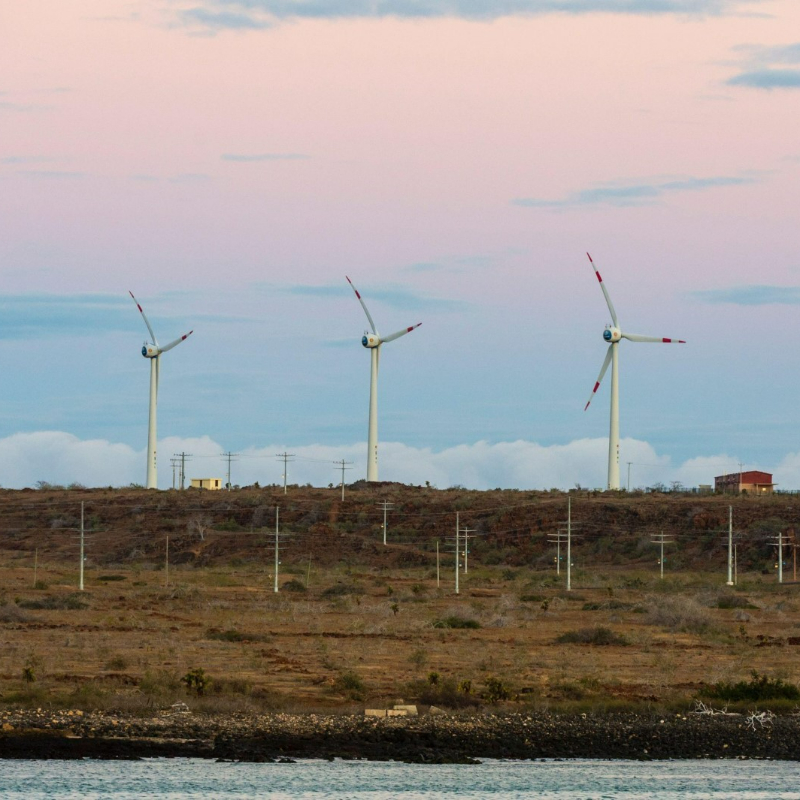
Since 2011, RE projects receiving the FiT had to contribute a specified amount per kWh generated to social and community development projects fostering social acceptance. Other initiatives, such as the Galapagos Island Zero Fossil Fuels initiative, spurred and accelerated RE deployment with projects displacing oil-based electricity generation. This initiative led to the development of two wind farms, two photovoltaic (PV) projects, and two hybrid PV-biofuel-battery projects with assistance from the UNDP, Korea (KOICA), Japan (JICS), and Germany (KfW).
Impact / Outcomes
Preferential dispatch helped increase RE access to transmission lines, driving in part an increase in wind energy in Ecuador from 3 GWh in 2010 to 73 GWh in 2017. Similarly, solar electricity generation grew from 4 GWh in 2013 to 35 GWh in 2017. Despite these increases, both sources only contributed 0.26% of total generation in 2013 and 0.39% in 2017, falling short of the targeted 6% in 2013. However, Ecuador’s RE capacity took of later on, achieving the 60% RE generation target in 2017 due to large hydro capacity, which accounted for over 71% of total electricity generation. The FiT and its preferential dispatch component are no longer available in Ecuador since 31 December 2016 but have helped jumpstart the RE industry in the country.
Additional Sources
- GME (2022). Ecuadorean Power Sector: Regulatory framework and Power Market Outlook, https://gme-global.com/uploads/archivos/20220112-122239.pdf
- IRENA (2015), Renewable Energy Policy Brief: Ecuador; IRENA, Abu Dhabi, https://www.irena.org/-/media/Files/IRENA/Agency/Publication/2015/IRENA_RE_Latin_America_Policies/IRENA_RE_Latin_America_Policies_2015_Country_Ecuador.pdf?la=en&hash=C1F46A560D0E8FF6655216BC36410A6D41B98B21
- Jacobs, D., Marzolf, N., Paredes, J. R., Rickerson, W., Flynn, H., Becker-Birck, C., & Solano-Peralta, M. (2013). Analysis of renewable energy incentives in the Latin America and Caribbean region: The feed-in tariff case. Energy Policy, 60, 601-610, https://www.researchgate.net/profile/Juan-Paredes-17/publication/271893107_Analysis_of_renewable_energy_incentives_in_the_Latin_America_and_Caribbean_region_The_feed-in_tariff_case/links/5aa70272a6fdcccdc46a8d59/Analysis-of-renewable-energy-incentives-in-the-Latin-America-and-Caribbean-region-The-feed-in-tariff-case.pdf
- USAID (2020). Ecuador Energy Sector Assessment, https://pdf.usaid.gov/pdf_docs/PA00WQNF.pdf
- https://www.iea.org/policies/5459-ecuador-feed-in-tariff-for-renewable-energy-regulacion-para-la-participacion-de-los-generadores-de-energia-electrica-producida-con-recursos-energeticos-renovables-no-convencionales-no-conelec-00113
- https://www.kfw-entwicklungsbank.de/SDG-portal/SDG-13/Hybridkraftwerke-Galapagos/
- https://www.nortonrosefulbright.com/en/knowledge/publications/e9fe5e64/renewable-energy-in-latin-america-ecuador
- https://www.trackingstandard.org/wp-content/uploads/I-REC-Country-Assessment-Ecuador-03Jan2022.pdf