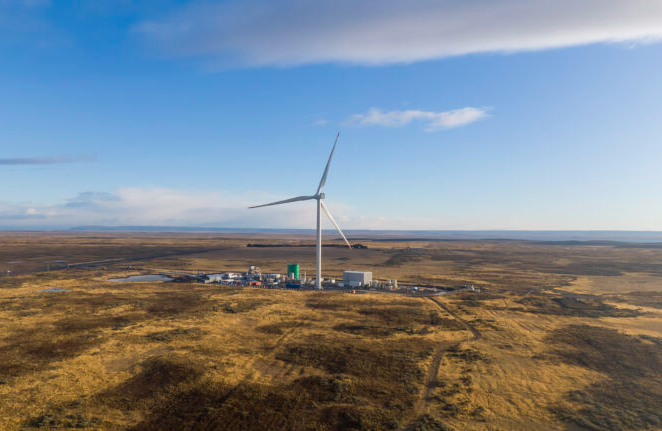
Haru Oni e-fuels Facility
Description
HIF Haru Oni, located 40 km north of Punta Arenas, Chile, is the world’s first integrated e-Fuels facility. It produces synthetic fuels using renewable wind energy from Patagonia and recycled CO₂.
The process begins with water electrolysis powered by a 3.4 MW wind turbine, generating green hydrogen. The hydrogen is then combined with captured CO₂, sourced from biogenic emissions and, in the future, directly from the atmosphere through a Direct Air Capture (DAC) unit currently under installation, to synthesize e-Methanol.
This e-Methanol can be used directly as a marine fuel or converted into other e-Fuels such as e-Gasoline, e-SAF (sustainable aviation fuel), or e-LG. The facility demonstrates that e-Fuels are a ready-to-use climate solution, chemically equivalent to fossil fuels and compatible with existing engines, pipelines, gas stations and infrastructure.
Since its inauguration in December 2022, Haru Oni has been operating successfully and exporting e-Fuels to Porsche, its sole offtaker. Haru Oni is not just a pilot, it is a fully operational facility producing real, commercial-grade fuels already in use, including in Porsche Motorsport events in Europe and during the Antarctic cruise season on zodiac motorboats. This demonstrates that e-Fuels are a practical and available solution, particularly for hard-to-electrify sectors such as aviation and shipping.
Haru Oni is also the first Power-to-X plant in Latin America to obtain ISCC PLUS certification, and in 2025, it became the first facility outside the European Union-and the first globally-to receive ISCC EU RFNBO certification for e-Gasoline production. This recognition validates that Haru Oni’s process meets international sustainability standards, including the use of 100% renewable energy and achieving over 70% emission reductions compared to fossil fuels.
Haru Oni’s success has paved the way for HIF Global’ s next generation of industrial-scale facilities in Chile, United States, Uruguay, Brazil, and Australia; demonstrating how regions with abundant renewable resources can become exporters of low carbon fuels.
The process
- Electrolysis: Wind-generated electricity powers an electrolyzer, separating oxygen from hydrogen in water molecules.
- CO₂ Supply: CO₂ is recycled from biogenic sources (currently in use) or captured directly from the air using DAC technology (under development).
- Synthesis: Green hydrogen is combined with CO₂ to produce green methanol (e-Methanol).
- Conversion: e-Methanol can be used directly in methanol-powered ships or converted into other e-Fuels, such as e-Gasoline for cars, e-SAF for aviation, or e-GL. Haru Oni currently produces e-Methanol, e-Gasoline, and e-GL.
Objective & Results
HIF Haru Oni was designed to demonstrate the full value chain of e-Fuels production using renewable energy and recycled CO₂. The project’s goal is to validate synthetic fuels as a ready-to-use, low carbon alternative for sectors where direct electrification is difficult, such as road transport, aviation, and shipping.
Since its inauguration in December 2022, Haru Oni has produced and exported e-Fuels to its client Porsche to be used in demonstration events in Europe and the Americas, confirming their technical viability and performance in conventional combustion engines. The facility is integrating Direct Air Capture (DAC) technology now, making it the first synthetic fuel plant in the world to do so.
Its success has laid the groundwork for HIF Global’ s next generation of industrial-scale e-Fuel projects in Chile (Cabo Negro), the United States (Matagorda), Uruguay (Paysandú), Brazil (Açu), and Australia (Tasmania).
Additional Sources
