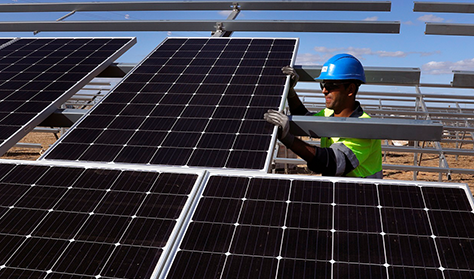
Convive Programme: A just energy transition in action - The Cedillo solar community
Project overview
In the town of Cedillo, located in Cáceres, Extremadura, Spain, Iberdrola has implemented an innovative dual-scale approach to solar energy development. The first is the Cedillo Solar Community, a 355-kilowatt collective self-consumption initiative that delivers direct energy benefits to local households and businesses. The second is a portfolio of large-scale utility solar projects – including the 50-MW Majada Alta and 50-MW San Antonio plants, as well as a larger 375-MW solar plant – which together establish Cedillo as a renewable energy hub.[1]
Both initiatives are emblematic of Iberdrola’s Convive Programme, which seeks to align renewable energy deployment with community development, environmental integration and just transition outcomes. Through Cedillo, Iberdrola demonstrates how national-scale climate goals can be pursued in tandem with local socio-economic uplift and sustainability.[2]
Approach
The Cedillo Solar Community was co-designed with the Cedillo Town Council and local residents to deliver solar energy at no upfront cost. Iberdrola installed rooftop photovoltaic (PV) systems on seven municipal buildings and adjacent land, creating a networked model under Spain’s collective self-consumption law. Households subscribed voluntarily, with energy virtually allocated via smart metering and credited to individual electricity bills. More than 80% of the town’s households opted into the programme in its first year.[3]
For the utility-scale developments, Iberdrola prioritized ecological and social integration. The projects were sited and developed with minimal ecological disruption and strong local consultation.[4] Cedillo’s renewables zone is part of Iberdrola’s broader strategy to regenerate rural areas through green industry, job creation and local partnerships.
Across both scales, Iberdrola applied principles from its Convive Programme – a company-wide initiative to embed local benefit, biodiversity enhancement and stakeholder inclusion into all renewable energy developments. Through the Convive framework, Cedillo became a showcase for holistic renewables integration.[5]
Business and economic value
The Cedillo Solar Community has delivered clear economic and social benefits. Residents report electricity bill savings of 30-50%, representing significant relief in a rural area with limited income diversity. The infrastructure was fully financed by Iberdrola, with no capital required from participants. The creation of this first solar community for an entire village aims to contribute to the development of this town of 450 inhabitants and to tackle depopulation by attracting new residents to the municipality. New residents will be able to benefit from this measure for the next five years. This model improves energy affordability, reduces exposure to price volatility and fosters community trust.[6]
For Iberdrola, the model builds brand value, enhances customer loyalty and reduces acquisition costs. The company faced no permitting delays or legal opposition in Cedillo. Moreover, the Cedillo community model aligns closely with EU funding priorities under the Green Deal and REPowerEU, unlocking eligibility for public financing streams related to energy equity, rural revitalization and decentralized energy.
The large-scale solar plants in Cedillo add economic depth. Combined, the plants will produce enough clean electricity to power hundreds of thousands of homes, while avoiding significant CO₂ emissions annually. The construction phases of these projects have generated over 800 local jobs, with additional employment in maintenance, services and training programmes.[7] Iberdrola’s investment also enhances grid resilience in the Extremadura region – a critical objective for Spain’s energy transition.
By pairing community-scale and utility-scale investments, Iberdrola has created a multi-layered business case: stable returns from utility-scale power purchase agreements (PPAs), social licence through local benefit and ESG alignment that supports sustainable finance and impact investment.
References:
- Photovoltaic plants in Cedillo - Iberdrola
- Convive Programme - Iberdrola
- We start up the solar village of Cedillo in Extremadura - Iberdrola España
- Photovoltaic plants in Cedillo, an engineering challenge with minimum environmental impact – Iberdrola
- The country's first solar community for a village, promoted by Iberdrola Spain, is recognized as Europe's best sustainability initiative - Iberdrola España
- The country's first solar community for a village, promoted by Iberdrola Spain, is recognized as Europe's best sustainability initiative - Iberdrola España
- Photovoltaic plants in Cedillo, an engineering challenge with minimum environmental impact – Iberdrola