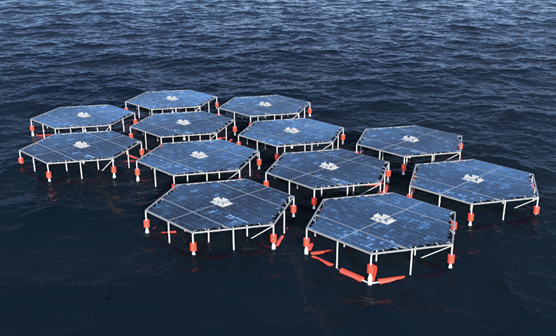
Huaneng Yellow Sea No.1: China's first wave-resistant floating offshore photovoltaic platform
Project overview
The Huaneng Shandong Peninsula South No.4 Offshore Wind Power Project, also called Yellow Sea No.1, is a pioneering hybrid wind-solar project located 30 km offshore from Haiyang City, Shandong Province, China. This 300-MW offshore wind facility is equipped with 58 5.2-megawatt wind turbines, generating 821 million KWh of electricity annually.[1] The project features China’s first non-overtopping floating offshore photovoltaic platform, engineered to survive once-in-50-years sea conditions and up to 10-metre waves. This platform reflects a breakthrough in ocean-based solar innovation and supports China’s pursuit of energy diversification.[2]
Implementation approach
The platform is constructed using a truss-type, steel-plastic composite hexagonal design, with each side exceeding 25 metres in length, covering an area of approximately 1,624 square metres and supporting 434 PV panels. These panels interlock into a “super honeycomb” structure to enhance resistance and operational stability. This design allows for the platform to be deployed up to 30 kilometres away from shore and 30 metres in depth.
The PV platform shares cables, grid infrastructures and maintenance systems with the surrounding wind turbine units. This enables a hybrid wind-solar power generation approach that stabilizes energy output, improves grid safety and reduces operating costs through shared services.
Business and economic value
The Huaneng hybrid project generates approximately 821 million kWh of electricity per year, replacing 246,300 tonnes of coal and reducing CO₂ emissions by over 640,000 tonnes annually. It represents a new frontier for China’s renewables economy, establishing technical viability and economic value for multi-resource offshore development.
The co-location of wind and solar assets optimizes marine spatial use and extends asset productivity, while shared infrastructure reduces capital and operations and maintenance (O&M) expenditures. Successful demonstration of Yellow Sea No.1 opens the door for expanded offshore PV deployment, which could unlock significant new energy potential for China’s coastal provinces. The project also improves regional energy security and grid resilience, particularly during peak consumption periods.[3]
The technological breakthroughs of Yellow Sea No.1 have not only resolved core challenges such as wind-wave resistance, corrosion resistance and stability for deep-sea PV platforms but also provided a replicable technical solution for the global offshore PV industry. By adopting a “wind-solar co-development” model, the project synchronously constructs PV platforms within offshore wind farms, achieving multi-resource utilization of wind energy, solar energy and marine space. This three-dimensional development model significantly enhances marine spatial utilization efficiency, optimizes the regional energy mix and accelerates progress towards China’s “Dual Carbon Goals”.
References:
- Yellow Sea No. 1 Project Profile - China Huaneng Group
- China launches 1st wave-resistant floating solar platform in Qingdao - Qingdao West Coast New Area
- Technical analysis of Offshore PV-wind Integration Projects in China - Chinese Renewable Energy Engineering Institute (CREEI) 2024