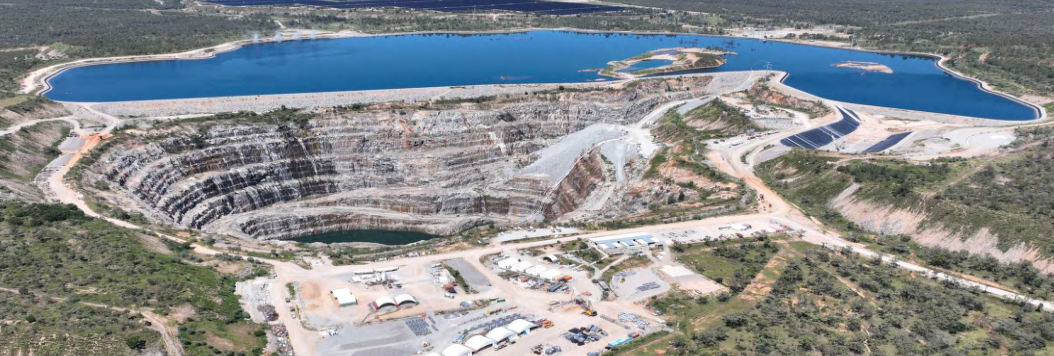
Kidston Renewable Energy Hub: Transforming legacy infrastructure into a multi-technology renewable powerhouse
Project overview
The Kidston Renewable Energy Hub is Australia’s first integrated solar and pumped hydro storage project, developed by Genex Power on a 1,500-hectare former gold mine in Far-North Queensland. Operational since 2017, the Kidston Stage 1 Solar Project (KS1) has a capacity of 270 megawatts (MW) and uses 540,000 single-axis tracking solar panels to maximize energy yield in one of Australia’s highest solar irradiation zones.
Repurposing existing mining infrastructure helped avoid typical land-use and permitting challenges. Building on this foundation, Genex Power[1] is developing the 250-MW/2,000-MWh Kidston Pumped Storage Hydro Project (K2-Hydro), designed to provide up to eight hours of continuous energy storage. The project repurposes two former mine pits as the upper and lower reservoirs, minimizing environmental impact while revitalizing disused infrastructure. Backed by a $396 million loan from the Northern Australia Infrastructure Facility (NAIF) and a $30 million grant from the Australian Renewable Energy Agency (ARENA),[2] K2-Hydro will be Australia’s first new pumped hydro project in over 40 years and is set to begin operation in 2025.
Approach
Kidston’s strategy combines renewable energy with industrial land reuse by converting an abandoned gold mine into a clean energy hub, avoiding land clearing and stakeholder conflicts. The solar output is secured by a 20-year Revenue Support Deed, while the pumped storage hydro project is backed by a 30-year energy storage services agreement with EnergyAustralia,[3] ensuring long-term revenue stability.
Advanced solar tracking systems boost efficiency and a 186-km, 275-kilovolt (kV) transmission line connects the site to the national grid – ensuring both solar and hydro outputs can be efficiently dispatched. The project reuses existing mine pits and sources water from the ground and rainfall. Once operational, the hydro component will be integrated with the solar array, storing excess daytime solar generation and dispatching it during peak demand periods or cloudy conditions, to help smooth the variability of renewable energy.
Business and economic value
At the site of a former gold mine in Queensland, solar panels now stretch across land once carved out for extraction. By repurposing existing mining infrastructure – including roads, transmission lines and cleared land – the Kidston Solar Project avoided many of the costs and logistical barriers that typically slow down renewable projects. The reuse of mining assets helped reduce initial development costs by an estimated 15-20% compared to greenfield alternatives. Backed by a $5.71 million grant from ARENA, the project secured financing from major banks and was delivered on time and within its $73.81 million budget.[4]
In 2022, the Kidston Solar Project was recognized as Australia’s best-performing solar farm, achieving a 26.4% capacity factor – higher than the national average of ~21-22% for large-scale solar. Each year, it generates approximately 145 gigawatt-hours (GWh) of electricity powering over 26,000 homes and offsetting 120,000 tonnes of carbon dioxide (CO₂).
The economic impact of the Kidston Hub continues to grow with the addition of the hydro project. With a total capital cost of about $396 million, the project is expected to create around 500 direct jobs during construction and 20 ongoing operational roles. Beyond employment, it delivers long-term economic benefits by enhancing energy reliability and attracting investment to the region. Once operational, the project will deliver critical firming services to the national grid, helping Australia meet its renewable energy and emissions reduction targets. At the same time, it positions Far-North Queensland as a major hub for integrated renewable energy innovation.[5]
References