PPC Group: From lignite to innovation – Kozani’s just transition to a clean energy and technology hub
Project overview
PPC Group, the leading Southeast European electric utility and the largest power supplier in Greece and Romania, is driving a landmark transformation in Kozani, Northern Greece – Greece’s former lignite heartland – by investing €5.75 billion in renewable energy, green industry and digital innovation. Historically dependent on lignite mining and coal-fired power plants, the region is undergoing one of Europe’s most ambitious energy transitions. This large-scale redevelopment is part of Greece’s national decarbonization strategy and is supported by European Union (EU) recovery and resilience mechanisms.
The PPC initiative is designed to replace fossil-based infrastructure with clean energy assets while creating new economic and social opportunities for local communities. The project offers a replicable example of how fossil fuel-dependent regions can transition towards more diversified, resilient and inclusive clean energy economies.
Approach
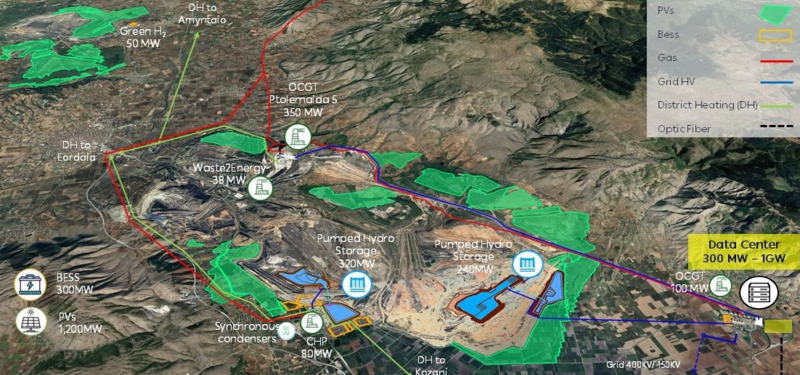
PPC’s strategy in Kozani combines large-scale renewables deployment with industrial and digital transformation. At the heart of the initiative is the development of 3 GW of new clean energy capacity, including 2.13 GW of solar PV sited on rehabilitated lignite mines. Most of this capacity is expected to be operational by 2025. To support system flexibility, PPC is building 860 MW of pumped hydro energy storage, including an 8-hour, 320-MW facility at the former Kardia Mine and a 12-hour, 240-MW facility at South Field Mine, alongside up to 300 MW of battery storage.[1] This integrated storage infrastructure will help balance the variability of renewables generation, enabling more stable and efficient energy distribution throughout the day.
To further enhance grid reliability, the existing generators at the decommissioned Kardia lignite power plant will be converted into synchronous condensers. This will support the stability of the national ultra-high-voltage electricity transmission grid, facilitating greater integration of renewable energy sources.
To drive digital growth, PPC is building a 300-MW data centre (scalable up to 1 GW). The data centre is ready to begin construction once hyperscaler agreements are finalized, with completion anticipated by 2027. A new fibre-optic network will accelerate digital transformation and attract tech-sector investment into the region. The data centre will be powered by new renewables capacity and a converted 350-MW open-cycle gas turbine (OCGT) by 2027, with potential upgrade to a 500-MW combined-cycle gas turbine (CCGT) based on future data centre expansion, all located in Kozani. The plan also includes green hydrogen pilot projects, aiming to attract tech investment, create future-proof jobs and position Kozani as a clean energy innovation hub.
Business and economic value
The Kozani redevelopment reflects the strong economic rationale behind a responsible and forward-looking energy transition. Replacing uncompetitive lignite plants with clean energy assets reduces operating costs, cuts greenhouse gas emissions, improves local air quality and aligns with EU climate goals and electricity market reforms. According to International Energy Agency (IEA) emissions benchmarks, the solar capacity alone could avoid around 3 million tonnes of CO₂ emissions annually.[2]
The initiative is also designed to maximize local economic value. Construction is expected to create 10,000 jobs, with up to 1,000 permanent roles during operation and more if the data centre is expanded. PPC has committed to supporting the workforce transition by investing in skills development and retraining programmes for former coal-sector workers, in collaboration with universities and technical institutes.
Circular economy principles underpin the transition: approximately €400 million is being invested in land restoration and decommissioning, with 95% of dismantled materials to be recycled and 8,000 hectares of degraded mining land returned to the Greek state for ecological and community use.
The project also introduces new mechanisms for shared ownership and public participation. PPC recently launched a €5 million social bond available exclusively to Kozani residents, guaranteed by the company and offering a fixed 8% return.[3] This enables community members to directly invest in – and benefit from – the region’s clean energy future.
Planning and governance are anchored in the European Union’s Just Transition Mechanism, with oversight provided by Greece’s Governmental Monitoring Committee for Just Transition. This ensures stakeholder engagement, transparency and alignment with national and EU just transition frameworks.
Taken together, PPC’s investments in Kozani illustrate how former fossil fuel regions can be transformed through integrated clean energy, and industrial and digital development – enabling faster, more inclusive energy transitions that deliver long-term economic and societal value.
References:
- PPC Group: 5.75 bn investments in green energy and technology transform Western Macedonia - PPC Group
- Annual direct CO2 emissions avoided per 1 GW of installed capacity by technology and displaced fuel - IEA
- Community Engagement and Fair Benefit Sharing of Renewable Energy Projects - Climate Action Network Europe