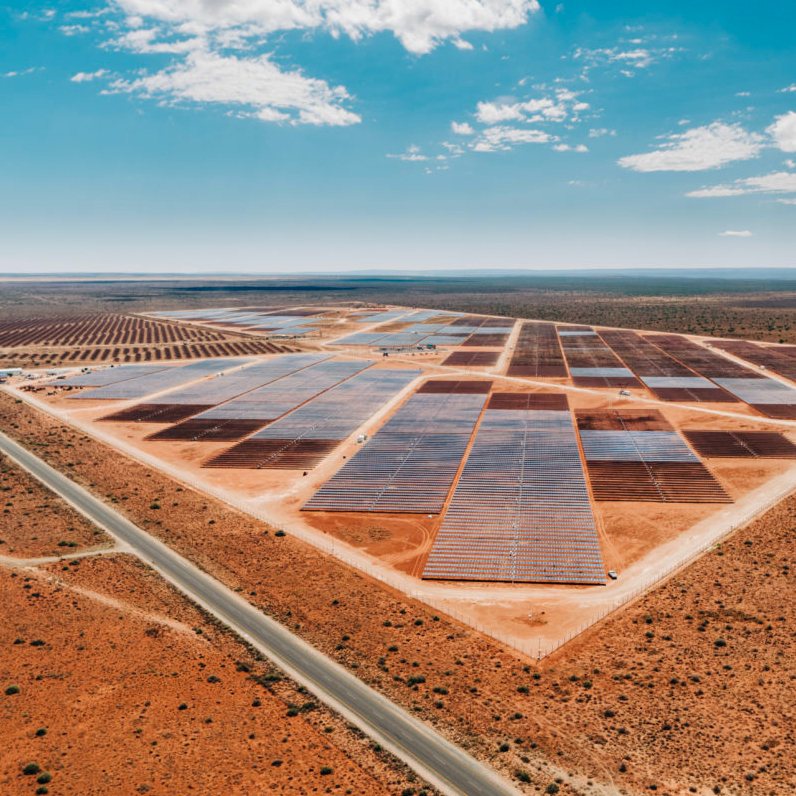
South Africa's Renewable Energy Independent Power Producer Procurement Programme (REIPPPP) - A model for public-private partnerships
Project overview
Launched in 2011, South Africa’s Renewable Energy Independent Power Producer Procurement Programme (REIPPPP) is globally recognized for catalysing private-sector investment in utility-scale renewables while embedding principles of social justice and inclusive development. Designed during a period of economic stagnation and post-apartheid inequality, the programme sought to ensure that clean energy deployment not only reduced emissions but also addressed the country’s pressing need for inclusive economic growth, especially in historically disadvantaged communities. The programme accounted for South Africa’s systemic exclusion, low growth and energy insecurity, taking a hybrid approach that integrated global procurement standards with domestic development goals.
Approach
Rather than adopt widely used feed-in tariffs, REIPPPP implemented a competitive auction model consistent with South Africa’s public-private partnership (PPP) principles. The Department of Energy, supported by the National Treasury and the PPP unit,[1] developed transparent and non-negotiable procurement documentation that met international standards and guaranteed bankability. International consultants were embedded within the design process to ensure investor confidence while minimizing legal ambiguity.
The programme also introduced a robust set of criteria for local development, mandating that local communities situated within a 50-km radius of the project benefit directly through equity ownership in projects, employment, local procurement and socio-economic investment. A minimum percentage of project ownership was required to be held by local community trusts, with expected dividend payouts increasing over time. Developers were also required to use a small percentage of top-line revenues to fund socio-economic and economic spend which included bursaries, health initiatives and infrastructure projects that aligned with community development priorities.[2] These obligations were embedded into project documents from the outset to ensure clarity and enforceability.
The programme operated in sequential bidding windows, enabling learning and adaptation between rounds. Government support was underpinned by a bespoke risk-sharing framework that guaranteed payments through Eskom, the national utility, and backed by Treasury without exposing the state to unchecked fiscal risk.[3] This model reduced uncertainty, increased lender trust and kept procurement timelines efficient.
Business & economic value
REIPPPP has delivered over $13 billion in committed private investment since inception, making it one of the largest renewable energy programmes in the developing world. The government’s transparent procurement process and bankable documentation eliminated delays typically caused by post-award negotiations, accelerating project delivery and lowering transaction costs for developers.
Crucially, the risk-mitigation mechanisms built into the programmes such as the government support framework agreement and Eskom payment guarantees, gave investors the confidence needed to enter a nascent market with complex socio-political dynamics. To date, no claims have been made regarding the Treasury-backed guarantees, underscoring the programme’s credibility and effective structuring.
At the local level, REIPPPP’s socio-economic development contributions have exceeded $64 million, funding bursaries, clinics, educational infrastructure and job creation. For example, children from rural communities have been fully funded through university with support for accommodation, books, mentorship and living expenses – demonstrating a long-term approach to breaking cycles of poverty.
Moreover, the programme has stimulated the emergence of a domestic renewable energy services sector, including local manufacturers and engineering firms, generating over 60,000 jobs during construction and operations. It is anticipated that by 2030, 200,000 new jobs would have been created as a result of REIPPPP. The community ownership model, while initially producing modest dividends, is structured to yield significant financial flows from year seven onwards – ensuring sustained benefit-sharing over the 20-year project life cycle.
REIPPPP has not only unlocked energy investment but also laid the foundation for broader private-sector engagement in infrastructure, spurring new government-led initiatives in grid, rail, port and water systems modelled on its framework. The programme has thus demonstrated that private capital, when aligned with developmental goals, can be a powerful lever for systemic transformation.
REIPPPP is widely recognized as a global best practice for policy-driven renewable energy development and how renewable energy procurement can be designed to serve both market and societal needs. By blending investor-grade certainty with ambitious community benefit mandates, the programme has redefined how PPPs in clean energy can deliver economic justice. Its emphasis on transparency, cost-competitiveness and social impact has enabled South Africa to deploy significant renewable capacity while fostering inclusive economic growth and investor confidence. It demonstrates the catalytic role policy frameworks can play in shaping just large-scale energy transitions.
References:
- Renewable Energy Independent Power Producer Procurement (REIPPP) Programme - Department of Mineral Resources and Energy - Republic of South Africa
- Independent Power Producer (IPP) Projects - IPP Office
- South Africa’s Renewable Energy Independent Power Producer Procurement Programme - NDC Partnership
- South Africa’s Renewable Energy IPP Procurement Program: Success Factors and Lessons - World Bank PPIAF