Vista Sands Solar: Securing project permitting via data-driven public health and ecosystem impact assessment
Project overview
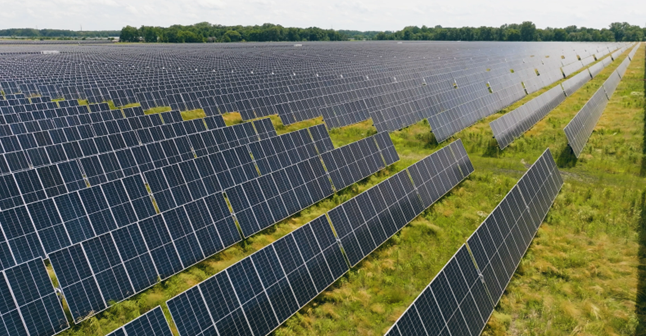
In Portage County, Wisconsin, US, Doral Renewables is developing the state’s largest solar project, the Vista Sands Solar project – a 1.3-GW (1,315.6-megawatts alternating current, MWAC) solar installation representing an investment of over $1 billion. As the project entered the permitting phase in early 2024, it encountered some local concerns due to its proximity to the Buena Vista State Wildlife Area, a critical habitat for the endangered prairie chicken. Concerns related to land use, environmental integrity and community impact posed potential risks to project approval.
To strengthen the regulatory case, Doral Renewables partnered with research and analytics firm Quantum Energy, to provide a data-driven assessment of the project’s wider benefits – quantifying public health, ecological and economic co-benefits beyond traditional emissions metrics. In December 2024, following this evidence-based approach, Wisconsin state regulators approved Vista Sands while praising the project's approach to community engagement and investment quality data. The project is expected to begin construction in 2026.
Approach
Quantum Energy utilized its TotalView Energy Platform, funded by the National Science Foundation, to support the regulatory process. This analytics platform combines hourly electricity grid modelling with life-cycle emissions, land and water use, meteorological and demographic data to quantify avoided pollution, health outcomes, biodiversity impacts and economic returns. For Vista Sands, TotalView modelled reductions in greenhouse gases, particulate matter, human toxicity-causing emissions, photochemical oxidants, acidification-causing emissions, etc. It translated these into disability-adjusted life years (DALYs) saved and avoided healthcare costs. For example, modelling showed that lower air pollution levels would significantly reduce respiratory and cardiovascular-related diseases in nearby residential zones, which is particularly important in a region with above-average rates of such diseases.
Ecological assessments focused on the site’s interaction with local species, including land use, water use and changes to pollutant levels in terrestrial and freshwater ecosystems. In conjunction with complementary studies, the analyses concluded that habitats of sensitive species, including the prairie chicken, would improve due to reduced greenhouse gas and terrestrial acidification-related emissions, reduced farming pesticide and insecticide use and an expansion of the ecological reserve (funded by Doral Renewables) that is home to many prairie chickens. Additionally, through siting modifications and habitat corridor protection measures, the project was reconfigured to maintain a 152-metre buffer around critical areas.
In addition to the electricity grid and life cycle impact assessment modelling, Quantum coordinated with legal, public health and environmental experts to co-develop technical submissions for hearings and statutory impact assessments. This ensured that findings could be directly used in regulatory decisions and public comments.
Business and economic value
The TotalView analysis estimated that the Vista Sands Solar project would displace approximately 1.2 GWh of natural gas and 950 GWh of coal-fired generation annually within the Midcontinent Independent System Operator (MISO) grid. This shift is expected to avoid 1.6 million metric tonnes of CO2 emissions in the first year of operation and provide enough clean electricity to power 446,032 homes.
The public health and ecosystem benefits are equally substantial. The project is projected to save 2,485 DALYs in its first year of operation, corresponding to reduced respiratory illness, fewer premature deaths and lower healthcare expenditures. It also avoids 3,260 metric tons of soil acidification emissions, as well as a number of other emissions affecting terrestrial and freshwater ecosystem quality, protecting the habitat corridors for at least five at-risk species.
Financially, during its first year of operations, Vista Sands is expected to deliver $630 million in first year ecosystem and health benefits. When regulators proposed a project capacity reduction of 365 MW, Quantum’s modelling demonstrated that this would eliminate 631 of those DALYs and erase $136 million in benefits in the first year alone. The evidence was instrumental in retaining the project’s full scale, safeguarding both health outcomes and over $450 million in projected energy revenues.
The total capital expenditure exceeds $1 billion, with around 500 jobs to be created during construction and 50 long-term operational roles. The project will provide over $6 million annually in utility aid payments to Portage Country and local municipalities. Additionally, its comprehensive co-benefit modelling has improved investor confidence, positioning it to compete for grants and other programs.
References:
- Home | Vista Sands Solar Farm
- Vista Sands Solar - Doral LLC
- Vista Sands Report - Quantum Energy
- TotalView Energy Platform - Quantum Energy
- Vista Sands 1.3 GW solar project approved in Wisconsin – pv magazine USA
- Vista Sands Solar Project Set to Transform Wisconsin’s Energy Landscape with Major Public Health, Environmental, and Economic Benefits - North American Clean Energy News Brief
- State regulators approve largest solar project in Wisconsin history - WPR
- Vista Sands Approved by the Public Service Commission of Wisconsin - RENEW Wisconsin
- U.S. Department of Energy’s Justice40 Initiative - The White House