Grafton Solar: Integrating renewable energy with agriculture for economic and environmental gains
Project overview
Located in Massachusetts, US, the Grafton Solar project is a 2-MW community solar farm with 1.4-MW of battery storage capacity, integrating solar power generation with active agricultural use. Operated by AES and operational since October 2022, the project demonstrates that at a small scale, energy, land use and community needs can be thoughtfully integrated.[1]
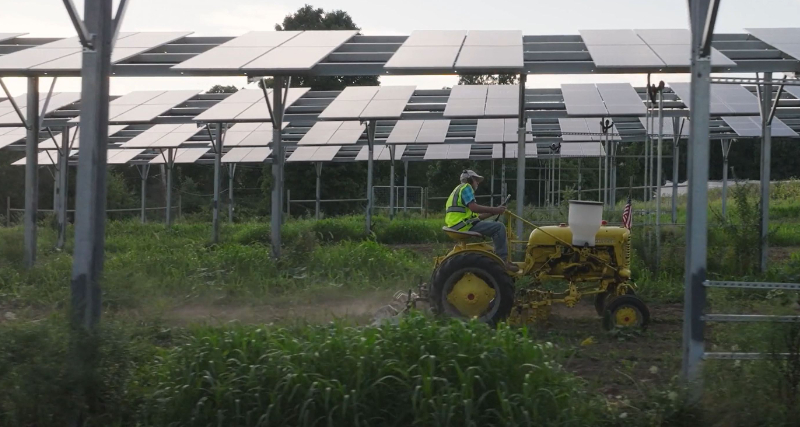
The project was co-developed with partners including a local farmer, government, American Farmland Trust and University of Massachusetts Amherst (UMass Amherst),[2] ensuring the design met both energy and agricultural needs from inception. Unlike traditional solar projects that displace agriculture, Grafton Solar is designed for dual use, supporting rotational cattle grazing and crop cultivation beneath elevated solar arrays to co-locate solar infrastructure with active agricultural use.
Approach
Grafton Solar’s implementation centred around redesigning the solar infrastructure to preserve farmland functionality. The agricultural plan, co-developed with farmers, shaped key design choices: solar panels were elevated to a minimum height of 3.2 metres above ground and spaced further apart to accommodate farm machinery and livestock grazing. Although this raised construction and material costs compared to traditional ground-mounted systems, it ensured the continued use of land for food production and created climate co-benefits such as reduced heat stress for cattle and enhanced soil moisture retention.
AES partnered with UMass Amherst and American Farmland Trust to research and monitor soil health, crop productivity and microclimatic impacts, contributing data to national agrivoltaics studies.[3] AES also conducted educational tours, farmer engagement and research dissemination to build community awareness and support for integrated energy-agriculture models.
Business and economic value
Grafton Solar demonstrates how dual-use renewable energy infrastructure can generate community value and align with long-term land stewardship goals. By co-locating energy production with active agricultural use, the project supports multiple income streams for farmers: lease payments from AES and ongoing agricultural revenue. This diversification reduces exposure to volatility in either sector and reduces reliance on a single source of revenue.
The project avoided common land-use conflicts between farmers and developers, enabling smoother permitting and gaining strong support from farmers, local officials and residents. AES further reinforced its long-term responsibility by securing a financial bond for full decommissioning and site restoration, ensuring the land can return to full agricultural use at project end. The project also benefits from the Solar Massachusetts Renewable Target (SMART) programme,[4] which subsidizes energy bills for low-income households who subscribe to the project’s clean energy output.
Beyond the Grafton project, AES has applied the lessons learned to scale co-location strategies across other developments, with more than 10,000 acres under active grazing at over 50 solar farms across the US and other applications involving crop integration and sustainable ecosystem design. The project has also contributed data and insights to partners like the US Department of Energy, National Renewable Energy Laboratory (NREL) and American Farmland Trust, to demonstrate maintenance of full agricultural potential and how community-centred design and practical adaptation of solar infrastructure can align agriculture with energy transition, strengthening long-term value creation for communities and the planet.[5]
References: