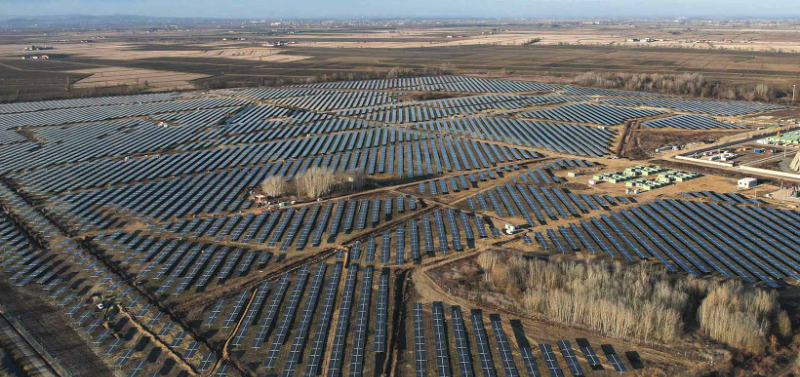
Trino Solar Park and Battery Storage: Driving sustainable power through local integration and community engagement in Northern Italy
Project overview
Located in Piedmont, Northern Italy, the Trino Solar Park [1] is a flagship example of clean energy deployment at a historically significant energy site. Developed by Enel, the project repurposes a 130-hectare site that hosted a thermoelectric power plant, in the same municipality that once was home also to a nuclear power plant. It now houses 160,000 bifacial photovoltaic panels and two lithium-ion battery energy storage systems (BESS), generating approximately 130 GWh of electricity annually – enough to power around 47,000 households and avoid 56,000 tonnes of CO₂ emissions per year.[1]
The project became operational in 2024 and represents a multidimensional approach to clean energy: combining advanced solar and storage technologies with community engagement, visual integration and ecological restoration. It reflects Italy’s broader strategy to accelerate renewable energy while ensuring social and environmental alignment.[2]
Approach
The Trino Solar Park demonstrates how clean energy development can be paired with environmental stewardship and participatory planning. Its technical core includes the installation of 3,096 single-axis solar trackers to optimize exposure and generation efficiency. Two BESS units – 25 MW/100 MWh and 208 MW/835 MWh – enable energy shifting, frequency regulation and enhanced grid flexibility.
Community engagement was embedded from the start. A local crowdfunding campaign, “Scelta Rinnovabile,” exceeded its fundraising target by 150%, allowing residents to directly invest in the energy transition.[3] Local community will also benefit from the restoration of key heritage buildings in Borgo Leri-Cavour - once the rural residence of Camillo Benso, Count of Cavour, a leading figure in Italy's 19th-century 'Risorgimento'.
The project also includes environmental offset measures co-designed with local authorities: reforestation on substantial private and public lands - of which nine hectares with 9,000 native trees completed, the creation of a wetland, and landscape integration using hedgerows and tree rows to reduce visual impact.
This hybrid model of technological innovation and stakeholder co-creation positions Trino as a leading example of how energy infrastructure can deliver on multiple fronts: climate, reliability, equity and ecology.
Business and economic value
Trino Solar Park contributes measurable value across the energy, environmental and local economic domains. The integration of BESS is a key enabling factor of energy transition; it enhances system reliability by allowing renewable energy to be stored and used during peak demand or grid balancing, reducing dependency on fossil-based backup generation.
The project supported job creation during the construction phase, particularly through the use of local contractors and labour. Its innovative crowdfunding model further deepened local participation and trust, illustrating how community-financed energy can foster public ownership and strengthen social licence.
Environmental compensation measures – including reforestation and wetland creation – not only restored ecosystem functions but also contributed to local biodiversity and climate adaptation. These co-benefits increase the long-term value of the land and demonstrate how renewable energy deployment can be harmonized with ecological recovery and spatial regeneration.
Trino exemplifies a responsible energy transition: one that is not only technology-driven but also place-based, inclusive and environmentally restorative.
References:
- Solar park and storage in Trino Italy - Enel Green Power
- Enel Green Power puts into operation Northern Italys largest photovoltaic plant in Trino, leading the energy transition - Enel
- Linking energy transitions with community initiatives - BBC