Vattenfall’s Hollandse Kust Zuid Offshore Wind Farm: Nature-Inclusive Engineering at Gigawatt Scale in the North Sea
Project overview
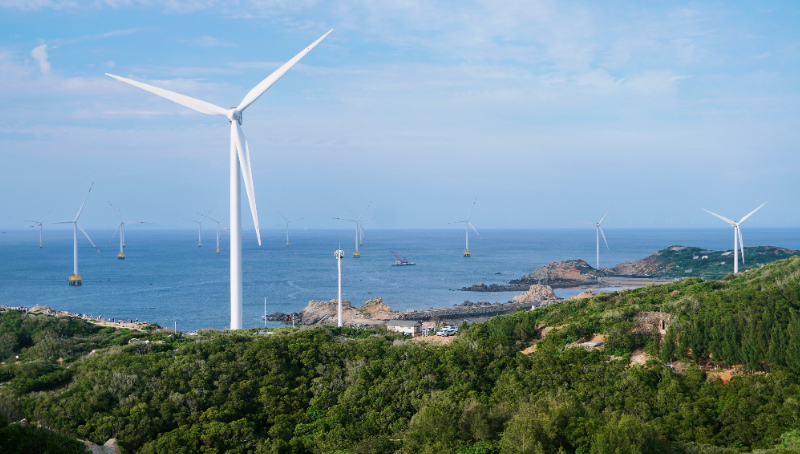
Hollandse Kust Zuid (HKZ) sits 18–36 km off the Dutch coast in the North Sea and is jointly owned by Vattenfall, BASF and Allianz. Operational since 2024, it has 139 turbines and 1.5 gigawatts (GW) of installed capacity, producing approximately 1.5 terawatt-hours (TWh) of electricity a year – enough for more than 1.5 million households. Funded by Vattenfall, it is the first offshore wind farm in Europe developed without direct government subsidies.[3][4]
Offshore wind must scale rapidly to support decarbonisation and energy security.[1] Yet expansion within heavily used marine environments demands that deployment contribute to ecosystem recovery, rather than only minimise harm. HKZ responds to this shift towards net-positive outcomes by embedding nature-inclusive design in its infrastructure and operations.[2][6]
Approach
HKZ also functions as a testbed for innovation and ecosystem enhancement. Its research and development platform, SeaLab, convenes research institutes, universities and other stakeholders to disseminate scientific knowledge on ecological initiatives and circular supply chain design. Working with De Rijke Noordzee (The Rich North Sea), Vattenfall:
- added elliptical openings to turbine foundations to allow water exchange and create shelter for marine species;
- installed artificial rock reefs on scour protection to increase habitat complexity; and
- deployed a double bubble curtain to reduce construction noise, while monitoring the impacts on marine mammals.[5]
Further pilots include thermal cameras and AI that trigger temporary shutdowns during peak bird migration, a floating seaweed farm between turbines, developed with North Sea farmers to explore co-location of renewable energy with sustainable food production, and recyclable blades developed by Siemens Gamesa to reduce the lifecycle impact of offshore infrastructure.[7] Results from these pilots are still being assessed, with monitoring informing adaptive management.
Early results from independent monitoring by The Rich North Sea indicate initial colonisation of the turbine foundations by fish and invertebrates.[8] Together, the measures contribute to Global Biodiversity Framework Targets 2 and 11 (restoration and ecosystem services), Target 4 (species recovery, by reducing disturbance to harbour porpoises and migratory seabirds) and Target 8 (climate change mitigation).
Business and economic value
HKZ was enabled by a stable regulatory environment, Dutch government-backed grid connections, visibility on future market volumes and a tender process that reduced risk for private investors while allowing power to be sold into wholesale markets. Within this framework, Vattenfall demonstrates that nature-inclusive design is commercially viable at gigawatt scale without subsidy – increasingly relevant as future tenders weigh environmental performance alongside price. SeaLab is a long-term investment in innovation: the AI bird-monitoring system, recyclable blade trial and seaweed pilots can be revisited and adapted for future projects.
For society, HKZ supplies fossil-free electricity equivalent to the consumption of more than 1.5 million households, contributing to industrial decarbonisation. For nature, water replenishment openings and artificial reefs increase habitat complexity within an actively used industrial site – the first time a turbine’s own structure has been used this way.
Site-level measures alone will not deliver system-wide regeneration. Scaling up requires marine spatial planning, cross-sector coordination and policy signals that reward net-positive contribution, not just impact mitigation.
References
1. European Environment Agency. (2024). Harnessing offshore wind while preserving the seas, Briefing No. 14/2024. https://doi.org/10.2800/3621684
2. Soininen, N., Huhta, K. & Vesa, S. (2025). Offshore Wind Power through the Lenses of EU Climate, Energy and Environmental Law—Between Climate Aspirations, Market Competition and Environmental Impact. Ocean Development & International Law, vol. 56, no. 4, pp. 505-525. https://doi.org/10.1080/00908320.2025.2587359
3. Vattenfall. (n.d.). Hollandse Kust Zuid. https://powerplants.vattenfall.com/hollandse-kust-zuid/
4. Ibid.
5. Krogh, M. (2023). Vattenfall goes the extra mile for dolphins in Denmark. Vattenfall. https://group.vattenfall.com/press-and-media/newsroom/2023/vattenfall-goes-the-extra-mile-for-dolphins-in-denmark/
6. Vattenfall. (2021). Annual and Sustainability Report 2021, pp. 50-51. https://group.vattenfall.com/investors/financial-calendar/annual-and-sustainability-report-2021/
7. Vattenfall. (2022). Vattenfall offshore wind farm will use recyclable wind turbine blades. https://group.vattenfall.com/press-and-media/newsroom/2022/vattenfall-offshore-wind-farm-will-use-recyclable-wind-turbine-blades/
8. The Rich North Sea (n.d.). Vattenfall. https://www.therichnorthsea.com/project/vattenfall/