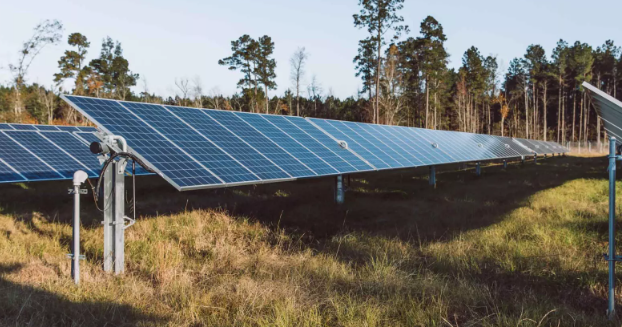
Wolf Run Solar Park: Powering clean energy with AI and driving local economic growth
Project overview
Wolf Run Solar Park is a 140-MW solar photovoltaic facility developed by EDP Renewables North America (EDPR NA) in Morgan County, Illinois, US. Wolf Run was purpose-built to power renewable energy. Operational since late 2024, the project, which is forecasted to be operational for 35-40 years, features 351,800 bifacial tracking solar panels across roughly 1,000 acres, maximizing solar capture efficiency throughout the day.[1] Through a long-term virtual power purchase agreement (VPPA), Microsoft has committed to procuring electricity and renewable energy credits (RECs) from Wolf Run, aligning its carbon reduction targets with the rapid expansion of high-energy digital infrastructure.[2]
Approach
The development of Wolf Run Solar Park strategically combined advanced solar technology, strong corporate partnerships and proactive community engagement. EDPR NA deployed bifacial solar panels with single-axis trackers, increasing overall energy yield by capturing sunlight from both sides of the panels. To ensure long-term financial viability, EDPR secured a VPPA with Microsoft early in the project timeline, locking in stable revenue streams and aligning energy production with one of the world’s fastest-growing sectors: AI.
From the outset, the project prioritized community integration and job creation. It accounted for environmental considerations, with the project estimated to save more than 177 million gallons of water each year while preventing air pollution that causes smog, acid rain and climate change. Additionally, Wolf Run’s remote grid integration was carefully managed to support both Microsoft’s energy needs and regional grid stability.
Business and economic value
By securing a long-term VPPA with Microsoft, the project de-risked its revenue profile, making it highly attractive to investors and financial institutions seeking low-risk, ESG-aligned assets. Over its projected 40-year operational lifespan, in addition to the benefits to Microsoft as the offtaker, the project yields long-lasting economic growth and numerous financial benefits to the region. Wolf Run will contribute approximately $31 million in property tax revenues to local governments, with significant allocations directed to the Triopia School District, supporting local education and workforce development.[3]
n addition, the project will generate $4.6 million in total local economic impact – of which $2.3 million will be paid to local landowners and $2.3 million will be spent with small, local and family-owned businesses. The project also supported workforce development with the creation of more than 210 local construction jobs and several permanent operational and maintenance positions.
Microsoft’s partnership not only guarantees energy demand but also positions Wolf Run at an advantage in a fast-growing sector where clean energy procurement is becoming a competitive advantage.
Wolf Run will support Microsoft’s sustainability and carbon reduction goals. In 2021, Microsoft launched a “100/100/0 clean energy goal,” with the target being 100% of electricity consumption, 100% percent of the time,[4] matched by purchases from zero-carbon energy sources by 2030.[5] This would add to its prior commitment to use 100% renewable energy in its buildings and data centres globally by 2025. Microsoft has also committed to becoming carbon negative by 2030 and to cover 100% of its electricity consumption in its buildings and data centres globally with renewable energy by 2025.
In broader terms, the project illustrates how digital infrastructure growth can be aligned with responsible energy deployment. By combining clean energy procurement with community engagement, water conservation and low-emission operations, Wolf Run demonstrates a replicable model for meeting corporate energy needs in a way that also supports local economic development and environmental stewardship. This approach provides a clearer pathway for scaling renewables in high-demand sectors like AI and cloud computing, while maintaining public trust, minimizing ecological impact and enabling more equitable energy transitions.
References:
- Wolf Run Solar Park Fact Sheet - EDP Renewables North America.
- EDP Renewables North America Delivers Three Additional Renewable Energy Projects for Microsoft - EDP
- Wolf Run Solar Park now operational, generating 140MW
- Microsoft Launches Cloud Service Enabling Emissions Tracking and Reporting, Sets Zero Carbon Energy Goal - ESG Today
- Microsoft Commits to Carbon Target Moonshot - ESG Today