
Innovation Playbook for Future Power Systems

In collaboration with Accenture

A practical resource for decision-makers as power systems evolve under increasing demand.
Scroll to explore innovative solutions and read the report for global insights. 

Explore the solutions

Discover 30+ new case studies added to our growing library of 130+ real-world examples, showcasing how 110 innovative solutions are delivering value across power systems today.  

A long-term delivery model for firm, usable clean energy contracts for an agreed output profile – clean electricity delivered when the buyer needs it – rather than paying only for generated megawatt-hours. In practice, the buyer defines delivery expectations such as hourly coverage, ramping needs, seasonal firmness, and performance during critical net-load hours. The supplier then designs and operates a portfolio – typically solar photovoltaics paired with battery energy storage, and sometimes complemented by additional resources – to meet those obligations. This shifts value from “energy produced” to “service delivered,” so the developer must optimise forecasting, dispatch, storage cycling, curtailment strategy, and maintenance to deliver a reliability characteristic, not just annual volume. The contract must include explicit firmness and delivery obligations – with measurable performance metrics, settlement rules, and remedies for under-delivery – otherwise it collapses back into a standard long-term power purchase agreement that can leave the buyer exposed during the hours that matter most. Strategically, this model aligns private procurement with power-system needs by rewarding flexibility and dependable clean capacity, and by creating bankable revenue for configurations that improve system adequacy, not only renewable energy build.Main outcomes of the solutionReliability & Flexibility: By contracting for an hourly delivery profile, the solution rewards dispatchable behaviour (forecasting, scheduled charging and discharging, and fast response) so PV plus battery energy storage is operated to manage variability and meet demand-critical hours rather than maximise annual megawatt-hours.Affordability: Firm-delivery obligations encourage asset optimisation - reducing peak stress, curtailment, and inefficient backup dispatch - which lowers total system costs by shifting value to least-cost flexibility and better utilisation of existing generation and network capacity.Institutional Efficiency & Transparency: A contract built on measurable delivery metrics and settlement rules makes performance auditable and comparable across suppliers, supporting clearer investment signals and procurement discipline that align private contracts with evolving adequacy and flexibility needs.Key implementation and scaling factorsHourly, location-based measurement and attribute tracking must be in place so delivery performance can be verified and settled with low dispute risk.Contracts must define firmness obligations as auditable metrics (coverage hours, tolerance bands, penalty logic and settlement timing) to keep the product distinct from a volumetric power purchase agreement.Market and regulatory frameworks must let storage monetize system value - including stacking revenues where allowed - so firm-delivery offers are investable at scale.Grid connection and operational integration, including forecasting, dispatch coordination and access to flexibility markets, must be secured to reliably deliver the contracted profile under real system constraints.Case studyMorocco’s Agency for Sustainable Energy (MASEN) and Acwa (2025) MoroccoIn 2025, Morocco’s Agency for Sustainable Energy (MASEN) awarded Acwa the Noor Midelt II and Noor Midelt III projects near Midelt. The implementation pairs utility-scale solar photovoltaics generation with co-located battery energy storage systems enabling the delivery of clean electricity beyond daylight hours. Together, the projects comprise approximately 800 MWp of solar PV capacity and around 1.2 GWh of battery storage, with batteries sized to provide several hundred megawatts of discharge capacity for over two hours to enhance grid stability and enable effective management of net-load fluctuations. Contracting is structured to support long-term performance: the projects are developed under a build–own–operate framework with Acwa in partnership with NAREVA Holding (as Moroccan local player). MASEN will act as the offtaker under a 30-year power purchase agreement. Earlier tender requirements for the Noor Midelt solar-plus-storage programme also specified delivery-point performance expectations for net capacity during off-peak hours, signalling a shift toward procuring usable output characteristics, not only energy volumes. References:Supply – Electricity 2025 – Analysis - IEAIEA-PVPS-T16-07-2026-EXEC-SUMM-Firm-Power-2026.pdfThe Value of Demand Flexibility Contracting-Principles-for-Moving-Towards-Location-and-Hourly-Clean-Energy-Matching.pdf24/7 Hourly Matching of Electricity | US EPAhttps://www.pv-magazine.com/2025/08/06/acwa-power-secures-two-solar-plus-storage-projects-in-morocco/https://www.enerdata.net/publications/daily-energy-news/acwa-power-secures-noor-midelt-ii-iii-solarbess-projects-morocco.html
Long-term delivery model for firm/usable clean energy

Moroccan Agency for Solar Energy (MASEN), Acwa
A strategic utility–supplier alliance for scalable grid modernization is a coordinated partnership model in which utilities, grid operators, energy providers and technology suppliers align network modernization needs, standardized equipment deployment and supporting service ecosystems to accelerate the grid upgrades required. Instead of treating equipment procurement, technical specification, installation and maintenance as separate workstreams, the alliance coordinates them through shared planning, standardized technical approaches and longer-term deployment visibility. This gives suppliers clearer signals on demand volume, location and timing, while giving utilities and grid operators more predictable technology availability, standardized designs and delivery capacity for network reinforcement and modernization programs. Historically, grid modernization often progressed as isolated projects with fragmented procurement, limited standardization and limited evidence to de-risk newer technologies. These conditions can slow investment decisions and increase costs. By creating repeatable deployment models across multiple assets, feeders, substations or service territories, the alliance allows suppliers to plan capacity expansion, strengthens supply chains and accelerates learning through shared specifications and installation standards. In parallel, long-term contracts, innovation financing and coordinated vendor ecosystems can support supplier scale-up, while standardized deployment reduces performance and delivery risks during equipment rollout.Main outcomes of the solutionAffordability: Reduces the delivered cost of electrification-enabling infrastructure by shifting from bespoke projects to more predictable deployment pipelines. Standardized designs, higher equipment utilization and coordinated installation schedules lower transaction, engineering and equipment costs. More predictable supplier demand can also reduce procurement risk and support faster, lower-cost rollout of grid components needed to connect new electric loads.Reliability & Flexibility: Supports system reliability by strengthening the distribution and transmission infrastructure needed to integrate new demand and distributed energy resources. Standardized, resilient and safer grid components can reduce outage risk, improve network performance and help utilities accommodate electrification without relying only on bespoke network upgrades.Sustainability: Accelerates emissions reductions by enabling the grid infrastructure required for electrification across industry, buildings and transport. Modernized, safer and more environmentally compatible grid assets can support renewable integration, reduce barriers to network expansion and improve the social and environmental acceptability of overhead-line upgrades.Key implementation and scaling factorsSecure grid connection capacity and permitting early, as grid constraints can delay both new clean electricity supply and new electrification-related load.Develop a coordinated vendor and service ecosystem with clear demand volume, location and timing so equipment manufacturing, installation and maintenance capacity can scale alongside network modernization schedules.Standardize contracting structures and investment-assessment assumptions across projects to reduce transaction costs and shorten the timeline to final investment decisions.Use long-term procurement, framework agreements or innovation-financing mechanisms to give suppliers the demand visibility needed to invest in manufacturing capacity, certification, installation capability and after-sales service.Coordinate grid component deployment with broader electrification plans, including industrial load growth, distributed generation, electric mobility and building electrification, so network upgrades are sequenced ahead of demand growth rather than becoming a bottleneck.Case studyIberdrola i-DE and Birka (2023), SpainIberdrola’s Spanish distribution company, i-DE, collaborated with Birka on the development and deployment of insulating crossarms for overhead power lines in Spain. The alliance combined utility-side technical validation, product development and supplier scale-up, supported by a three-year purchase contract and financing through Iberdrola’s PERSEO innovation program. Birka’s lightweight composite crossarms combine structural strength with electrical insulation and are designed to reduce bird electrocution risk and improve resiliency on distribution networks. Public deployment evidence shows i-DE testing the solution in Burgos in 2023 and later installing Birka crossarms in Olmedo, Valladolid, and Murcia. The case shows how a utility can use long-term procurement, innovation financing and standardized component deployment to strengthen supplier capacity while modernizing overhead lines for safer, more scalable electrification. Qualitative outcomes include improved biodiversity protection, repeatable installation models and reduced environmental risk in grid reinforcement programs.References:Building the Future Transmission GridIberdrola continues to install insulating crossarms manufactured by Birka – Birka CompositesInformation provided to World Economic Forum by Iberdrola (June 2026)

Strategic utility–supplier alliance for scalable grid modernization
Iberdrola, Birka Composites
A collective corporate contribution model for clean energy finance is a business model innovation that mobilizes private sector capital for the energy transition by standardizing a small, voluntary revenue commitment across companies and pooling it into a managed fund directed at clean energy deployment.  The model responds to a practical barrier to corporate participation in clean energy finance: many companies, particularly small and medium-sized enterprises, lack the structures, expertise or scale to deploy climate capital individually. By standardizing the contribution as a fixed share of annual revenue, the model reduces participation to a simple, low-friction commitment that is modest for any individual company but potentially significant at scale.  Contributions are aggregated through a platform that routes pooled funds to delivery partners with a track record in clean energy deployment, including in emerging and developing economies where energy access deficits are greatest. The model is designed to use catalytic capital to attract additional public, philanthropic and private investment, amplifying the total financing mobilized beyond the sum of individual corporate contributions. Main Outcomes of the Solution Sustainability: Channels private sector capital into clean energy deployment, grid modernization and community resilience projects, helping accelerate decarbonization and reduce dependence on fossil-based energy. Business Value: Creates a simple participation pathway for companies seeking to support clean energy finance without developing proprietary investment programs, lowering transaction costs and strengthening the case for collective corporate action. Socioeconomic Impact: Links corporate climate participation to energy access, job creation and community resilience by directing pooled capital toward clean energy projects in emerging and developing economies. Key Deployment and Scaling Factors Set the contribution threshold at a level that is financially manageable for businesses of different sizes, while remaining meaningful when aggregated across many participants. Partner with delivery organizations that have a demonstrated track record in clean energy finance, project deployment, blended finance and co-investment mobilization. Simplify participation through a single platform sign-up and annual contribution, reducing the need for companies to manage project selection, due diligence or deployment directly. Establish transparent fund governance, impact reporting and assurance mechanisms so participating businesses can understand how funds are allocated and what outcomes are delivered. Build visible networks of participating businesses to create social proof and peer momentum, particularly among SMEs where collective action norms can support adoption. Direct pooled funds toward markets where catalytic capital can address financing gaps and support both decarbonization and socioeconomic outcomes. Ensure claims made by participating companies are aligned with credible climate disclosure and anti-greenwashing guidance, especially where contributions are used in sustainability reporting. Case study Point One and Global Energy Alliance for People and Planet (2026), Global Point One launched in March 2026 as a global platform mobilizing private sector finance for clean energy by inviting businesses to commit 0.1% of annual revenue through a single platform sign-up. The initiative launched with more than 30 participating businesses and a target of raising at least $200 million by 2030, with the aim of attracting up to $3 billion in additional institutional investment.  The platform’s inaugural delivery partner is the Global Energy Alliance for People and Planet (GEAPP), founded in 2021 by The Rockefeller Foundation, IKEA Foundation and Bezos Earth Fund. GEAPP’s 2025 impact report states that its partnership model has unlocked $7.8 billion across 137 projects in more than 30 countries and is on track to improve energy access for 91 million people, support or create 3.1 million jobs and livelihoods and prevent 296 million tons of carbon emissions. The Alliance’s blended finance model has demonstrated the ability to unlock up to $15 in additional co-investment for every $1 contributed through first-loss structures and public-private-philanthropic partnerships designed to reduce risk for institutional investors. Point One’s model is built around a leverage mechanism. According to Point One, analysis by Global Nation suggests that allocating 0.1% of global business revenue could help finance a clean power transition by 2040, assuming each business dollar attracts at least $1.50 in additional public and private funding. Point One also cites GEAPP’s blended finance track record as evidence that catalytic capital can mobilize additional investment, though these projections should be treated as model-based estimates rather than realized outcomes.  A Point One survey of SME decision-makers in the UK and US, conducted by Survation in January 2026, found that 69% were comfortable with a contribution level equivalent to 0.1% of revenue or higher, while 79% supported a simple collective clean energy and climate effort. These findings indicate potential demand for a standardized corporate contribution model, while actual scale will depend on sustained business participation, transparent reporting and the ability of delivery partners to convert pooled contributions into bankable clean energy projects. References:Point One – Almost Nothing Changes Everything Point One Launches with Businesses to Help Close the Clean Energy Funding Gap – Global Energy Alliance for People and Planet Point One Launch Press Release – PR Newswire Global Energy Alliance for People and Planet: 2025 Impact Report 
Collective corporate revenue contribution model for clean energy finance
Point One, Global Energy Alliance for People and Planet
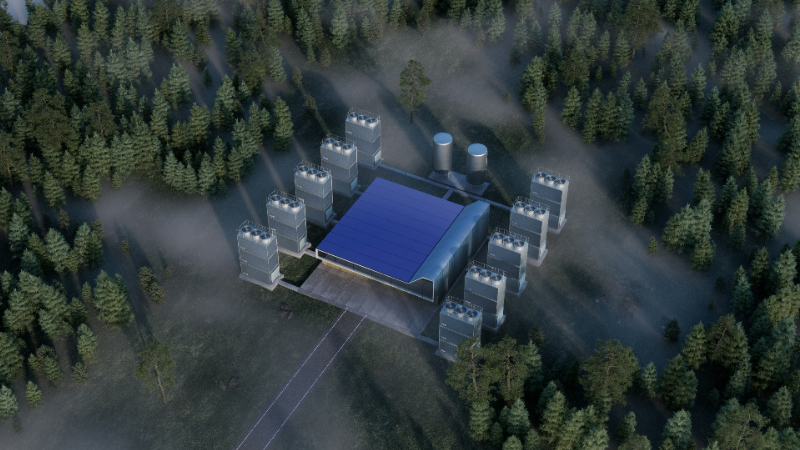
Modular direct air capture is an engineered carbon removal approach that uses repeatable, factory-built units to extract carbon dioxide directly from ambient air, rather than from a concentrated industrial exhaust stream. In a typical solid-sorbent system, fans move air through materials that selectively bind carbon dioxide at lower temperatures; the captured carbon dioxide is then released when the material is heated, producing a concentrated stream that can be permanently stored underground or used in products such as low-carbon concrete, synthetic fuels or industrial materials.  The modular design matters because direct air capture remains early in commercial deployment and needs faster manufacturing, lower project execution risk and easier technology upgrades to reach meaningful scale. By using standardized modules that can be connected in arrays, developers can add capacity incrementally, replicate project designs across sites and replace key components as capture materials improve. The approach also enables co-location with renewable generation, energy storage, industrial facilities and carbon transport or storage infrastructure, helping developers integrate direct air capture into broader low-carbon industrial and energy systems.  The model’s commercial importance lies in turning a capital-intensive climate technology into a repeatable infrastructure platform. Scale can come from manufacturing learning, portfolio deployment, technology upgrades and long-term offtake contracts rather than one-off project delivery.  Main Outcomes of the Solution Business Value: Creates a more bankable pathway for carbon removal by shifting project delivery from bespoke infrastructure builds to repeatable, manufactured assets. Long-term offtake contracts can improve investment certainty for projects located near low-carbon power, heat, carbon transport, storage infrastructure or industrial users. Sustainability: Supports decarbonization by creating a route to remove residual emissions that are difficult or costly to eliminate directly. Its climate value depends on using low-carbon electricity and heat, minimizing lifecycle emissions and pairing captured carbon dioxide with verified durable storage or use pathways. Key Deployment and Scaling Factors Locate DAC projects where low-carbon electricity, clean heat, or waste heat can support operations without increasing system emissions.  Standardize modular units to reduce delivery risk by enabling repeatable installation, phased expansion, and factory-based production.  Allow component and sorbent upgrades so that projects can improve performance without replacing the full asset.  Capture capacity paired with verified storage or utilization pathways to ensure that removed carbon dioxide delivers durable climate value.  Long-term offtake contracts, public procurement, tax credits, and hub-based infrastructure to improve bankability and attract capital for scale-up. Case study CarbonCapture and True North Carbon (2025), Canada In 2025, CarbonCapture, through its Canadian subsidiary True North Carbon, deployed the Tamarack direct air capture project at Deep Sky Alpha near Innisfail, Alberta. The project reached first capture on 22 October 2025 and is described by the company as Canada’s largest single-technology direct air capture deployment. Tamarack is designed to remove up to 2,000 tons of carbon dioxide from the atmosphere each year using modular direct air capture equipment powered by solar energy.  The implementation demonstrates a phased deployment model in which standardized capture modules are installed at a shared carbon removal facility, rather than developed as a stand-alone bespoke plant. The project is expected to generate the company’s first carbon removal credits and includes local supplier participation, community engagement and education programs with local and Indigenous communities. These project benefits should be treated as company-stated expectations until independently verified outcomes are available. References:Direct Air Capture - Energy System - IEA CarbonCapture | World Economic Forum DOE Explains...Direct Air Capture | Department of Energy Newsroom | Carbon Capture Inc. True North Carbon's Tamarack Project, Canada's Largest Single-Technology Direct Air Capture Deployment, Achieves First Capture in Innisfail, Alberta 
Modular direct air capture (DAC)
CarbonCapture
A shared storage capacity leasing model turns battery storage from a project-specific compliance asset into a tradable, system-facing flexibility resource. In this structure, an independent storage operator can buy electricity when market prices are low, sell electricity when prices are high, and receive compensation for maintaining dependable discharge capacity. At the same time, charging electricity can be exempted from selected grid-related charges, including transmission, distribution, and certain government surcharges, which improves operating economics and makes market-based dispatch more viable.  The leasing element allows storage capacity to be registered centrally and contracted across an entire province, enabling renewable generators or other eligible counterparties to lease capacity instead of building dedicated batteries at each site. This matters because it stacks multiple value streams into a single business model – energy arbitrage, capacity compensation, and leasing revenue – while widening access to storage services beyond the owner of the asset.  Strategically, the model supports a more efficient build-out of flexibility: storage can be deployed where it is most valuable to the power system and  then shared through market arrangements rather than duplicated project by project. As electricity systems absorb more variable renewable generation, this kind of market design helps align storage investment with both commercial incentives and system reliability needs. Main outcomes of the solution Affordability: Shared storage lowers total system cost by allowing multiple users to access a single storage asset instead of building separate project-specific systems. Exempting certain charging-related grid costs and combining leasing, market trading, and capacity payments also improves asset utilization and reduces the cost of deploying flexibility at scale.  Reliability & Flexibility: The model increases dispatchable flexibility by enabling storage to respond to spot market conditions and by compensating available capacity. This supports balancing of variable wind and solar generation, peak demand management, and overall system operability.  Institutional Efficiency & Transparency: Central registration and province-wide leasing through the electricity trading center create a structured framework for sharing storage. Defined participation and transaction rules support a more transparent and organized market for storage services. Key implementation and scaling factors Allow storage to participate directly in electricity markets as an independent asset class. Combine spot market revenues, capacity payments, and leasing income to improve commercial viability. Establish central registration and province-wide leasing mechanisms to enable efficient sharing of storage capacity. Exempt charging electricity from selected transmission, distribution, and surcharge components to improve project economics. Align storage deployment with renewable expansion and system flexibility needs to support efficient scaling. Case study Shandong Provincial Development and Reform Commission, Shandong Provincial Energy Administration, and the National Energy Administration’s Shandong Regulatory Office (2022), China In Shandong Province, China, the shared storage capacity leasing model was introduced through a provincial policy framework issued by the Shandong Provincial Development and Reform Commission, the Shandong Provincial Energy Administration, and the National Energy Administration’s Shandong Regulatory Office.  The framework allows independent energy storage to participate directly in electricity markets by purchasing electricity to charge and selling electricity back to the grid when discharging. It introduced a two-part compensation structure combining energy market revenues with capacity payments and requires storage capacity to be centrally registered through the provincial electricity trading center for leasing across the province by renewable energy companies.  For designated demonstration projects, monthly available-capacity compensation was set at up to twice the standard level applied under prevailing market rules. The policy also exempts eligible charging electricity from selected transmission, distribution, and government surcharge costs. In practice, this framework establishes a structured approach for transitioning storage from a project-specific asset to a shared provincial flexibility resource with multiple revenue streams and formal market participation.   Solution and insights developed with contributions from CNESA. References: Shandong Introduced China's First Energy Storage Support Policy in Electricity Spot Market — China Energy Storage Alliance  
Shared storage capacity leasing model

Shandong Provincial Development and Reform Commission (Shandong DRC), Shandong Provincial Energy Administration, National Energy Administration (NEA) Shandong Regulatory Office
Load flexibility frameworks define how electricity consumers can adjust demand in response to grid needs, price signals or operational constraints. Rather than treating demand as fixed, these frameworks classify flexible load according to practical performance characteristics such as response speed, duration, availability, frequency of activation, ramping capability and depth of demand reduction or shifting. This gives system operators, utilities, aggregators and customers a common basis for assessing how load can contribute to reliability, balancing, congestion management and peak reduction. The framework is particularly useful for large new loads, such as industrial facilities, data centers, hydrogen production, EV charging hubs or electrified heating systems, where grid connection queues can be delayed by local capacity constraints or uncertainty over reinforcement needs. By defining when and how a customer can reduce or shift demand, utilities can evaluate flexible connection options, staged energization or non-firm service arrangements more consistently. This can help identify existing grid headroom, reduce repeated bespoke studies and support more consistent connection decisions while maintaining system reliability. By translating customer-side flexibility into standardized operating terms, the framework helps integrate demand-side resources into grid planning and operations. When properly measured and governed, flexible loads can reduce stress on the grid, improve use of existing network capacity and support higher renewable integration without relying only on generation-side capacity or network reinforcement.  Main Outcomes of the Solution Reliability & Flexibility: Enables demand-side resources to support grid needs such as peak reduction, congestion management, balancing and frequency response. Affordability: Improves utilization of existing grid assets by using flexible demand to defer or reduce the need for immediate network reinforcement or generation capacity. Institutional Efficiency & Transparency: Creates common definitions, performance expectations and participation rules for utilities, system operators, aggregators and customers. Key Deployment and Scaling Factors Standardize flexibility definitions covering response speed, duration, availability, frequency of activation, ramping capability and depth of demand adjustment. Establish measurement and verification methods to confirm that flexible load performs as expected during grid events or market participation. Integrate flexibility into planning, connection, market and operational processes so demand-side resources can be evaluated alongside supply-side and network options. Develop customer participation models that reflect different load types, including industrial facilities, commercial buildings, data centers, EV charging and thermal loads. Define clear commercial, regulatory and operational arrangements covering incentives, obligations, dispatch rights, data sharing and reliability requirements. Case study Electric Power Research Institute DCFlex Flex MOSAIC Framework (2026), United States EPRI’s DCFlex Flex MOSAIC™ Framework provides a standardized, technology-neutral way to describe and evaluate flexibility from large loads, particularly data centers. It defines flexibility through common performance characteristics such as notification time, duration, frequency of use, load adjustment depth, ramp behavior and availability. This gives utilities, system operators, regulators and developers a shared basis for assessing whether flexible demand can support grid connection and operation. The framework addresses a common interconnection challenge: large loads are often studied as bespoke projects, which can increase uncertainty, study time and cost. By classifying flexibility against grid needs such as congestion relief, peak reduction, balancing and frequency response, the framework helps identify where existing grid headroom can be used more effectively without compromising reliability. The case demonstrates how standardized flexibility definitions can support more consistent connection decisions for large electricity users. It also provides a foundation for voluntary flexible-load programs, allowing data centers and other large loads to participate in grid support while preserving a pathway toward firmer service over time. References:Flex MOSAIC™ | DCFlex EPRI Launches Flex MOSAIC to Reduce ‘Time to Power’ for Data Centers | FinancialContent 
Load flexibility framework for grid planning, operations and large-load connection
Electric Power Research Institute (EPRI)
Interconnection queue reform changes how grid operators study and approve new generation or storage projects seeking grid connection. Instead of processing projects one by one under a serial, first-come, first-served queue, projects are grouped into study cycles and assessed together based on network impact, readiness, site control, technical completeness and financial commitments. This helps system operators focus engineering resources on projects that are more likely to proceed, while reducing the risk that speculative or incomplete projects occupy queue capacity and delay more viable resources.  The model typically introduces defined application windows, validation phases, phased impact studies and decision points where developers must either post additional security, meet readiness requirements or withdraw before costs and commitments escalate. By moving toward a first-ready, first-served approach, interconnection reform can improve queue discipline, shorten review timelines, increase transparency for developers and support faster integration of new resources needed for reliability, electrification and renewable growth.  Main Outcomes of the Solution Reliability & Flexibility: Accelerates connection of generation and storage resources needed to meet demand growth, improve resource adequacy and support changing system needs. Affordability: Reduces time and cost spent studying speculative or less-ready projects, while improving visibility on network upgrade needs and cost allocation. Institutional Efficiency & Transparency: Creates clearer queue rules, readiness requirements, study phases and developer decision points, improving predictability for system operators, regulators and project developers. Key Deployment and Scaling Factors Clustered study process that groups projects into defined application cycles rather than processing each project individually. Readiness requirements covering site control, technical data, deposits and other evidence that projects are capable of advancing. Phased study design, including early system-impact screening, detailed impact analysis and facilities-level assessment. Digital tools and standardized application review processes to manage high volumes of interconnection data and reduce manual review bottlenecks. Clear rules for withdrawal, restudies and network-upgrade cost allocation to reduce late-stage uncertainty for developers and system operators. Case study PJM Interconnection (2026), United States PJM’s first full reformed interconnection queue cycle demonstrates a cluster-based, first-ready, first-served model for processing new generation and storage projects. The reform replaces PJM’s earlier serial, first-come, first-served queue approach with a clustered cycle process designed to screen project readiness earlier and prevent less-viable projects from clogging the queue. The validation phase confirms whether applicants have submitted required technical and financial information, including site control and readiness commitments, before qualified projects move into clustered system-impact studies. In April 2026, PJM announced that 811 new generation projects, representing around 220 GW of capacity, had applied to connect through the first cycle of its reformed process. PJM described this as the first major intake under a redesigned approach focused on improving the certainty, speed and discipline of project review. PJM’s Cycle 1 applications include a diverse mix of resources, including storage, gas, nuclear, solar, wind, hybrid, hydro and other projects.  The case shows how interconnection queue reform can create a more structured pathway for new resources to connect to the grid. PJM expects projects in the cycle to be reviewed through a multi-stage process, with phased studies and decision points running into 2028. The reform is particularly relevant as PJM faces rising demand from data centers, advanced manufacturing and electrification, making timely interconnection of new supply critical for reliability. References:  PJM’s First Reformed Queue Cycle Draws 811 Projects, 220 GW FERC Conditionally Accepts PJM Interconnection Reforms for a First-Ready, First-Served Clustered Cycle Approach | Washington Energy Report 
Interconnection queue reform
PJM Interconnection
Cap-and-floor investment frameworks support long-duration electricity storage by reducing revenue uncertainty while preserving market-based operation. Under this model, storage assets continue earning revenues from electricity market activities, but a regulated floor provides minimum revenue protection if market earnings fall below an agreed threshold, while a regulated cap limits excess revenues and can return upside value to consumers. This creates a clearer investment case for storage assets that have high upfront costs, long development timelines and uncertain future market revenues. Long-duration electricity storage can provide flexibility over extended periods, helping shift surplus renewable generation, manage periods of low renewable output, support security of supply and reduce reliance on fossil-fuel-based backup or balancing resources. However, many long-duration technologies face financing barriers because their full system value is not always captured through short-term wholesale or ancillary service markets. A cap-and-floor framework helps address this gap by creating a bankable revenue structure, while still incentivizing projects to operate efficiently in the market. Main Outcomes of the Solution Business value: Improves investor confidence and project bankability by creating minimum revenue protection while allowing upside from market operation. Reliability and flexibility: Supports investment in long-duration storage assets that can provide extended balancing, system flexibility and security-of-supply benefits. Affordability: Protects consumers through a revenue cap and helps unlock storage that can reduce wider system costs by improving renewable integration and reducing reliance on more expensive balancing options. Key Deployment and Scaling Factors Clear eligibility criteria defining qualifying long-duration storage technologies, minimum duration requirements and project readiness conditions. Transparent cap-and-floor revenue design, including how the cap, floor, rates of return and revenue assessment periods are calculated. Robust project assessment process covering eligibility, project cost assessment, cost-benefit analysis and consumer value. Consumer protection mechanisms ensuring that excess revenues above the cap are returned and that floor payments are justified. Defined institutional roles for government, regulator, system operator and project developers, including licensing, cost recovery, monitoring and reporting arrangements. Case study Ofgem Long Duration Electricity Storage Cap-and-floor Scheme (2025), United Kingdom Ofgem is implementing a cap-and-floor scheme to enable investment in long-duration electricity storage while protecting consumers. Under the model, Ofgem sets a minimum and maximum level of revenue for an LDES project: when revenues fall below the floor, consumers top up the difference through energy bills; when revenues exceed the cap, the extra money is returned to consumers through reductions in network charges. Ofgem states that this model encourages investment by guaranteeing revenues that can offset high upfront costs and market uncertainty for LDES projects.  The first application window is structured around two streams. Stream 1 applies to more mature technologies, requiring at least 100 MW of capacity and TRL 9. Stream 2 supports less mature technologies, requiring at least 50 MW of capacity and TRL 8. Both streams must be able to discharge continuously at full power for at least eight hours. The scheme responds to a clear system need: Ofgem identifies an indicative capacity range of 2.7–7.7 GW of additional LDES required by 2035, based on NESO advice.  The case shows how a regulated investment framework can improve bankability for long-duration storage, while using eligibility thresholds, cost-benefit analysis and consumer-protection mechanisms to support system flexibility and security of supply. Reference: Long duration electricity storage | Ofgem Long Duration Electricity Storage: Technical Decision 
Cap-and-floor investment framework for long-duration electricity storage

Office of the Gas and Electricity Markets (OFGEM)
Green electricity market platforms create dedicated trading channels for buyers and sellers of renewable electricity. Instead of relying only on bilateral contracts or long-term procurement, these platforms allow renewable energy to be traded through organized power exchanges across short-term and forward time horizons. Buyers can procure green electricity to meet sustainability targets or renewable purchase obligations, while renewable generators gain an additional route to market. These platforms improve price discovery for renewable electricity by allowing participants to submit bids based on quantity and price, and by clearing green electricity separately or alongside conventional market segments. They can also support flexible procurement across day-ahead, intraday, weekly or monthly products, helping buyers manage demand variation while enabling renewable generators to sell surplus output. When linked to renewable purchase obligations or certificate systems, green electricity market platforms can increase transparency, improve liquidity and create clearer investment signals for renewable generation. Main Outcomes of the Solution Sustainability: Accelerates renewable electricity consumption by creating dedicated market channels for green power procurement. Affordability: Improves price discovery and procurement flexibility, helping buyers access renewable electricity through competitive market mechanisms. Institutional efficiency and transparency: Strengthens renewable power markets through clear trading rules, exchange-based procurement and linkage with renewable compliance mechanisms. Key Deployment and Scaling Factors Dedicated green electricity trading segments within existing power exchanges. Clear eligibility rules defining which renewable resources and buyers can participate. Integration with renewable purchase obligations, renewable energy certificates or other compliance frameworks. Multiple contract horizons, including day-ahead, intraday, weekly and monthly products, to support buyer flexibility. Transparent market clearing, settlement and reporting processes to build confidence among generators, buyers and regulators. Case study Green Term Ahead Market and Green Day Ahead Market (2020), India India introduced dedicated green electricity trading products to deepen the market for renewable electricity and provide competitive price signals. The Green Term Ahead Market has operated since August 2020, while the Green Day Ahead Market has been available since October 2021 as an additional market segment for renewable electricity trading. The Ministry of Power states that GTAM and GDAM enable procurement of green energy through power exchanges, which can be counted toward renewable purchase obligations. The GDAM allows participants to submit quantity and price bids for renewable electricity, with price discovery carried out before the conventional day-ahead market. Buyers can claim renewable purchase obligation credit for power purchased through GDAM, while renewable energy sellers cleared in the conventional day-ahead market may claim renewable energy certificates. The Ministry reported that total GDAM volume from October 2021 to January 2023 reached 4,186.64 million units. The Green Term Ahead Market provides additional flexibility by allowing renewable electricity trading across intraday, day-ahead contingency, daily, weekly, monthly and any-day single-sided contracts, with procurement available up to 90 days. The Ministry reported that GTAM volume from August 2020 to January 2023 reached 8,509.49 million units. The case shows how dedicated green power exchange products can improve renewable electricity procurement, create clearer market signals and support compliance with renewable purchase obligations. References: Press Release:Press Information Bureau IEX | Indian Energy Exchange 
Green electricity market platform for renewable power procurement

Indian Energy Exchange
Revenue underwriting schemes support investment in renewable generation and clean dispatchable capacity by reducing downside revenue risk for project developers. Under this model, eligible projects compete through tenders for long-term underwriting agreements that provide a revenue safety net if market revenues fall below an agreed level, while allowing government or consumers to share in upside returns when project revenues exceed agreed thresholds. This improves bankability for capital-intensive clean energy assets while retaining exposure to market signals. The mechanism is particularly useful where electricity systems need rapid build-out of renewables, storage and other dispatchable clean capacity, but investment is slowed by merchant price uncertainty, financing constraints, grid connection risk or policy uncertainty. By using competitive tenders, governments can target specific capacity volumes, technologies or locations, while selecting projects based on price, deliverability, system value and broader community or economic criteria. [1],[2] Main Outcomes of the Solution Business value: Improves investor confidence and project bankability by providing long-term revenue certainty for renewable generation and clean dispatchable capacity. Sustainability: Accelerates deployment of low-carbon electricity resources needed to replace fossil-fuel generation and support clean power targets. Affordability: Uses competitive tenders and revenue-sharing design to reduce investment risk while limiting public exposure and returning upside value when projects perform strongly. Key Deployment and Scaling Factors Design competitive tenders with clear eligibility rules, bid evaluation criteria and capacity targets for renewable generation and clean dispatchable resources. Define long-term underwriting contracts with revenue floors, upside-sharing arrangements, payment triggers, settlement methods and payment caps. Integrate procurement with system planning so contracted projects support reliability, renewable integration and grid needs. Include deliverability requirements covering grid connection, land access, permitting, financing, community engagement and project timelines. Maintain exposure to market signals, including operational incentives around dispatch, availability and negative pricing. Establish transparent governance and cost-recovery arrangements to balance investor confidence, consumer protection and public accountability. Case Study Australian Government Capacity Investment Scheme (2023), Australia Australia’s Capacity Investment Scheme is a revenue underwriting scheme for renewable generation and clean dispatchable capacity. Successful projects receive long-term agreements with an agreed revenue floor and ceiling, reducing downside market risk while preserving exposure to wholesale market signals. If project revenue falls below the floor, government support covers part of the shortfall; if revenue exceeds the ceiling, the project shares upside revenue with the government.  The underwriting design also accounts for negative price exposure. Tender guidance describes a zero-price floor approach for net revenue calculations, where payments linked to negative prices are excluded from the calculation. This helps avoid treating negative-price periods as lowering annual revenue for underwriting purposes, while retaining incentives for projects to manage dispatch and contracting exposure. The scheme was expanded on 29 July 2025 from 32 GW to 40 GW of new capacity nationally. The target increased from 23 GW to 26 GW of renewable generation capacity and from 9 GW to 14 GW of clean dispatchable capacity, with the expanded scheme to be rolled out from 2024 to 2027.  The case shows how revenue underwriting can reduce investment risk while maintaining competitive discipline. By combining a revenue floor, ceiling and tender-based allocation, the scheme improves bankability for clean energy projects while helping Australia accelerate renewable generation and dispatchable capacity deployment. [1],[2] References: https://www.dcceew.gov.au/energy/renewable/capacity-investment-scheme  The Capacity Investment Scheme 
Revenue underwriting scheme for clean energy investment

Department of Climate Change, Energy, the Environment and Water of Australia
Balancing market platforms enable system operators to procure reserve and ancillary services through transparent, competitive market mechanisms. Instead of relying only on administratively procured reserves or bilateral arrangements, qualified resources bid into standardized products that reflect system needs such as frequency control, supply-demand balancing, renewable forecast-error management and contingency response. These resources can include generation, pumped hydro, battery storage, self-generation and demand response, provided they meet technical performance requirements. As renewable penetration increases, balancing needs become more dynamic because system operators must manage larger forecast errors, shorter-term variability and unexpected changes in supply or demand. A dedicated balancing market helps create clearer price signals for flexibility, expands participation beyond conventional generators and can improve the efficiency of reserve procurement. By defining products according to response time, duration and operational purpose, the platform allows different technologies to compete to provide the flexibility services most suited to their capabilities. Main Outcomes of the Solution Reliability and flexibility: Supports frequency control, supply-demand balancing and contingency response by procuring reserve products with defined technical requirements. Affordability: Can improve procurement efficiency by allowing multiple resource types to compete to provide balancing services, helping reduce reserve procurement costs where markets are liquid and well designed. Institutional efficiency and transparency: Creates standardized products, market rules and published trading information that improve transparency and neutrality in reserve procurement. Key Deployment and Scaling Factors Define balancing products clearly, including response time, duration, activation conditions, locational requirements and performance standards. Establish resource-neutral participation rules that allow generation, storage, self-generation and demand response to compete if they meet technical requirements. Develop market systems for bidding, clearing, dispatch, settlement, performance assessment and publication of trading results. Coordinate balancing market operation with transmission system operation, renewable forecasting, congestion management and imbalance settlement. Set transparent governance, monitoring and penalty arrangements to maintain market confidence and reliable delivery of contracted reserves. Ensure telemetry, metering, communications and cybersecurity standards are sufficient for near-real-time activation and verification. Align market rules with broader system planning and investment signals so flexibility providers can build credible revenue stacks.  Case study Electric Power Reserve eXchange Balancing Market (2024), Japan Japan’s balancing market is used by general transmission and distribution operators to procure reserves for frequency control and supply-demand balancing. The market was established in April 2021 as part of broader electricity market reform to support cross-regional procurement of balancing capacity, improve transparency and reduce adjustment costs through competition.  The market was introduced in phases. Tertiary reserve 2 began in fiscal year 2021, tertiary reserve 1 in fiscal year 2022 and, from fiscal year 2024, primary reserve, secondary reserve 1 and secondary reserve 2 were introduced, enabling market trading across all five product categories. Participation can include thermal generation, pumped hydro, battery storage, self-generation and demand-response providers that meet technical requirements.  EPRX began operating the balancing market from April 2024, taking over from the earlier structure operated by Japan’s general transmission and distribution operators. Its role is to support stable, transparent and neutral market operation as the importance of balancing procurement grows with renewable integration and power-market reform.  The case shows how a national balancing market can create a structured route for multiple flexibility resources to provide reserve services. By fiscal year 2024, Japan’s balancing market had introduced all five reserve product categories, covering response times from fast primary reserves to slower tertiary reserves. The market framework expanded participation beyond conventional thermal generation to include batteries, pumped hydro and demand-response providers, supporting more flexible system operation as renewable penetration and short-term balancing needs increase. References: 一般社団法人 電力需給調整力取引所 Organization Overview | About the Electricity Supply and Demand Adjustment Exchange | Electricity Supply and Demand Adjustment Exchange 
Balancing market platform for reserve and ancillary services

Electric Power Reserve eXchange (EPRX)
Energy savings insurance and standardized investment models make it easier to finance energy efficiency upgrades by addressing a long-standing concern – uncertainty about whether predicted savings will be delivered. In the past, many projects relied mainly on contractual performance guarantees from contractors, which could still leave building owners and lenders exposed if results were disputed, difficult to verify, or dependent on a single company’s financial strength. This solution improves on that approach by adding two practical elements. First, an insurance policy can protect the customer if agreed savings are not achieved, shifting performance risk to an insurer that is structured to manage it. Second, a standardized package – including shared contract terms, a consistent method to estimate and verify savings, and independent validation – makes projects easier to compare and assess. Together, these elements reduce uncertainty and administrative complexity, which can lower financing barriers and help smaller projects attract capital. A key benefit is repeatability: once the model is established, similar upgrades can be deployed across multiple sites and organizations with faster approvals and more predictable outcomes. Main outcomes of the solution Affordability: By making energy efficiency upgrades easier to finance and replicate, the solution accelerates demand reduction and peak load relief. This can lower system operating costs and help moderate consumer bills through reduced energy consumption and deferred network investment. Business Value: By shifting performance risk from customers and lenders to an insurance-backed structure, the solution improves bankability and enables portfolio financing. This can increase private capital participation and make returns more predictable for efficiency investments. Institutional Efficiency & Transparency: By using standardized contracts and consistent validation of savings – typically based on recognized measurement and verification protocols – the solution reduces negotiation and due diligence time, strengthens trust in reported results, and supports faster and more consistent approvals across projects and markets. Key implementation and scaling factors Standardize documentation and calculation methods so projects use repeatable contracts and consistent savings estimation and verification, reducing transaction costs and enabling replication. Require independent technical validation to confirm baselines, assumptions, and expected savings before financing and insurance attach, reducing disputes and increasing lender confidence. Develop clearly defined energy savings insurance products with transparent triggers, roles, and remedies, improving financeability and reducing risk premiums. Build bank and investor readiness through consistent project data packs and underwriting guidance so financiers can evaluate projects without bespoke engineering reviews. Enable pipeline aggregation through common eligibility criteria and reporting standards so smaller projects can be bundled into portfolios and financed at scale. Case study Inter-American Development Bank (IDB) and partners including BASE (2013), Global In 2013, the Inter-American Development Bank (IDB), together with partners including BASE – the Basel Agency for Sustainable Energy – developed the Energy Savings Insurance (ESI) model to unlock investment in energy efficiency by reducing the risk that projected savings are not delivered. In Europe, the model has been implemented in Italy, Portugal, and Spain through initiatives including the GoSafe with ESI program. These deployments combine standardized contracts adapted to national legal frameworks, independent validation of expected savings, and participation from local insurers and financial institutions. European implementation has also incorporated digital project management and reporting tools to improve traceability of project performance and reported savings. Building on early implementation experience, the approach has expanded to additional markets, supporting wider replication of the same financing structure. Reported results from early deployments indicate that the model can support measurable reductions in energy use for participating enterprises while helping build a growing pipeline of financed projects and mobilized investment. This helps shift energy efficiency upgrades from isolated transactions toward repeatable programs capable of scaling across multiple sectors. References: WEF_Industrial_Electrification_2024.pdf Financing Energy Efficiency – Energy Efficiency Policy Toolkit 2025 – Analysis - IEA Energy Savings Insurance (ESI) Europe | BASE Energy Savings Insurance: Advances and Opportunities for Funding Small- and Medium-Sized Energy Efficiency and Distributed Generation Projects in Chile Energy Savings Insurance: Building Trust in Energy Efficiency Investments | BASE 

Energy savings insurance and standardized investment models
Inter-American Development Bank, BASE
A regulated innovation funding framework for energy network transformation is a structured, publicly administered mechanism that channels ring-fenced funding from network price controls into the development and demonstration of new technologies, services and business models needed to decarbonize electricity and gas networks.  Rather than relying on utilities to self-fund innovation or on commercial markets to develop early-stage solutions, the framework creates a dedicated pathway through which energy network companies partner with innovators and apply for staged funding against published challenge areas. Projects typically progress through phases such as feasibility, proof of concept and large-scale demonstration, with funding increasing at each stage and fewer projects advancing.  The framework is designed to address a persistent market failure: transformational energy infrastructure innovation is often too risky and too long-cycle for private capital alone, while the changes required for net zero are too urgent to leave to incremental network investment. By embedding innovation funding within the regulatory price control, the mechanism strengthens accountability to consumers, requires measurable net benefit and creates a replicable program structure that can be extended, scaled and refined across successive price control periods. Main Outcomes of the Solution Sustainability: Accelerates the development and deployment of technologies needed to decarbonize electricity and gas networks, including whole-system integration, network flexibility, electrification and low-carbon energy infrastructure. Affordability: Limits consumer cost exposure through competitive allocation, net-benefit requirements and phased funding gates that concentrate resources on the most promising projects. Institutional Efficiency & Transparency: Embeds innovation within the regulatory framework, creating clear governance, challenge-based direction, published project information and accountability for consumer-funded innovation. Key Deployment and Scaling Factors Embed the innovation fund within the regulatory price control so consumer funding is subject to clear governance, net-benefit requirements and regulatory accountability. Publish challenge areas co-developed with industry, consumers, regulators and government to focus innovation on priority system needs. Use a phased funding structure – such as feasibility, proof of concept and demonstration – to manage risk and create a clear progression pathway from early concept to deployment. Require network license holders to partner with innovators, technology companies and research institutions so funded ideas are connected to operational network needs. Add deployment support in successive price control periods to bridge the gap between successful demonstration and widespread operational adoption. Require transparent monitoring, reporting and knowledge-sharing so lessons from funded projects can inform wider industry practice. Align funding with data governance, cybersecurity, interoperability and safety requirements, particularly where projects involve digital systems or operational network assets Case study Ofgem and Innovate UK, Strategic Innovation Fund (2021–2026), United Kingdom The Ofgem Strategic Innovation Fund is delivered in partnership between Ofgem and Innovate UK as part of the RIIO network price control. Launched in 2021 as a five-year, £450 million program under RIIO-2, the fund supports innovation in gas and electricity networks for a low-carbon future. Ofgem and Innovate UK now describe SIF as a £1 billion program, including a further £500 million for the RIIO-3 period.  By the end of 2024, the program reviewed more than 270 new ideas and approved more than £104 million of funding, including 12 large-scale Beta demonstration projects. The 2024 annual report also identified 234 funded projects involving 339 organizations, with 191 completed and 43 live. These figures indicate the scale of participation and the staged progression model used to filter ideas toward larger demonstrations.  For RIIO-3, the program introduces five innovation challenges for 2026 to 2033, covering industrial and business connection acceleration, network build speed and cost, plug-and-play domestic devices, outage reduction and decentralized system balancing. Ofgem’s governance documentation also confirms a multi-phase project approach designed to mitigate innovation risk.  Projected outcomes from funded projects include more than £5.9 billion in potential cost savings and over 12.2 million tons of CO₂-equivalent in potential emissions reductions by 2035, based on illustrative projections assuming projects progress to full rollout. These projected benefits are associated with innovations in areas such as network flexibility, decentralized system balancing, electrification and whole-system integration, and should be treated as projected benefits rather than realized outcomes. References:Apply to the Strategic Innovation Fund (SIF) – Ofgem Ofgem Strategic Innovation Fund Programme Page – Innovate UK Business Connect Strategic Innovation Fund Annual Report 2024 – Innovate UK / UKRI £84 Million of SIF Funding to Accelerate Race to Net Zero – UKRI  

Regulated innovation funding framework for energy network transformation
Innovate UK, Ofgem
Bankable competitive procurement frameworks provide a credible and repeatable route for converting identified infrastructure needs into financeable projects. They bring together structured competitive tendering, clear qualification and evaluation criteria, standardized contractual arrangements and explicit allocation of risks between public authorities, utilities, developers and lenders. Unlike stand-alone contracting mechanisms, these frameworks cover the pathway from defining the required project and inviting competition to establishing the long-term revenue arrangements needed to reach financial close. Competitive bidding can support price discovery and cost discipline, while long-term revenue arrangements, such as power purchase agreements or availability-based contracts, provide greater certainty over future cash flows. This combination can reduce development and financing risk, broaden participation among domestic and international investors and strengthen confidence that projects will proceed on clearly defined terms. The approach is particularly relevant where investment appetite exists but projects lack a credible route to market or a sufficiently predictable revenue model. Such frameworks are widely used for renewable generation and can also be applied, with asset-specific contractual structures, to storage, transmission and other strategic power infrastructure. When applied across successive procurement rounds, they can create a visible project pipeline, allow documentation and processes to be refined over time and support delivery at scale.Main Outcomes of the SolutionBusiness Value: Creates bankable investment opportunities by combining competitive procurement with long-term contractual revenue models, reducing financing risk and supporting private capital participation in strategic power infrastructure. Institutional Efficiency & Transparency: Establishes structured and repeatable procurement processes with clear qualification requirements, evaluation criteria and contractual frameworks, improving transparency and giving developers, financiers and public authorities greater confidence throughout the project lifecycle. Affordability: Supports competitive price discovery, cost discipline and efficient risk allocation, helping contain procurement and financing costs that may ultimately be borne by electricity consumers.Key implementation and scaling factorsBuild the technical, commercial and legal capacity of procuring authorities to design tenders, evaluate bids and manage contracts consistently across multiple projects.Establish well-defined project pipelines with clear procurement timelines, technical requirements and sufficiently prepared permitting, site and grid connection arrangements where applicable.Ensure long-term revenue arrangements are supported by financially credible counterparties, appropriate credit support where required and contractual terms that provide sufficient certainty over future cash flows.Allocate construction, permitting, grid connection, market and project delivery risks to the parties best positioned to manage them, while avoiding risk allocation that unnecessarily increases financing or public-sector costs.Set qualification and evaluation criteria that are rigorous enough to support project delivery while remaining proportionate to encourage effective competition and broad market participation.Maintain predictable regulatory and market frameworks that support the procurement mechanism and associated long-term contractual arrangements. Case studyDubai Electricity and Water Authority (DEWA) (2012 - ongoing), United Arab EmiratesDubai Electricity and Water Authority (DEWA) has used an independent power producer (IPP) procurement framework to develop successive phases of the Mohammed bin Rashid Al Maktoum Solar Park, which was launched in 2012. The 200 MW second phase, inaugurated in 2017, was the first phase developed under the IPP model, combining competitive procurement with long-term contractual arrangements.  DEWA continued this approach for subsequent phases. For the 1,800 MW sixth phase, it launched the procurement process in September 2022, receiving 23 expressions of interest and subsequently prequalifying seven international bidders. Masdar was selected as preferred bidder in 2023 for the project, with investment of up to AED 5.51 billion (USD 1.50 billion as of Sep 2026). The project reached financial close in February 2024.DEWA subsequently initiated procurement of the seventh phase under the IPP model, reporting expressions of interest from50 international companies in April 2025, subsequently prequalifying 10 international bidders. The project has now progressed to the bid evaluation stage.The successive procurement rounds illustrate how a repeatable competitive framework, combined with long-term revenue arrangements, can provide a defined route to market and mobilize private investment for large-scale renewable generation.References:IRENA - Renewable energy auctions: Design for risk allocationWorld Bank - Power Purchase Agreements (PPAs) and Energy Purchase Agreements (EPAs) Public Private PartnershipExecutive summary – Electricity Market Design – Analysis - IEARenewable Energy: Enhancing power procurement capabilitiesMohammed bin Rashid Solar Park reduces carbon emissions in Dubai.DEWA's IPP projects enhance investments in UAE and DubaiDubai Electricity and Water Authority selects the best bidder to implement the sixth phase of the Mohammed bin Rashid Al Maktoum Solar ParkDEWA and Masdar Reach Financial Closing on 1800MW Solar Park PhaseGreat success for DEWA as 47 global companies express interest in developing 7th phase of the Mohammed bin Rashid Al Maktoum Solar Park

Bankable competitive procurement frameworks
Dubai Electricity and Water Authority
Public-led adoption readiness pathways provide a structured approach for helping emerging technologies progress from technical development toward commercial deployment. Led by government departments, public innovation agencies or national laboratories, these pathways establish a common methodology for identifying adoption barriers that are not captured through technical maturity assessments alone. They can examine factors such as the strength of the value proposition, market demand, resource availability and regulatory or societal conditions that may affect deployment. By giving technology developers, program managers, investors and other stakeholders a shared basis for assessing these risks, public entities can help clarify the actions required before wider market uptake. The resulting assessment may inform program design, funding priorities, commercialization planning and risk-management decisions, while allowing different technologies within a portfolio to be considered through a consistent lens. These pathways do not replace technical testing, project due diligence or procurement qualification, nor do they certify that a technology is ready for deployment. Their role is to make nontechnical adoption barriers more visible and provide a repeatable process for identifying and addressing them. This can be particularly valuable where promising technologies have demonstrated technical potential but continue to face unclear or fragmented routes toward commercial use. DOE similarly describes ARLs as complementing rather than replacing technical readiness assessment.Main Outcomes of the SolutionInstitutional Efficiency & Transparency: More consistent adoption assessments, it establishes a common methodology for identifying commercialization barriers beyond technical maturity, supporting more transparent and evidence-based decisions across technology portfolios. Business Value: Clearer commercialization pathways, it identifies adoption risks and readiness gaps early, helping developers, investors and public programs prioritize actions needed to support market uptake. Key implementation and scaling factorsDefine the technology, value-chain boundaries and assessment timeframe consistently before evaluating adoption readiness.Base assessments on current evidence and involve relevant market, industry, public-sector and community stakeholders where their perspectives affect identified adoption risks.Apply adoption readiness alongside technical readiness rather than as a substitute for technical testing, engineering qualification or project due diligence.Translate identified adoption risks into specific commercialization actions, program support or risk-management priorities.Maintain consistent assessment criteria and evidence requirements while allowing the methodology to adapt to different technologies, markets and stages of development.Periodically reassess adoption readiness as market conditions, regulation, supply chains and technology maturity evolve.Case studyUS Department of Energy (DOE)  (2023), USAThe US Department of Energy (DOE) developed the Adoption Readiness Level (ARL) framework and its Commercial Adoption Readiness Assessment Tool (CARAT) through the Office of Technology Transitions, which now operates as the Office of Technology Commercialization, in partnership with industry stakeholders. The framework complements Technology Readiness Levels by assessing commercialization and adoption risks separately from technical maturity. The framework assesses technologies across 17 dimensions grouped into four areas (Value Proposition, Market Acceptance, Resource Maturity and License to Operate) and translates the assessment into an ARL score from 1 to 9 while identifying the individual barriers contributing to that score. DOE program offices use ARLs to inform program design, investment and risk-management decisions. DOE has also piloted the approach through national laboratories. At Sandia National Laboratories, an ARL pilot helped technology teams identify adoption risks, clarify commercialization roadmaps, improve understanding of market needs and prepare more effectively for funding applications. At Pacific Northwest National Laboratory (PNNL), researchers applied the framework to redox-flow batteries, creating a replicable methodology for technology evaluations intended to inform future funding priorities.ReferencesAdoption Readiness Levels (ARL) Framework | Department of Energy 

Public-led adoption readiness pathways
US Department of Energy
Modular and repeatable grid infrastructure designs use standardized configurations and prefabricated assemblies to reduce the amount of infrastructure that must be engineered and constructed from scratch for each project. Prefabricated substations are one application: equipment and structures such as switchgear, transformers, protection and control systems, auxiliary systems, control rooms and other building elements can be manufactured or assembled into modules off site, transported to their final location and integrated there. Utilities can develop standardized reference designs that define repeatable layouts, equipment arrangements, interfaces and technical requirements, while adapting elements that depend on local network and site conditions. Factory production can take place in parallel with site preparation and civil works, reducing the volume and duration of on-site construction. It can also move assembly, testing and quality control into more controlled environments. Reusing proven designs across subsequent projects can reduce repeated engineering and make equipment requirements, manufacturing and construction processes more predictable. Site-specific engineering remains necessary where network configuration, voltage requirements, environmental conditions, land constraints or safety and regulatory requirements differ.Main outcomes of the solutionAffordability: Reusing standardized designs and shifting assembly to controlled factory environments can reduce repeated engineering, on-site construction and rework across successive projects, supporting more efficient use of capital as networks expand. Reliability & Flexibility: Modular designs can accelerate the deployment, replacement or expansion of substations and other network infrastructure needed to connect new generation and demand while maintaining the equipment, protection and control functions required for secure network operation. System Resilience: Prefabricated and transportable modules can shorten on-site installation and facilitate faster replacement or restoration of critical grid functions following equipment failure or physical disruption, particularly where pre-engineered designs and compatible modules are available.Key deployment and scaling factorsReference designs should standardize layouts, interfaces and equipment configurations that recur across projects while retaining sufficient flexibility for site-specific network, environmental and safety requirements. Modularization should be considered early in project design so that factory fabrication, equipment integration and testing can progress in parallel with site preparation and civil works.Equipment dimensions, interfaces and transport requirements need to be designed around the practical constraints of moving prefabricated modules from manufacturing facilities to their final sites.Factory assembly requires defined quality assurance and testing procedures so that integrated modules can be verified before shipment and final commissioning on site. Repeatable designs deliver greater value when utilities establish a sustained pipeline of similar projects, allowing proven engineering and construction approaches to be reused rather than repeatedly customized.Case studyState Grid Zhejiang (2025), ChinaIn 2025, State Grid Zhejiang Electric Power completed a fully modular 500 kV substation in Fucun township, Jinhua, Zhejiang province. The Pancun village substation applied a construction method combining prefabricated assembly with intelligent systems. More than 80% of its modular components, including the steel-structured control room and firewalls, were prefabricated off site and assembled at the final location. The substation was completed in 14 months – faster than traditional construction methods – while risks associated with work at height were reduced by 50% and dust pollution was minimized. The facility is in a high-tech industrial cluster containing more than 200 enterprises and over a dozen major industrial projects and is expected to ease local power-supply constraints. According to State Grid Zhejiang Electric Power, the substation is also expected to strengthen the local and city-wide main grid by enhancing the flexibility and resilience of the regional power network.References:IEC 62271-202:2022 | IECNation's 1st modular 500-kV substation online - Chinadaily

Modular and repeatable grid infrastructure designs
State Grid Corporation of China
Integrating battery energy storage systems (BESS) into a digital representation of the grid allows operators to evaluate storage alongside network conditions and other operational actions. The approach couples distributed battery systems with a digital twin of the distribution grid – a dynamic representation of the physical network, its loads, generation and storage – on which operators can forecast conditions, simulate interventions and assess whether proposed actions can resolve network constraints before deployment.Batteries may otherwise be optimized primarily against asset or market objectives without explicitly accounting for local network conditions. Integrating storage into the grid model allows the network constraint and potential response to be evaluated together. The same environment that identifies an emerging thermal or voltage constraint can assess whether available flexible resources or network reconfiguration could address it and evaluate the resulting effects across the network.This capability is becoming more relevant as electrification, distributed energy resources and variable renewable generation increase the complexity of network planning and operation. Coordinating storage with network conditions can enable batteries to support both routine grid operation and preparedness for disruptions, while allowing their potential value to be considered alongside conventional network reinforcement.The approach can extend the digital twin across operations, preparedness and planning. In operations, it models customer-owned and operator-owned batteries as flexible resources, incorporating operating constraints and network conditions into dispatch and reconfiguration decisions. In preparedness, it allows operators to simulate island operation ahead of an event, testing voltage profiles, load balancing and restoration sequences. In planning, it provides an environment to evaluate candidate battery locations and sizing against network needs and conventional reinforcement options. By modeling the services storage can provide at different locations – from congestion management and voltage support to backup supply during disruptions – operators can assess where storage could defer or avoid network reinforcement.Main Outcomes of the SolutionReliability and Flexibility: Integrating storage into the grid model enables operators to assess batteries for congestion management, voltage support and balancing while accounting for network conditions and operating constraints.Affordability: Evaluating battery location and sizing against network constraints can help target storage where it may defer or reduce conventional network reinforcement and improve utilization of existing infrastructure.System Resilience: Simulating island operation, backup supply and restoration strategies in advance can support more structured preparedness and help assess how storage can maintain critical supply during network disruptions.Key Deployment and Scaling FactorsTreat battery siting and sizing as network planning decisions, considering the constraints addressed and the combination of services storage is expected to provide.Maintain accurate network models, telemetry and asset data so that the digital twin reflects relevant network conditions, battery availability and operating constraints.Establish interoperable data interfaces between batteries, digital platforms and grid operational systems, with clear responsibilities for dispatch, island operation and restoration.Validate control strategies before field deployment, using simulation and, where appropriate, Hardware-in-the-Loop testing to assess behavior under normal, fault and recovery conditions.Design controls to operate safely under degraded communications, with appropriate local control, fail-safe behavior and physical operating constraints.Establish cybersecurity, authentication and access controls for data exchange and remote operation of distributed storage.Integrate grid and preparedness planning so that resilience benefits and associated availability requirements can be considered alongside conventional network investment.Align deployment with grid codes, connection requirements, market arrangements and regulatory treatment of storage, including rules governing cost recovery and the provision of network and preparedness services.Case studyB-READY Consortium (2026–2028), NorwayB-READY is a Norwegian research and innovation project developing and testing battery systems for grid operation and emergency preparedness. The project received up to NOK 76 million (USD 8.1 million as of Sep 2026) in public funding through Norway’s Green Platform scheme. Led by SINTEF Energy Research, with Pixii as project owner, the consortium includes technology providers, distribution and transmission system operators, an energy producer, a public transport operator and research institution.The project is developing approaches to integrate battery systems into grid operation and planning. These include digital-twin-based tools for battery siting, methods for incorporating battery operating constraints into grid management and simulation of island operation and restoration. Falkor  participates in the grid operation and integrated grid and preparedness planning workstreams, alongside grid operators and research partners.The approaches are being tested through laboratory and field pilots, including island operation and black start, a solar-plus-storage hybrid plant and vehicle-to-grid applications. The project is also assessing whether batteries can provide both routine grid services and emergency preparedness while reducing the need for conventional network reinforcement. Project partners estimate that wider use of battery systems could reduce planned Norwegian grid investment needs by up to NOK 8.5 billion (USD 911 million as of Sep 2026) by 2030, equivalent to 5% of the approximately NOK 170 billion (USD 18.2 billion as of Sep 2026) of planned grid investment used as the project's reference case.References:B-READY - SINTEF
BESS digital twin and AI-based control
Real-time network visibility gives system operators a more accurate and continuously updated view of how the grid is performing, replacing conservative assumptions with measured operating conditions. Sensors installed on transmission lines and substations, smart meters and other monitoring devices capture information such as power flows, equipment loading, conductor temperature and local weather conditions. Communications infrastructure then transmits this data to control-room systems, where software processes it into information operators can use to understand network conditions and make operational decisions. This can reveal where congestion is emerging, where assets are approaching their limits and where unused capacity remains available. Dynamic line rating is one application: rather than assigning a fixed capacity to a transmission line based on conservative environmental assumptions, operators can adjust its rating using actual or forecast conditions. More broadly, improved visibility can help operators manage congestion, integrate variable renewable generation and make greater use of existing infrastructure while maintaining safe operating limits. As power flows become more variable and distributed energy resources increase, extending this visibility beyond transmission systems into distribution networks will become increasingly important for managing a more dynamic power system.Main Outcomes of the SolutionAffordability: Real-time visibility enables operators to make better use of existing network assets, relieving congestion and increasing usable capacity without immediately building new infrastructure. This can reduce redispatch, congestion and reinforcement costs, improving the cost-effectiveness of the power system. Reliability & Flexibility: Live information on network conditions allows operators to respond to changing power flows and identify available capacity while remaining within safe operating limits. Better situational awareness also supports the management of variable generation and enables greater operational flexibility as renewable penetration increases. Sustainability: Greater visibility can increase the amount of renewable generation the existing network can accommodate. By revealing available transmission capacity and helping operators manage congestion dynamically, it can reduce network constraints that would otherwise restrict renewable integration.Key implementation and scaling factorsDeployment depends on sufficient sensor and monitoring coverage across transmission and distribution assets to provide operators with an accurate view of network conditions. Reliable, low-latency communications and integration with control-room systems are needed to turn field measurements into information operators can use in real time. Data quality, interoperability and standardisation are critical as visibility solutions scale across different assets, technologies and network operators. Operators need validated methodologies and confidence in real-time measurements before dynamic information can be incorporated into operational limits and routine decision-making. Scaling requires regulatory frameworks that recognise the value of digital monitoring investments and allow associated costs to be recovered, particularly where they can defer conventional network reinforcement.Case studiesPowergrid (2020), IndiaIndia established 11 Renewable Energy Management Centres (REMCs) to improve the integration and real-time management of variable renewable generation. Implemented by POWERGRID on behalf of the Government of India, the centres are located alongside seven State Load Dispatch Centres, three Regional Load Dispatch Centres and the National Load Dispatch Centre in New Delhi. The REMCs combine real-time renewable generation monitoring with AI-based forecasting and scheduling tools, providing grid operators with greater visibility of changing wind and solar output and supporting coordination with existing dispatch systems. At commissioning in 2019–20, the 11 centres monitored approximately 55 GW of wind and solar capacity. The deployment strengthened operators’ situational awareness and their ability to manage the variability and balancing challenges associated with increasing renewable penetration, supporting smoother and more secure grid operation.Great River Energy (2024), USAGreat River Energy (GRE), a Minnesota-based generation and transmission cooperative, partnered with Heimdall Power to deploy dynamic line rating technology across its transmission network. Beginning at scale in 2024, the project installed 50 Heimdall Neuron sensors across 10 GRE-owned transmission lines spanning 175 miles. The sensors collect real-time information on transmission lines and their surrounding conditions, allowing GRE to assess available capacity based on actual operating conditions rather than relying solely on static ratings. After 12 months of operation, the deployment identified substantial additional transmission capacity, including gains of up to 63% during periods of peak demand. Great River Energy also projects approximately $3.175 million in avoided congestion costs over five years. The project demonstrates how asset-level monitoring can translate real-time network visibility into greater utilisation of existing transmission infrastructure and measurable reductions in system congestion costs.ReferencesAdvanced Transmission Technologies | U.S. Department of Energy Renewable Energy Management Centres Commissioned | Government of India, Ministry of Power Neurons Boost Grid Capacity | Great River Energy One Year Inside America’s Largest DLR Deployment | Heimdall Power

Real-time network visibility
Power Grid Corporation of India, Great River Energy
Digital interoperability and cybersecurity standards establish common requirements for how power-system data is structured, exchanged and protected across organizations, software applications and digital platforms. As electricity networks become more interconnected and digitally managed, transmission and distribution operators increasingly rely on data exchanged across organizational and national boundaries and on systems supplied by multiple technology vendors. Interoperability standards define common information models, data formats and exchange rules so that different applications can interpret and use the same grid information consistently, reducing reliance on bespoke interfaces and supporting coordinated planning and operation. Cybersecurity standards provide the complementary protection layer, establishing common requirements for cybersecurity risk assessment, information protection, monitoring, incident reporting and response across interconnected electricity-system actors. Together, these standards allow digital systems to exchange information consistently while establishing shared expectations for how data, applications and connected infrastructure are protected. Implementation requires more than publishing technical specifications – common requirements need to be embedded in software, operational processes and procurement, supported by conformity and interoperability testing and monitoring, and updated as technologies, system dependencies and cyber risks evolve.Main Outcomes of the SolutionReliability & Flexibility: Consistent data exchange across applications and operators, supporting coordinated system planning and operation. System Resilience: Common approaches to cybersecurity risk management, monitoring, incident reporting and crisis response across interconnected systems. Institutional Efficiency & Transparency: Standardized information models and exchange processes that reduce reliance on bespoke interfaces and improve consistency of data exchange.Key Deployment and Scaling FactorsDefine common information models, exchange formats and implementation rules so that organizations and software applications interpret information consistently.Maintain data quality and governance processes to support consistent implementation and reliable exchange of information across systems.Conduct interoperability and conformity testing to verify that different implementations of the same standard can exchange and use data correctly.Apply cybersecurity requirements across relevant organizations, technologies and suppliers, with responsibilities proportionate to identified cyber risks, including supply chain and third-party risks.Establish common processes for cybersecurity risk assessment, information sharing, incident reporting and crisis management so that threats affecting multiple actors can be identified and addressed in a coordinated manner.Regularly maintain and update interoperability and cybersecurity standards as grid processes, software, technologies and cyber risks evolve.Case studiesENTSO-E (2017-present), European UnionENTSO-E developed the Common Grid Model Exchange Specification (CGMES) to support interoperable exchange of power-system models between transmission system operators and the software applications used for system operation and development across Europe. CGMES defines a common framework for exchanging grid-model data and was incorporated into International Electrotechnical Commission specifications in 2017, with subsequent editions published as international standards. ENTSO-E complements the specification with a conformity assessment framework and interoperability testing, allowing applications from different suppliers to demonstrate implementation of assessed CGMES requirements. Its public conformity registry includes applications from multiple technology suppliers and system operators. ENTSO-E notes that conformity declarations and attestations apply to the functionality assessed and do not by themselves confirm that an application covers all requirements of a particular business process.Interoperability testing has continued as CGMES and associated network-code profiles evolve. Tests in 2025 and 2026 covered data exchange for Regional Coordination Processes, with a focus on coordinated security analysis. CGMES therefore provides a common data foundation through which different applications can exchange grid models for coordinated operational and planning processes.European Commission (2024), European UnionIn 2024, the European Commission adopted the EU Network Code on Cybersecurity for the electricity sector – Commission Delegated Regulation (EU) 2024/1366 – establishing sector-specific cybersecurity rules for cross-border electricity flows. The regulation establishes a common framework covering minimum cybersecurity requirements, cybersecurity risk assessment, monitoring, reporting, information sharing and crisis management. It also includes provisions addressing supply chain risks and cybersecurity controls.The framework provides for the identification of high-impact and critical-impact entities whose activities can affect cross-border electricity flows, alongside responsibilities for competent authorities, ENTSO-E, the EU DSO Entity and other European institutions. It establishes recurring cybersecurity risk assessments at entity, Member State, regional and Union levels and processes for identifying high-impact and critical-impact processes and entities. Rather than relying solely on independent approaches among interconnected electricity actors, the Network Code establishes common processes for assessing and managing cybersecurity risks that can affect electricity-system operation across borders.References:CIM Conformity and InteroperabilityDelegated regulation - EU - 2024/1366 - EN - EUR-Lex 

Digital interoperability and cybersecurity standards
European Network of Transmission System Operators for Electricity (ENTSO-E), European Commission
Industrial facilities account for a significant share of electricity demand and can provide opportunities for both energy efficiency and demand-side flexibility. Industry accounted for nearly 40% of global electricity demand growth in 2024, with industrial electricity consumption increasing by nearly 4%. Improving visibility into asset-level consumption and demand patterns can help facilities identify inefficiencies, manage peak demand and respond to changing system conditions. Edge AI energy intelligence solutions analyze data from facility control, metering and energy management systems close to the point of use. Applications can include asset- and line-level monitoring, load forecasting, anomaly detection, peak-demand management and identification of operational efficiency opportunities. Local data processing can also reduce reliance on external connectivity and enable sensitive operational data to remain within the facility. Where operational flexibility exists, optimized industrial loads could also participate in demand-side flexibility services, extending facility-level optimization to the wider power system.Main Outcomes of the SolutionAffordability: Identification of avoidable consumption, demand peaks and equipment performance issues can reduce energy and maintenance costs and improve energy efficiency per unit of output.Reliability and Flexibility: Asset- and line-level forecasting can support peak management and more informed load planning. Where operational flexibility exists, optimized loads may also participate in demand-side flexibility programs.Sustainability: Reducing avoidable electricity consumption can lower associated emissions, with impacts measured against site-level consumption baselines.Key Deployment and Scaling FactorsIntegrate existing facility systems as a modular layer across control, metering and energy management systems, reducing the need for equipment replacement and limiting operational disruption.Maintain human oversight by allowing operators to review recommendations before implementation and preserving an auditable decision trail.Establish site-level baselines and measurement protocols to distinguish realized savings from projected benefits and verify impacts using metered consumption.Design for replication across industrial sectors while allowing configuration for site-specific factors such as tariffs, operating schedules, equipment and consumption patterns.Case studyNommas.ai (2025), Saudi ArabiaNommas.ai is a Saudi Arabia-based industrial AI company building the intelligence layer for industrial operations, with energy management as a core application. In October 2025, the company deployed its WattX edge AI energy intelligence platform at a manufacturing facility in Saudi Arabia. The platform integrates with the facility’s existing systems and monitors energy consumption across production assets and utilities. The deployment uses an advisory-first model in which identified issues are translated into quantified recommendations for operator review before action. A baseline based on historical consumption is used to assess impact, with savings measured against metered consumption following corrective actions.The platform provides facility-level visibility into energy consumption and is used to identify abnormal consumption, support forecasting-led peak management and detect indicators of equipment degradation. A generative AI layer translates each finding, including leaks and idle consumption, into a specific, quantified recommendation, and the system’s accuracy improves with every verified outcome. Nommas.ai targets a 10–20% reduction in energy cost per facility within the first year. At scale, Nommas.ai aims to aggregate optimized industrial loads to participate in utility-facing demand-side flexibility services. References:Electricity – Global Energy Review 2025 – Analysis - IEAInformation provided to World Economic Forum by Nommas.ai (June 2026)How AI agents are changing manufacturing in the Global South | World Economic Forum
Edge AI for industrial energy intelligence
Nommas.ai

Submit your Solutions

The Innovation Playbook is a living resource which will evolve and expand over time. Public and private stakeholders are invited to submit innovative solutions for consideration for inclusion in future editions of the Playbook. 

Selected solutions will benefit from greater visibility, demonstrate impact and scalability on a trusted global platform, and help shape dialogue on the future of power systems. 

Please follow the link to submit a solution. If you would prefer to work offline before submitting, you can download a Word version of the survey here.  

Future of Power Systems

A World Economic Forum Initiative