Foxconn: Robots-per-Operator as a Workforce Planning Discipline
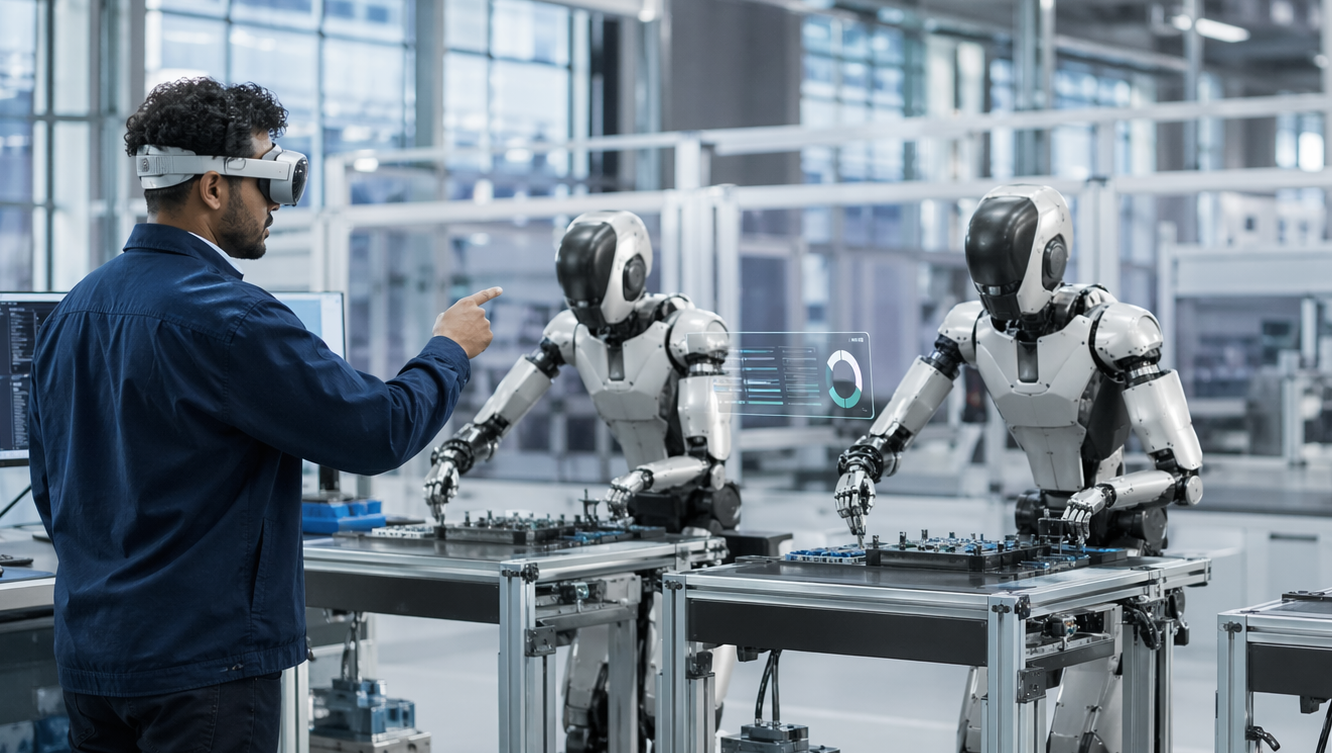
Context: Foxconn Industrial Internet is deploying humanoid robots and AI agents in production workflows as part of a broader human-machine collaboration strategy. Implementation is rooted in frontline technical expertise, with operator teams identifying tasks that robots and agents can perform, running those tasks across production cycles and defining the handoffs required to keep throughput stable.
Approach: Foxconn structures every workflow around two explicit paths. The standard path covers repeatable cases suited to augmentation and automation. The exception path routes edge cases to human operators, then returns work to the standard path once resolved. When a robot or agent signals failure or uncertainty, an operator completes the task, recalibrates the technology, or reroutes the work so the line does not stall. Teleoperation, delivered through devices such as the Apple Vision Pro, enables workers to teach and correct robots efficiently.
Foxconn uses the number of robots one operator can supervise at current reliability levels as a workforce planning metric, connecting technology investment directly to labour productivity. The organization has identified two foundational skill categories for workers operating in this model: prompt engineering and data feedback. Data feedback is the ability to identify the edge cases and unusual failure modes that actually improve model performance over time. Operators have shifted from executing work toward supervising machines, intervening on exceptions and contributing to performance improvement through training and calibration. Supervisors manage safety boundaries, confirm technological and human readiness at the start of each shift, reduce the frequency of recurring exception types and improve the quality of handoffs between the standard and exception paths.
Results: Each operator supervises three humanoid robots, each completing assigned operations at an 80% success rate, with operators intervening through teleoperation for the remaining 20%. One person managing three robots at that reliability produces about two and a half times the output they would produce working alone, an output leverage ratio of approximately 1:2.5. Separately, Foxconn's AI agents, which handle planning, scheduling and decision-support tasks, operate autonomously 90% of the time, with human takeover required for the remaining 10%. The current learning curve for a robot to adapt to a new operational task is approximately two weeks; Foxconn’s target is to reduce that learning to three days. Approximately 150 operators have transitioned into robot trainer and supervisor roles as of April 2026.