Intenseye Leading with Trust: AI-Powered Safety to Power Future Production Floors and Warehouses
Context: As manufacturers integrate robots, autonomous equipment and AI agents into production lines, the shape of the safety challenge is changing. Total recordable injuries are declining in advanced economies, but serious injuries and fatalities are not falling at the same rate and in some sectors are rising. Larger machinery, faster cycles and human-robot interaction zones mean that a single unsafe act, a bypassed light curtain, an entered restricted zone, an unsafe hand placement, can produce catastrophic outcomes that traditional safety architectures were not designed to prevent. Engineering controls such as light curtains, pressure mats and lockout-tagout remain necessary but cannot keep pace with environments where humans, autonomous systems and conventional machinery operate in close proximity. The gap requires a layer of real-time intelligence that can detect what engineering controls miss and a deployment model that earns the trust of frontline workers.
Approach: AI computer vision, applied to existing CCTV infrastructure, provides continuous detection across more than fifty categories of unsafe acts and conditions: PPE non-compliance, restricted-area entries, ergonomic deviations and unsafe proximity to machinery and vehicles. Video is processed at the edge and personally identifiable information is stripped before any data enters the analytics layer, enabling anonymized outputs without sacrificing detection fidelity. When integrated with programmable logic controllers, the same capability can trigger sub-second emergency stops when safeguards are bypassed, collapsing the response time between detection and intervention, with automatic restart once the hazard clears.
Aggregate signal, not individual events, is where the diagnostic value sits. Heat maps and temporal patterns surface which workflows, layouts and operating conditions generate unsafe acts repeatedly, shifting the unit of analysis from the worker to the system. When unsafe behaviour is observed, the relevant question is what conditions made that behaviour rational. In one documented case, repeated machine-bypass incidents traced back to equipment that could only be diagnosed while running, under a zero-downtime mandate. The process was structured to produce the unsafe act. That reframe, from behaviour to conditions, is what allows the data to drive operational redesign rather than individual correction.
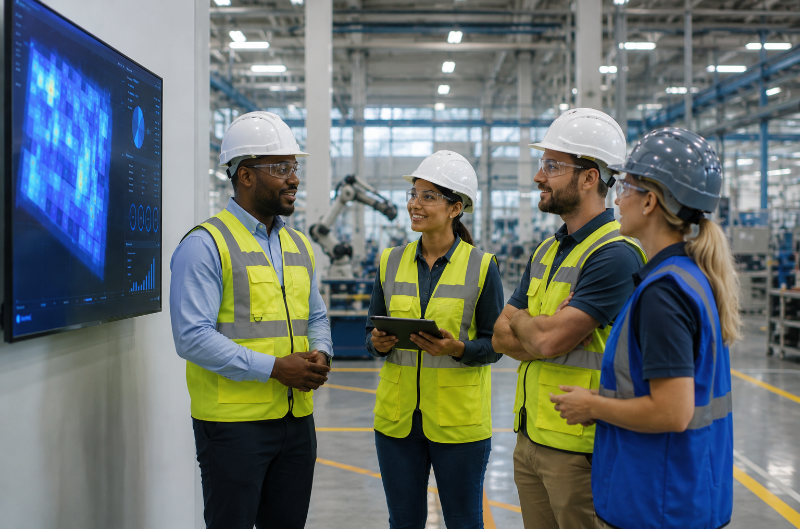
Trust is a precondition for this model to function. Anonymized reporting, with heat maps and aggregated counts placed in front of operators at every daily shift change and no worker images or identities surfaced, converts continuous observation from a surveillance mechanism into a shared diagnostic tool. Worker feedback loops directly into how detectors are configured, making the system's behaviour visibly responsive to frontline input. Across deployments, this combination produces an observable shift in how workers relate to the technology within four to six weeks of go-live. At one global flexible packaging manufacturer, plant leadership reported that operators came to describe the capability as "our additional eye that never sleeps" rather than an oversight mechanism, a shift that emerged within the first month of structured daily shift-change conversations.
The capability is also reshaping adjacent roles. Two customer organizations have created EHS AI Specialist positions to manage the interface between continuous machine observation and human safety decision-making. Time previously spent on manual walkdowns is being redirected toward root-cause analysis, exception review and controls design, a reallocation of human attention toward higher-order judgement.
Results: Across three independently documented deployments, continuous AI observation has produced measurable reductions in audited recordable injuries. At a North American manufacturer of engineered steel structures, Total Recordable Injury Rate in pilot departments at one of the company's largest facilities fell from 9.7 to 2.1 over three years, a 78% reduction and total recordable injuries across the site fell from 33 to 2. Improvement extended well beyond the original pilot departments, indicating a site-wide safety-culture lift rather than localized compliance. At a global flexible packaging manufacturer, a four-site pilot across three continents produced a 44% improvement in monthly Total Recordable Injuries, with monitored sites averaging a TRI of 1.56 versus 2.81 at comparable non-monitored sites. At a global industrial textile manufacturer, a rollout across 28 facilities delivered a 24% reduction in recordable injuries, more than 53,000 corrective actions completed in year one and 93% of workers reporting they feel safer at work.
Pathway analytics have also surfaced operational inefficiencies invisible to conventional monitoring. At one discrete manufacturer, heat maps detected a sustained increase in late-shift walking distance between two workstations, with no incident, no near-miss and no complaint. Root-cause analysis traced it to a toolbox displaced during a prior layout change, forcing repeated unscheduled tool runs each shift. Standardizing placement across sites carrying the same pathway signature reclaimed thousands of labor hours annually. A separate manufacturer has extended the same capability to material flow and cycle-time analysis as a lean-operations tool, applying it to production efficiency independently of safety reporting.
As automation density increases, the safety function shifts from auditing past failures to continuously engineering the conditions under which humans and machines share space. As of May 2026, this capability is active across 31 countries, 173 cities and 400+ facilities, processing more than 22 billion video frames per day. The monitored workforce exceeds 100,000, a conservative estimate reflecting headcount at actively deployed facilities, with the actual population meaningfully higher.