OCP Group's Participatory Model for Automation
OCP Group, a global leader in phosphate-based plant nutrition solutions, is undertaking one of the most ambitious industrial transformations in Africa. While digitalization and automation are central to this journey, the Group quickly learned that technology alone does not deliver sustainable change. What determines success is people – their readiness, ownership and ability to shape the transformation from within. As one OCP talent leader put it: “When you involve people in the project, they have ownership. When you have ownership, you are 90% sure you will succeed.” This insight led OCP to reimagine its operating model around human-machine collaboration – weaving automation, capability building and organizational learning into a single, unified strategy. OCP Group’s approach rests on three pillars:
1. Cross-functional ownership
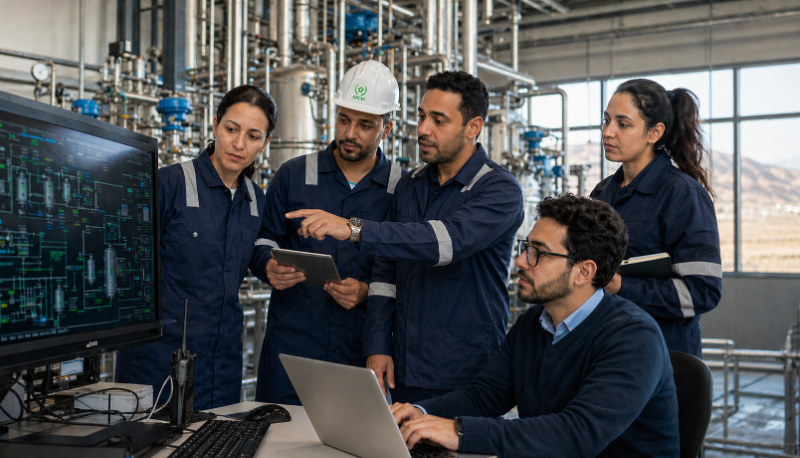
Each automation project is led not by a central digital team, but by a multidisciplinary group that includes control room operators, maintenance technicians, process engineers, production engineers and, for the first time, data scientists working directly with field teams from the outset.
A pilot project focused on automating a phosphoric acid production line demonstrated the power of this model. It succeeded where previous top-down initiatives had failed and quickly generated interest from other teams eager to adopt the same approach.
2. Reskilling designed with and for workers
Training is not developed in isolation. For each automation project, OCP Group convenes business leaders, technical experts and senior operators to define the new competencies required and translate them into targeted learning modules.
For example, as control room operators transitioned from manual supervision to automated line management, their role evolved toward more advanced monitoring, analysis and optimization tasks. Building on their strong operational expertise, they further strengthened their understanding of process chemistry to better interpret system behaviours, diagnose anomalies and enhance performance, while progressively developing capabilities in using data and AI-enabled tools to support deeper analysis, anticipate complex deviations and improve decision-making.
3. Communities of practice to sustain learning
To ensure continuous capability building, OCP Group has created communities of practice in automation, metrology, instrumentation and process engineering. These networks enable decentralized problem-solving, peer-to-peer learning and the rapid diffusion of best practices across sites.
Innovative learning tools, including virtual reality for safety-critical training and simulation platforms for complex operational scenarios, reinforce this ecosystem.
Results: Higher Engagement, Stronger Performance and a Scalable Model
The Group is now scaling this participatory model across its major industrial programs. Staff involved in automation design report higher engagement, a clearer sense of how their roles are evolving and greater confidence in the transition.
The Group’s internal framing is explicit: time unlocked through automation is reinvested in higher-value activities such as continuous improvement and process optimization. This reframes automation not as a threat but as a career accelerator.
Operational results are already visible. On one automated acid production line, OCP Group recorded:
- 7% reduction in raw water consumption;
- 17% reduction in sea water consumption;
- 0.5‑point increase in yield; and
- Greater process stability and product quality.
These gains support the Group’s broader ambition to build a decarbonized, circular industrial model powered by innovation, talent and responsible stewardship of natural resources.
Looking Ahead: Scaling Human-Machine Collaboration Across OCP Group
As part of its Future of Work agenda, OCP Group aims to free up 20% of employees’ time to contribute to cross-functional, high-impact projects. Automation is a key enabler - but only when paired with the right human capabilities, organizational culture and learning systems.
By embedding human-machine collaboration at the heart of its transformation, the Group is demonstrating how an African industrial champion can combine technological excellence, people-centered change and sustainable growth – turning its mission, Bringing Phosphorus to Life, into action.