Governing AI Deployment through Workforce Readiness at Western Digital
Context: Western Digital (WD) builds the storage foundation that powers certainty in the AI‑driven data economy. WD’s commitment to scale, reliability and innovation shapes its internal operations, where the company manufactures high volumes of storage products each day across global sites. As WD began deploying AI agents across its manufacturing operations, the company recognized that workforce readiness was essential to realizing the technology's full potential. By investing early in targeted training programmes, WD empowered its engineers to confidently govern AI-enabled systems, accelerating adoption and amplifying impact across the organization.
Approach: To ensure technology and workforce readiness advance together, WD combined two key elements: a dedicated organizational function to manage the transition and a focused pilot to develop and validate the approach before scaling.
A Future of Work function, consisting of representatives from HR, IT and Operations, was established to connect AI-focused teams with operational teams. This group identifies how roles are evolving, defines new job streams and prepares engineers ahead of expanded AI capabilities and adoption. The Future of Work function oversees both building and deploying AI agents, ensuring they are designed effectively and operate safely over time. This effort began with a two-day workshop involving 25 cross-functional participants to align priorities and expectations. The programme is organized into six core workstreams: governance (data, AI agents and AI agent supervisors, including red-teaming and adversarial testing), AI agent creation, validation and testing, change management, skills mapping and training, and operational efficiency and productivity. Execution is coordinated across technology, operations and HR teams through weekly joint planning meetings, shared milestones (including minimum viable agent delivery, HR-led job and skills gap analysis, training curriculum and change initiatives) and regular reviews with executive sponsors.
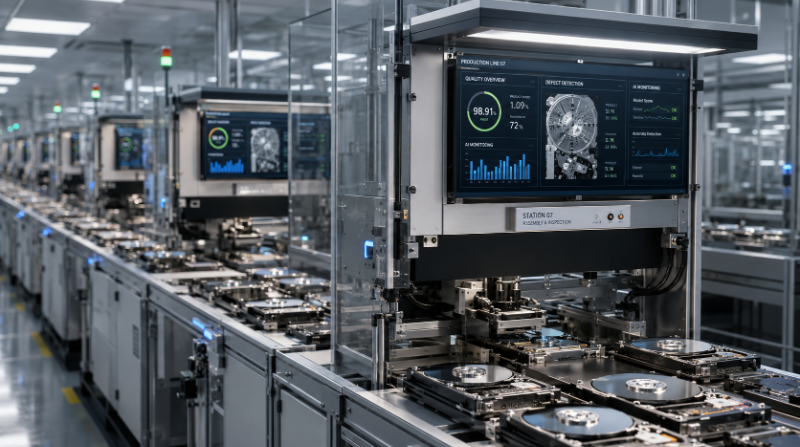
In parallel, a pilot programme focused on two manufacturing workflows to demonstrate proof of concept and value. Each workflow will be supported by an AI agent supervisor that empowers employees to take on higher‑value, more strategic responsibilities. WD is upskilling existing process engineers to supervise, train and set boundary conditions for AI agents within their domains — a model that leverages deep process expertise while enabling scalable AI governance. Engineers selected for these supervisor roles complete a competency-based certification covering AI and ML model outputs, data architecture and sources, model refinement, output auditing (including adversarial and unfairness testing and red teaming), stakeholder reporting and communications and incident documentation. As agents take on routine tasks, from defect detection to containment routing to disposition decisions, the engineer's role shifts from execution to oversight. Engineers can now focus on monitoring performance, optimizing the rules and boundaries the agents operate within and resolving complex or unexpected cases.
Results: The combined approach of establishing a dedicated function and running a targeted pilot, successfully moved WD’s AI agent transformation to active execution within 3 months. As of May 2026, the two pilot workflows are on track to transition automated agent operations with a human AI agent supervisor role. With the new role structure, certification pathway and governance model are fully defined and operational. The Future of Work function is taking key learnings from the pilot programme into a scalable playbook for broader AI adoption and workflow transformation across the enterprise.