Massachusetts Center for Advanced Manufacturing: Building a Coordinated Workforce and Technology Ecosystem
Context: New England's industrial base is concentrated in defense supply chains, aerospace and precision manufacturing, sectors experiencing rapid technological change and talent challenges; the supply of graduates from technical programs is increasingly insufficient and the skillsets of incumbent workers are lagging industry requirements. New England is characterized by smaller, specialized manufacturers with limited capacity to design or fund workforce programs. The region needed a coordinating mechanism that could connect government, education, and industry into a functioning system.
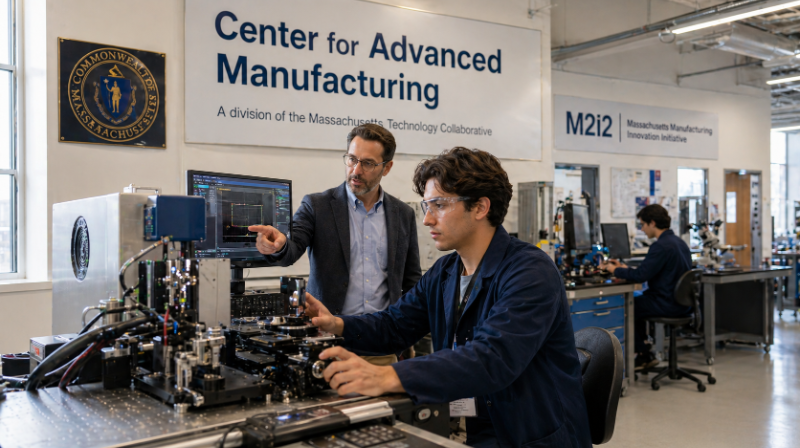
Approach: The Center for Advanced Manufacturing (CAM), a division of the Massachusetts Technology Collaborative (MassTech), focuses on fostering a connected manufacturing ecosystem and supporting the state’s industrial base. Through the Massachusetts Manufacturing Accelerate Program (MMAP), CAM issues capital equipment grants to small- and mid-sized manufacturers, conditioning that funding on engagement with technical assistance providers who establish a business case, assess workforce implications and identify training before acquisition. This addresses the common failure mode in which technology is purchased but not fully deployed. Partner nonprofits such as the Berkshire Innovation Center (BIC) and the Massachusetts Manufacturing Extension Partnership (MassMEP) provide expert guidance, providing companies with an outside perspective on how to modernize their operations and set their workforce up for success. Through the Massachusetts Manufacturing Innovation Initiative (M2I2), CAM also invests in collaborations between academic research institutions and startups, providing funding for projects that move products towards commercialization and equipment that community college and university students can be trained on. Finally, curriculum alignment is anchored to validated industry frameworks; CAM works with Manufacturing USA institutes and manufacturers statewide, to identify core competency standards that have become a shared reference point for colleges building new programs and updating existing programs.
Results: Community colleges across Massachusetts are incorporating AI, robotics, automation and model-based definition into curricula in response to employer demand signals. Apprenticeship programs historically underutilized in the region are expanding, with Massachusetts receiving dedicated funding to scale these pathways. Most significantly, pairing capital equipment grants with workforce development support has begun to shift the unit of intervention from choosing between technology investment and talent development to a system that incorporates talent upscaling and development to improve business strategic alignment. The scale of CAM’s investment portfolio reinforces these systemic gains. To date (April 2026),
Through M2I2, CAM has funded 100 projects, invested over $100 million in Massachusetts organizations and leveraged more than $370 million from other sources, supporting more than 100 new products, assisting over 400 entrepreneurs, training more than 1,000 students and workers and creating over 1,000 jobs.
Through MMAP, CAM has made 128 awards totaling $22.3 million in capital equipment grants, attracted $55.7 million in committed matching funds and supported the creation of over 800 new advanced manufacturing jobs.